
If you want a smooth and colorful floor with special designs inside, epoxy terrazzo flooring gives you the most choices. For outside spaces or places where many people walk, cement terrazzo is best because it is strong and lasts a long time.
The terrazzo flooring market around the world was worth 27.4 billion dollars in 2025. Epoxy terrazzo is popular in stores and fancy homes. Cement terrazzo is still the best for busy places that need little care.
| Key Factor | Why It Matters |
|---|---|
| Durability | Handles lots of use |
| Design | Lets you be creative |
| Location | Good for inside or outside |
| Maintenance | Changes how you care for it |
| Cost | Changes how much you spend |
| Sustainability | Helps the environment |
Think about what your project needs the most. G·ONE can help you pick the best terrazzo system.
Key Takeaways
- Pick epoxy terrazzo if you want bright colors and cool designs. You can make it look any way you want.
- Use cement terrazzo outside. It handles weather and lots of people walking very well.
- Look at how much care each needs. Epoxy terrazzo is simple to clean. It needs less work than cement terrazzo.
- Think about how fast you can use the floor. Epoxy terrazzo dries fast. You can use the space sooner than with cement terrazzo.
- Check how much it costs over time. Epoxy terrazzo costs less to keep up each year. It is a good choice for saving money later.
Quick Comparison
Key Differences
It is important to know how epoxy terrazzo and cement terrazzo are not the same. Epoxy terrazzo flooring lets you pick from many colors and designs. You can make bright shapes or even put logos in the floor. Cement terrazzo works better outside or in busy places. It can handle rain, sun, and changes in weather.
Epoxy terrazzo flooring is thinner than cement terrazzo. You can put it in faster, and it dries quickly. Cement terrazzo is thicker and takes more time to finish. You might have to wait longer before you can walk on it.
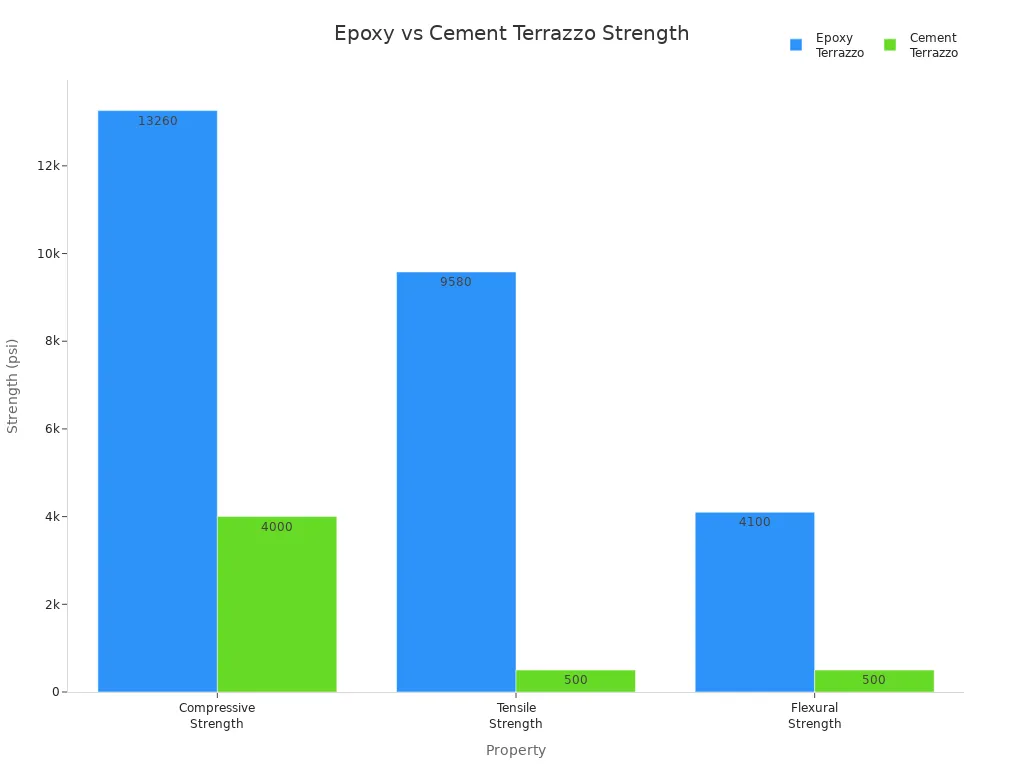
Epoxy terrazzo flooring is also stronger. It has higher compressive, tensile, and flexural strength. This means it does not crack or break as easily as cement terrazzo. You will not need to clean it as much because it does not soak up stains. Cement terrazzo needs more cleaning and care since it is more porous.
Tip: Pick epoxy terrazzo flooring if you want a floor that is easy to clean and lasts a long time inside. Choose cement terrazzo if you need a floor for outside or places with lots of weather changes.
Summary Table
Here is a table to help you see the main features of epoxy terrazzo and cement terrazzo:
| Feature | Epoxy Terrazzo Flooring | Cement Terrazzo |
|---|---|---|
| Design Options | Unlimited colors and patterns | Limited colors, classic look |
| Durability | Very high, resists cracks and stains | Strong, but can crack or stain |
| Compressive Strength | 13,260 psi | 4,000 psi approx. |
| Tensile Strength | 9,580 psi | 400-600 psi approx. |
| Flexural Strength | 4,100 psi | 400-600 psi approx. |
| Installation Time | Fast (cures in days) | Slow (cures in weeks) |
| Thickness | Thin (1/4″ to 3/8″) | Thick (1/2″ to 3″) |
| Maintenance | Low, easy to clean | Higher, needs sealing and care |
| Location | Indoor only | Indoor and outdoor |
| Life Expectancy | 40+ years | 40+ years |
| Cost | Medium to high | Medium to high |
| Sustainability | Low VOCs, recyclable | Natural materials, recyclable |
You can use this table to help you pick the right terrazzo system for your project. Think about where you want the floor, how much design you want, and how much time you have to install it.
Durability
Surface Strength
When you choose a floor, you want it to last. Surface strength tells you how well a floor can handle weight and pressure. Epoxy terrazzo flooring stands out because it has a compressive strength of about 14,000 PSI. This means it can take heavy loads without breaking. Cement terrazzo has a compressive strength of around 4,000 PSI. You will notice the difference if you have lots of people walking or moving carts over the floor every day.
- Epoxy terrazzo flooring has more than three times the compressive strength of cement terrazzo.
- This makes it a smart choice for busy places like schools, airports, and hospitals.
- The resin binder in epoxy terrazzo creates a strong, smooth surface that resists scratches and dents.
Note: If you need a floor that can handle heavy use, epoxy terrazzo flooring gives you better surface strength.
Crack & Impact Resistance
Cracks and chips can make a floor look old and worn. You want a floor that stays smooth and safe. Epoxy terrazzo flooring resists cracks and impacts much better than cement terrazzo. The high compressive strength helps stop cracks from forming, even when people drop heavy objects or roll carts across the floor.
- Epoxy terrazzo is highly resistant to surface cracks.
- It stands up to heavy foot traffic and daily wear.
- The resin sealer makes the floor less porous, so stains and chemicals do not soak in easily.
Cement terrazzo can crack or chip more easily, especially in high-traffic areas. You may need to repair it more often if you use it in busy spaces. For places where you expect a lot of movement and activity, epoxy terrazzo flooring will last longer and look better.
Design Flexibility

Color & Pattern Options
You can make many different looks with terrazzo. Epoxy terrazzo flooring lets you pick from lots of colors. You can match any color, like red or blue. This helps you design a floor that fits your style or brand. You can also add glass or mirror pieces to make it shine.
Cement terrazzo gives a classic look. It has more natural and soft colors, often with marble chips. The color choices are fewer, so it looks more old-fashioned. This style works well in old buildings or outside.
Here is a quick table to compare color and pattern choices:
| Type of Terrazzo | Color Options | Pattern Options |
|---|---|---|
| Epoxy Terrazzo | Many RAL or BS4800 shades | Many patterns, can use glass, mirror, and other pieces |
| Cement Terrazzo | Only earthy, soft colors | Classic patterns with marble pieces |
- Epoxy terrazzo has almost endless color choices.
- You can make it match any color you want.
- Cement terrazzo has fewer colors, mostly natural ones.
Tip: Pick epoxy terrazzo if you want bright colors or special patterns. It gives you the most choices.
Custom Branding (e.g., G·ONE)
You can use terrazzo to show your brand or school pride. Epoxy terrazzo makes it easy to put logos or shapes in the floor. The material lets you make sharp lines and bright colors. This helps your brand stand out. Many stores, hotels, and schools use this to make their space special.
Cement terrazzo can also have custom designs, but there are fewer choices. The colors are not as bright, and the patterns are softer. If you want your logo to be clear and bright, epoxy terrazzo is better.
Here is a table to help you compare:
| Feature | Cement Terrazzo | Epoxy Terrazzo |
|---|---|---|
| Porosity | Needs sealing, more porous | Not porous, no sealing needed |
| Stain Resistance | Not as good at stopping stains | Stops stains very well |
| Chemical Resistance | Not strong against chemicals | Very strong against chemicals |
| Color Flexibility | Not many color choices | Many color choices |
Note: G·ONE can help you make a terrazzo floor that shows your brand and lasts a long time.
Installation Location

You need to think about where your floor will go. Some terrazzo types are better for inside. Others are better for outside. Pick the right terrazzo for your space. This helps your floor last longer and look good.
Indoor Use
Epoxy terrazzo flooring is best for inside buildings. You often see it in schools and hospitals. It is also in airports and offices. The surface does not let water or stains in. It keeps out germs and is easy to clean. The floor stays nice for a long time. You do not have to seal it after you polish it. This saves you time and work.
Here is a table to help you compare:
| Type of Terrazzo | Best Use | Characteristics |
|---|---|---|
| Epoxy Terrazzo | Indoor | Non-porous, resists stains, bacteria, and moisture |
| Cement Terrazzo | Outdoor | Suitable for outdoor applications, more traditional look |
- Epoxy terrazzo keeps water and stains away.
- You can use it in places that need to be clean.
- Both types of terrazzo do not need much care.
Tip: If you want a bright and easy-to-clean floor inside, epoxy terrazzo is a great choice.
Outdoor Suitability
Cement terrazzo works well outside. You can use it in plazas and walkways. After you polish it, you put on a sealer. The sealer keeps out water and helps the floor last. This makes it good for rain and sun.
- Cement terrazzo lasts a long time outside.
- The sealer keeps water and dirt out.
- Epoxy terrazzo does not do well outside. Sun and rain can hurt it.
Here is a table to show where each terrazzo type works best:
| Type of Terrazzo | Recommended Locations | Environmental Conditions |
|---|---|---|
| Epoxy Terrazzo | Indoor settings such as schools, hospitals, airports, and corporate buildings | Not recommended for outdoor use |
| Cement Terrazzo | Both indoor and outdoor settings, including plazas and walkways | Suitable for high-moisture environments |
Note: For outside projects, cement terrazzo gives you a strong floor. It looks classic and stands up to weather.
Epoxy Terrazzo Flooring: Maintenance & Cleaning
Ease of Maintenance
You want a floor that stays clean with little effort. Epoxy terrazzo flooring makes this easy for you. The surface is smooth and does not have grout joints, so dirt and dust cannot hide. You can keep your floor looking new with simple steps.
- Dust mop the floor every day to remove dirt and grit.
- Use a damp mop with an all-purpose cleaner for deeper cleaning.
- Polish the floor from time to time to keep it shiny.
You do not need special tools or harsh chemicals. Neutral cleaners mixed with water work best. Let the cleaner sit for a few minutes to loosen grime, then rinse with clean water. The process is quick and does not take much time. You will not spend extra money on sealers or worry about stains soaking in. Cement terrazzo needs more care. You must use neutral pH cleaners and seal the surface to protect it from stains.
Tip: Choose epoxy terrazzo flooring if you want a low-maintenance floor that saves you time and money over the years.
Chemical & Stain Resistance
You may worry about spills or chemicals damaging your floor. Epoxy terrazzo flooring gives you peace of mind. The epoxy resin forms a strong layer that blocks stains and chemicals. Oil, juice, and cleaning products cannot soak into the surface. You can wipe up spills easily without leaving marks.
Cement terrazzo does not resist stains as well. Liquids and chemicals can seep in and cause damage. You must seal cement terrazzo often to keep it safe. Over ten years, you will find that epoxy terrazzo flooring costs less to maintain. It stays bright and clean with less work.
Note: Both epoxy and cement terrazzo can last for decades, but epoxy terrazzo flooring keeps its beauty with less effort.
Installation Process
Steps & Timeline
It is good to know how terrazzo is put in. Both epoxy and cement terrazzo use almost the same steps. But, the time it takes is not the same. Here are the main steps you will see:
- Get the surface ready
- Fix any cracks
- Put on primer
- Mix and pour the terrazzo
- Grind the floor
- Polish the floor
Epoxy terrazzo flooring is done in about 8 days. Cement terrazzo takes much longer to finish. It can take 4 to 5 times more days. This is because cement needs more time to dry. Epoxy dries in about one day, but cement takes longer.
| Type of Terrazzo | Typical Installation Time |
|---|---|
| Epoxy Terrazzo | About 8 days |
| Cement Terrazzo | 4-5 times longer than epoxy |
Tip: Pick epoxy terrazzo if you want your floor done fast.
Project Downtime
You want your space open and ready to use. A fast job means you wait less time. Epoxy terrazzo lets you use your floor sooner. It dries fast. Cement terrazzo needs more time before you can walk on it or move things back.
Some special rules can change your project. Both types need a strong and clean base. Do not put terrazzo over loose tiles or broken floors. Many self-leveling and gypsum-based products do not work well with terrazzo. You also need to control moisture. If you skip these steps, your floor may crack or not stick right.
- Getting the base ready is very important.
- Cement terrazzo can shrink and crack if not done right.
- Epoxy terrazzo stays strong and does not shrink.
Note: Good planning and a strong base help your terrazzo floor last longer and look nice.
Cost Comparison
Upfront Costs
You want to know how much you will pay first. Epoxy terrazzo flooring often costs less than cement terrazzo. This is true for most big building projects. The price changes based on your design and space size. The materials you pick also change the cost. Here is a table to help you see the difference:
| Flooring Type | Average Cost per Square Foot |
|---|---|
| Epoxy Terrazzo | $30 – $65 |
| Cement Terrazzo | Higher than Epoxy |
Epoxy terrazzo gives you many colors and patterns for less money. Cement terrazzo costs more because it uses more material. It also takes longer to put in. You can save money by pouring epoxy terrazzo over a good floor. This means you do not have to tear out the old floor. You can use local stone or glass to save even more.
Tip: Measure your space before you buy materials. This helps you only buy what you need and not waste money.
Long-Term Value
You want your floor to last and save money over time. Both epoxy terrazzo and cement terrazzo can last up to 100 years. You almost never need to replace them. Epoxy terrazzo has a low yearly cost—about $0.80 per square foot. This is much less than vinyl or carpet. Those floors need to be replaced more often and cost more each year.
| Flooring Type | Expected Lifespan | Annual Lifecycle Cost | Replacement Frequency |
|---|---|---|---|
| Epoxy Terrazzo | 75-100 years | $0.80 per sq ft | Rarely needed |
| Cement Terrazzo | 75-100 years | N/A | Rarely needed |
| Vinyl Composite Tile | 10-15 years | $1.57 per sq ft | Every 10-15 years |
| Commercial Carpet | 7-10 years | $1.65 per sq ft | Every 7-10 years |
| Ceramic Tile | 25-40 years | N/A | Every 25-40 years |
You can save more by hiring skilled workers. They finish faster and make fewer mistakes. This lowers the cost of labor. Buying from suppliers who give discounts for big orders also helps. Each project teaches you new ways to save money and do better next time.
Note: Epoxy terrazzo and cement terrazzo both give you good value. You pay more at first, but you save on repairs and new floors for many years.
Sustainability
Materials & VOCs
You want your floor to be safe for you and nature. Both epoxy terrazzo and cement terrazzo use materials that do not let bad chemicals out. These floors help keep the air inside fresh. You will not smell harsh odors or worry about gases when they are installed.
Here is a table so you can see the difference between each terrazzo:
| Type of Terrazzo | VOC Emissions | Materials Used | Additional Benefits |
|---|---|---|---|
| Cement-based Terrazzo | None | Inorganic binders | Little to no off-gassing, mold-free |
| Thin-set Epoxy Terrazzo | None | 100% solid formulas (no VOCs) | Non-porous, improves indoor air quality |
Epoxy terrazzo uses a resin that does not let out any VOCs. This keeps your floor safe for your health. Cement terrazzo also does not have VOCs. It is made with natural binders and stops mold from growing. Both kinds help make your building healthy.
Tip: Pick epoxy or cement terrazzo if you want a floor that keeps your air clean and safe.
Recyclability
Terrazzo floors help the earth because they use recycled stuff. Both epoxy terrazzo and cement terrazzo have recycled pieces in their mix. This means less garbage goes to dumps.
- Epoxy terrazzo can be made of up to 60% recycled material. You can find glass, mirror, or stone bits in the floor.
- You can choose many types of recycled pieces, like:
- Used glass and mirror bits
- Leftover marble and granite bits
- Reused porcelain and concrete bits
- Cement terrazzo also has recycled pieces. What you use depends on your project.
Picking terrazzo means you support recycling and help the earth. Your floor will look good, last many years, and save resources.
Note: Terrazzo floors look nice and support the planet at the same time.
Choosing the Right System
Common Scenarios
You want to pick the best terrazzo for your project. Start by thinking about where you will use the floor and what you need it to do. Here are some common situations to help you decide:
- If you need a floor for a school hallway or hospital, you want something strong and easy to clean. Epoxy terrazzo flooring works well in these places. It stands up to heavy foot traffic and keeps its shine for many years.
- For outdoor spaces like plazas or walkways, cement terrazzo is a better choice. It handles rain, sun, and changing weather. You can use it in places where people walk or gather outside.
- If you want a floor with bright colors, special patterns, or your company logo, epoxy terrazzo gives you more design options. You can match your brand or create a unique look.
- When you need a fast installation, epoxy terrazzo cures quickly. You can use your space sooner and get back to work or school faster.
- If you care about the environment, both terrazzo types can include recycled materials. This helps you build a greener project.
Tip: Think about how you will use the space, how much design you want, and how quickly you need the floor ready. This helps you choose the right terrazzo system.
Decision Checklist
Use this checklist to help you make the best choice for your project. Go through each point and see which terrazzo type matches your needs:
- Indoor Use: Choose epoxy terrazzo for indoor spaces. Cement terrazzo works for both indoor and outdoor areas.
- High Foot Traffic: Pick a system that handles lots of people walking every day.
- Longevity: Look for a floor that lasts over 100 years with proper care.
- Maintenance: Select a surface that is easy to clean and does not need much upkeep.
- Budget: Think about your budget now and how much you will save over time.
- Design Customization: Decide if you want many colors, patterns, or custom logos.
- Indoor Air Quality: Make sure the floor does not release harmful chemicals.
- Sustainability: Use recycled materials if you want an eco-friendly project.
- Acoustics: Consider if you need a floor that reduces noise in busy areas.
- Installation Speed: Choose a system that cures quickly if you need the space ready fast.
You can use this checklist to compare your needs with what each terrazzo system offers. If you want a colorful, easy-to-clean floor inside, epoxy terrazzo flooring is a smart choice. For outdoor spaces or classic looks, cement terrazzo gives you strength and style.
Note: Write down your top needs before you decide. This makes it easier to talk with your terrazzo expert and get the best results.
Think about what you need before picking terrazzo. Epoxy terrazzo flooring is good for inside places like schools or offices. It lets you pick many designs. It is strong and easy to clean. Cement terrazzo is better for outside or places that get used a lot. Here is a table to help you choose:
| Project Type | Best Choice |
|---|---|
| Commercial | Epoxy Terrazzo |
| Outdoor | Cement Terrazzo |
| Residential | Both can work |
- Always talk to contractors who know terrazzo.
- Make sure you tell them what you want.
- Ask for names of people they have worked for.
- Use the checklist above and ask G·ONE for help.
FAQ
What is the main difference between epoxy terrazzo and cement terrazzo?
Epoxy terrazzo has a resin binder. Cement terrazzo uses a cement binder instead. Epoxy terrazzo lets you pick from more colors. It also feels smoother under your feet. Cement terrazzo is better for outside places. It can handle lots of weather changes.
Can you use epoxy terrazzo outdoors?
You should not put epoxy terrazzo outside. Sun and rain can hurt it. Cement terrazzo is better for outdoor areas. It does not get damaged by weather.
How do you clean terrazzo floors?
You can sweep or dust mop every day. Use a damp mop and a neutral cleaner for deep cleaning. Epoxy terrazzo does not need to be sealed. Cement terrazzo needs sealing to stop stains.
Is terrazzo flooring eco-friendly?
- Yes, both types can use recycled glass or stone.
- These floors last many years, so you do not replace them often.
- Both kinds help cut down on waste and are good for green building.