
Terrazzo def: a composite material of aggregates bound in a cementitious or resin matrix, then ground and polished smooth. Architects and designers value terrazzo for durability, design flexibility, low lifecycle cost, and sustainability. This practical guide to terrazzo resolves the core decision between cementitious and epoxy systems, poured-in-place and precast tile, and how those choices align with performance and LEED goals. As a how to guide for architects, it also addresses specification details. G·ONE offers precast terrazzo, UHPC panels, and custom samples for global projects. The global terrazzo flooring market reached USD 12.2 billion in 2022, with a 7.2% CAGR projected through 2033.
Key Takeaways
- Terrazzo is a durable composite of aggregates in a binder, ground and polished smooth.
- Choose epoxy terrazzo for fast-curing, chemical-resistant interiors like hospitals.
- Choose cementitious terrazzo for exterior and wet areas that need moisture tolerance.
- Poured-in-place terrazzo creates seamless floors for large, custom designs.
- Precast terrazzo tiles install fast and work well for small or complex areas.
- Customize terrazzo with aggregates, colors, and divider strips to match your brand.
- Terrazzo lasts 75-100+ years and saves money over its long lifecycle.
- Terrazzo supports sustainability with recycled content and low VOCs for LEED credits.
Terrazzo Def: What Is Terrazzo?
Terrazzo def: a composite material made of aggregates bound in a cement or resin matrix, poured or precast, then ground and polished to a smooth finish. This definition captures the essential nature of a material that has evolved from humble origins into a sophisticated architectural specification. Understanding what is terrazzo requires examining its composition, its history, and the practical reasons architects and designers specify it for demanding projects.
The Composite Definition
Aggregate, Matrix, and Binder
Three components define terrazzo: aggregate, matrix, and binder. Aggregate refers to the chips of marble, glass, granite, or other materials that provide color and visual texture. The matrix is the continuous phase that surrounds and holds the aggregate. The binder is the cementitious or resin material that hardens the matrix into a solid surface. A divider strip is a thin metal or plastic profile that separates different color zones and controls cracking.
The ratio of aggregate to binder varies by system. Cementitious terrazzo uses a marble aggregate to cement ratio of 2:1. Epoxy terrazzo combines Part A (base color) with Part B (hardener) at a 5:1 ratio, then mixes in filler powder and aggregate. Across all types of terrazzo, the chips combine with either Portland cement or resin binder to achieve a minimum surface chip density of 70 percent.
Grinding and Polishing
After the mixture cures, grinding and polishing transform the rough surface into a smooth, reflective finish. Grinding exposes the aggregate chips and levels the surface. Polishing refines the surface to the desired sheen. This mechanical process distinguishes terrazzo from other poured floors and reveals the decorative potential of the aggregate blend.
From Ancient Masonry to Modern Systems
Venetian Origins
Terrazzo originated with Venetian mosaic workers who reused leftover marble chips to build terraces around their living quarters. The earliest installation involved mixing marble remnants with clay to form inexpensive terraces, then leveling the surface by rubbing it with a stone by hand. Over time, the method advanced to using a long-handled weighted grinding stone called a galera. Goat milk was later found to work as an early sealer that enhanced the marble’s color and sheen. According to the National Terrazzo and Mosaic Association, Venetians created terrazzo over 500 years ago.
Cementitious and Resin Evolution
Cement eventually replaced clay as the binder, and the material evolved into the engineered systems available today. Modern terrazzo falls into two main categories: cementitious and resin-based. Cementitious systems use Portland cement as the binder and suit exterior applications. Epoxy and other resin systems cure faster and offer different performance characteristics for interior use. This evolution from Venetian masonry to modern engineered systems demonstrates the material’s adaptability across centuries.
Why Specify Terrazzo?
Durability and Design Flexibility
Architects and designers specify terrazzo for four primary reasons: durability, design flexibility, low lifecycle cost, and sustainability. Terrazzo lasts 40-100+ years, often exceeding the building’s functional life. Compressive strengths exceed 10,000 PSI, and the absence of grout lines eliminates failure points. Water absorption of 0.56% reduces liquid penetration and staining. Compressive strength of 115 MPa supports structural stability under heavy loads. Flexural strength of 12 MPa exceeds the industry average of 7-8 MPa, improving crack resistance. Mohs hardness of 4-5 provides wear resistance suitable for continuous public use.
Design capabilities include unlimited matrix colors, aggregates, divider strips, and waterjet inlays. These features support branded and high-visibility spaces. Custom aggregate blends and inlaid logos preserve brand identity while maintaining durability.
Lifecycle Cost and Sustainability
Terrazzo carries a higher upfront cost but delivers the lowest total cost of ownership compared with carpet, LVT, ceramic tile, and polished concrete. The table below compares expected service life across flooring types.
| Flooring Type | Expected Service Life |
|---|---|
| Terrazzo | 75–100+ years |
| Porcelain tile | 25–40 years |
| Vinyl composition tile | 10–15 years |
Sustainability benefits include LEED credit qualification, recycled content, zero or low VOCs, and avoidance of replacement waste. Seamless, non-porous terrazzo resists high traffic, chemical exposure, and microbial demands in education and healthcare facilities. The absence of grout joints eliminates moisture traps and microbial harbors. G·ONE produces precast terrazzo and UHPC panels for global projects, supporting these performance and sustainability goals.
Terrazzo Specification: Composition and Components
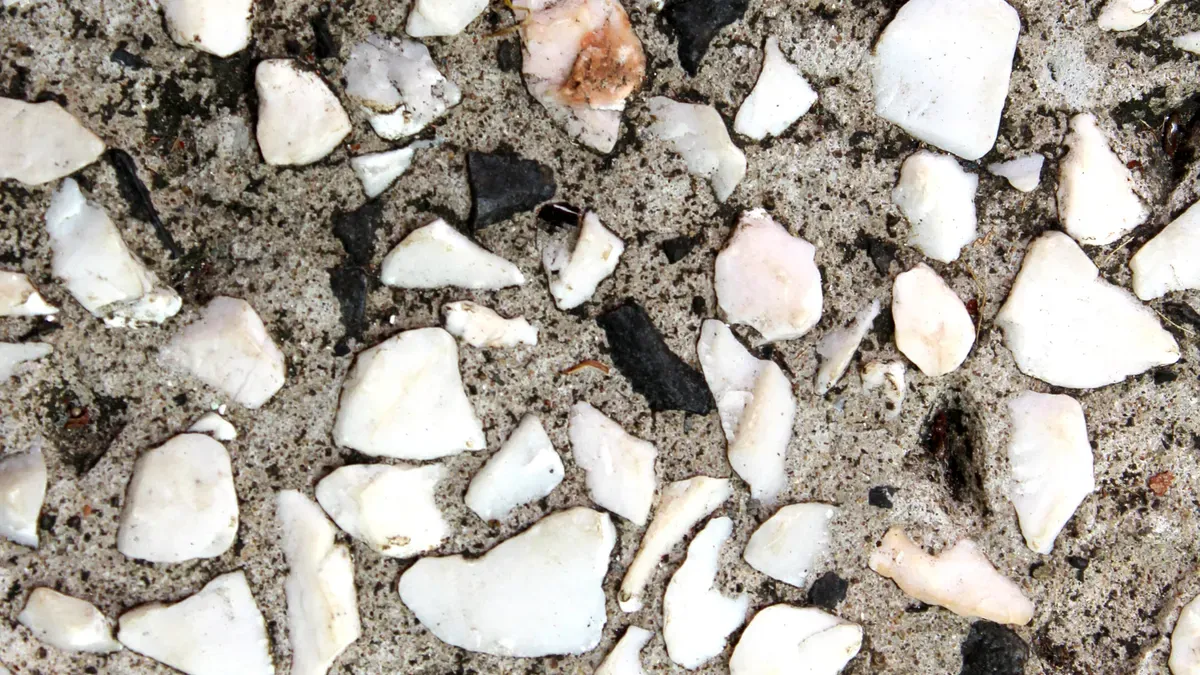
A complete terrazzo specification addresses four core components: aggregate, matrix, binder, and divider strip. Aggregate provides most of the visual impact and typically makes up 75–85% chip density. The matrix is the continuous phase that surrounds the aggregate. The binder is the cementitious or resin material that hardens the matrix. A divider strip is a thin metal or plastic profile that separates color zones and controls movement.
| Component | Role | Examples |
|---|---|---|
| Aggregates | Provide visual impact; 75–85% chip density | Marble, granite, glass, mirror |
| Binders | Suspend the aggregate | Cement, epoxy resin |
| Pigments | Color the binder | Neutral or custom colors |
| Divider Strips | Separate colors and designs | Zinc, brass, aluminum, plastic |
Aggregates
Marble, Glass, Granite
Aggregate size, gradation, and color shape the final appearance. Terrazzo aggregates come in three major sizes: 0, 1, and 2. Size 0 is the smallest, while size 2 is the largest. Smaller chips produce a subtle, speckled, uniform look. Larger chips create a bolder, mosaic-like or old-world aesthetic. Aggregate shape further influences the visual effect.
Different types of aggregates come in varying levels of hardness, so it is important not to pair very hard aggregates with very soft ones. For example, if using marble aggregates, avoid pairing them with plastic; glass is a better alternative.
Recycled and Specialty Options
Recycled glass is a popular terrazzo aggregate because it reduces landfill waste and offers a sustainable option. Other recycled choices include crushed porcelain and recycled concrete. Specialty aggregates such as crushed mirror and mother-of-pearl expand design possibilities. G·ONE offers regular, recycled, and mosaic terrazzo lines as examples of composition variety.
Binders
Cementitious Matrices
Cementitious binders use Portland cement hydrated with water. They are porous and breathable, making them suitable for high-moisture and exterior applications. Cement terrazzo provides a classic, earthy aesthetic. However, it is thicker, heavier, and more prone to shrinkage than resin systems.
Epoxy and Resin Matrices
Epoxy resin binders use a 100% solids resin matrix with no water. They offer superior strength, a non-porous surface that resists stains and bacteria, and limitless vibrant color options. Epoxy bonds well with specialty aggregates like glass, metal, and shells. This system is limited to interior use due to UV discoloration.
Base Colors, Strips, and Finishes
Pigments and Color Fields
Pigments color the binder. Cementitious binders can be pigmented to neutral colors. Epoxy binders can be colored to custom colors, supporting branded and high-visibility spaces.
Divider Strip Materials
Divider strips divide terrazzo areas, allow contrasting colors and designs, and accommodate movement in larger floors. Common materials include zinc, brass, aluminum, and plastic. A common width is 16 gauge or 1/8 in. Workers grind strips flush after polishing.
Honed, Polished, and Matte
Polished terrazzo offers a classic glossy finish favored by designers. Honed terrazzo is ground to a uniform level, creating a satin-like surface with a subtle matte sheen. Matte terrazzo provides a non-glossy, subdued contemporary finish suitable for minimalist or industrial designs. These terrazzo specifications and design choices affect both aesthetics and performance. Proper terrazzo production ensures consistent results across all finish types.
Epoxy vs. Cement-Based Terrazzo
The selection between epoxy vs cement systems determines schedule, substrate prep, and long-term performance. Both binder families produce durable surfaces. They diverge sharply on cure time, moisture tolerance, and ideal environments. Architects must weigh these factors before committing.
Performance Compared
Cure Time and Thickness
Cure time separates the two systems more than any other variable. Epoxy terrazzo systems cure in hours, allowing grinding within a short window. Cementitious terrazzo requires days to weeks before the binder reaches working strength. This schedule gap carries direct dollar value on fast-turnaround jobs.
| Factor | Epoxy Terrazzo | Cementitious Terrazzo |
|---|---|---|
| Curing time | Fast, hours to a short window | Extended, days to weeks |
| Placement thickness | Thin-set, often 1/4″-3/8″ | Thicker build, often 1/2″+ |
| Moisture sensitivity | Higher, slab must read dry | Lower, tolerates more slab moisture |
| Best for | Fast-turnaround interiors | Heavy wear, exterior, wet areas |
| Schedule impact | Shorter cure, faster turnover | Longer cure, more sequencing |
Placement thickness also matters. An epoxy terrazzo system installs thin, often at 1/4″-3/8″, which suits renovations with limited floor buildup. Cementitious systems build thicker at 1/2″+. They tolerate more substrate imperfection but add dead load. Both systems demand flat slabs; the thinner epoxy layer leaves less room for correction.
Chemical and Moisture Resistance
Chemical resistance varies widely between binders. The epoxy terrazzo system resists oils, solvents, and most industrial chemicals, making it a preferred choice in hospitals and research facilities. Cementitious terrazzo requires regular sealing to maintain comparable performance. Epoxy terrazzo delivers a nonporous finish that resists staining.
| Attribute | Epoxy Terrazzo | Cementitious Terrazzo |
|---|---|---|
| Chemical resistance | Resists oils, solvents, and most industrial chemicals | Requires regular sealing |
| Moisture sensitivity | Nonporous; resists moisture penetration | Porous when unsealed; absorbs moisture, stains, bacteria |
| Moisture vapor transmission | Can blister if substrate moisture escapes during curing | Same risk; barriers required |
Both systems share one critical vulnerability. Moisture vapor transmission can blister or fail either surface when substrate moisture escapes during curing. Humid climates and on-grade slabs require moisture barriers before placement, regardless of binder. Epoxy terrazzo resists moisture penetration at the surface, while cementitious surfaces absorb moisture and stains unless sealed.
Ideal Applications
Epoxy for Fast-Track Interiors
Architects choose epoxy terrazzo floors for high-traffic interiors where speed matters. Hospitals, laboratories, and corporate lobbies benefit from the nonporous surface and chemical resistance. Epoxy terrazzo handles heavy foot traffic without wearing. The rapid cure lets crews grind and polish sooner, returning spaces to service faster. An epoxy terrazzo floor installation works best on slabs that read dry through the curing window. A well-detailed epoxy terrazzo system demands a clean substrate and stable temperature. Proper epoxy terrazzo installation also requires controlled humidity. Many specifiers prefer epoxy terrazzo floors for research facilities demanding strict hygiene. Epoxy terrazzo provides a seamless, monolithic look. Specifiers choose epoxy terrazzo for fast-track work.
Cementitious for Exteriors
Cementitious terrazzo excels in exterior and high-moisture environments. Portland cement and polyacrylate matrix terrazzo suits both interior and exterior applications. Rustic terrazzo, a style with a rough surface, provides slip resistance for outdoor plazas and walkways. Cementitious systems retain color under sunlight, ideal for facades and plazas. Low water absorption prevents efflorescence in wet areas and swimming facilities. The applications of terrazzo extend beyond flooring into facades and landscapes.
Installation and Coordination
Sequencing with Other Trades
A commercial terrazzo installation runs several weeks from mobilization to final polish. The process follows a strict sequence:
- Substrate assessment and moisture testing
- Preparation and mitigation (grinding, crack repair, leveling, moisture barrier)
- Layout and divider strips (pattern setout before material placement)
- Mixing and placement (pour, spread, compact)
- Curing (binder reaches working strength)
- Abrasive grinding (successive passes expose aggregate)
- Grouting (fill pinholes and voids)
- Polishing and sealing (final finish with slip resistance verified)
Curing and grinding are the two stages owners try to compress, but compressing either causes aggregate pull-out or uneven sheen. A commercial flooring contractor should join before final material selection on custom work or uncertain slabs. Early involvement solves elevation, moisture, phasing, and lead-time problems while still inexpensive.
Mockups and Samples
Physical samples narrow preferences before commitment. True terrazzo lead times can run 3–4 months, so owners must select early. Require a mockup panel before full mobilization. A small installed sample reveals the crew’s grinding standard and serves as the reference for the final punch list. On complex patterns, include at least one color transition and one divider strip. The decision between epoxy or cement terrazzo often comes down to moisture, schedule, and maintenance.
The mockup gives the owner, designer, contractor, and installer one shared definition of “right.” G·ONE offers tailored consultations and project samples to support this phase. Designers benefit from reviewing polished terrazzo options before writing the full specification. The choice between cementitious and epoxy terrazzo reduces to schedule, environment, and performance.
Specify Terrazzo Floors: Poured-in-Place vs. Precast
Architects face a fundamental choice when they specify terrazzo floors: seamless poured-in-place terrazzo or modular precast terrazzo tiles. Each format carries distinct trade-offs in site conditions, curing requirements, thickness, tolerance, and installation speed. The decision shapes project timelines, budgets, and long-term maintenance.
Poured-in-Place
Seamless and Monolithic
Poured-in-place terrazzo creates a continuous, jointless surface with no unit-to-unit field joints. This monolithic bond to the substrate means the concrete breaks before the bond fails. Large open flooring spaces benefit from this seamless look, including hotel lobbies, hospital corridors, and airport concourses. Designers gain the greatest freedom for site-specific patterns, curved transitions, and inlaid graphics shaped in situ. A poured-in-place terrazzo floor adapts to as-built site conditions during installation.
Site and Curing Needs
Poured-in-place terrazzo systems demand rigorous site preparation. The concrete subfloor must be flat, clean, and structurally sound. Cracks, voids, and height deviations require correction before placement. Subfloor deflection needs evaluation because terrazzo is rigid and cracks if the substrate flexes. Brass or zinc divider strips are set into the substrate to define panel layout. A sand-cement underbed is poured and screeded level within the strips. The cement-aggregate mixture is then poured, seeded densely with aggregate chips, and troweled flat.
Curing time varies by binder. Epoxy terrazzo can cure overnight and be walked on the next day. Cementitious terrazzo requires a multi-day cure schedule. After sufficient cure, the surface is ground progressively through diamond tooling sequences from coarse stock removal through fine polishing. Cementitious terrazzo is sealed with a penetrating sealer after final polish. Epoxy terrazzo requires no sealing after polishing.
Precast Tile
Modular and Consistent
Precast terrazzo tiles are manufactured off-site in a controlled facility. This factory-controlled curing supports consistent density and finish quality across a production run. Precast excels at repeatable, precision-manufactured elements such as matching stair units and wall panels with exact tolerances. Terrazzo tiles work best for smaller or complex floor areas where precision is critical. Custom logos and organizational symbols are best suited to precast because inlaid design work is finalized in the factory.
Installation Speed
Precast terrazzo tiles install faster because products are manufactured off-site. The dry-trade process sets finished units with adhesives or mechanical anchors like large-format tile. This reduces on-site wet work, dust, and curing downtime. A specialty contractor is not required. Terrazzo tiles are easier to install in small or complex areas where equipment may be hard to reach. Renovations benefit because tile minimizes dust and disturbance compared with grinding and on-site preparation for poured terrazzo. Vertical applications such as walls, ramp wrappings, and interior cladding also install quickly with terrazzo tiles.
Choosing the Right Format
Budget, Schedule, Substrate
Budget and schedule factors often determine the format. Poured-in-place terrazzo carries more cost in on-site labor, sequencing, and curing time. Precast carries more cost in factory fabrication and shipping logistics. Cement-based terrazzo for facades and flooring can cost from £300 per square meter as a rough reference. Epoxy terrazzo floors range from $40–$150 per square foot depending on material quality and design complexity. General terrazzo costs often start around $9 per square foot and rise to $35+ per square foot for intricate patterns and premium materials.
If site time is limited, precast’s off-site production relieves pressure on the critical path. Poured-in-place terrazzo floor installation is sensitive to site conditions, trade sequencing, and weather. Structural constraints matter too. Poured terrazzo adds loading and thickness considerations that require checking against structural and floor-buildup allowances early in design.
Hybrid Specifications
A hybrid approach often delivers the best result. Large continuous floor areas favor poured-in-place terrazzo. Discrete vertical or modular elements favor precast. Stair treads, wall panels, base coves, benches, planters, reception counters, and elevator cabs all suit precast. Long runs, complex curves, or stairs adjoining poured floors favor poured-in-place for continuity. G·ONE produces precast terrazzo and UHPC plates as modular, high-performance options for global projects. These products support hybrid terrazzo specifications that combine seamless floors with precision-fabricated elements.
Design Possibilities and Customization
Aggregate Selection
Contrast, Density, Scale
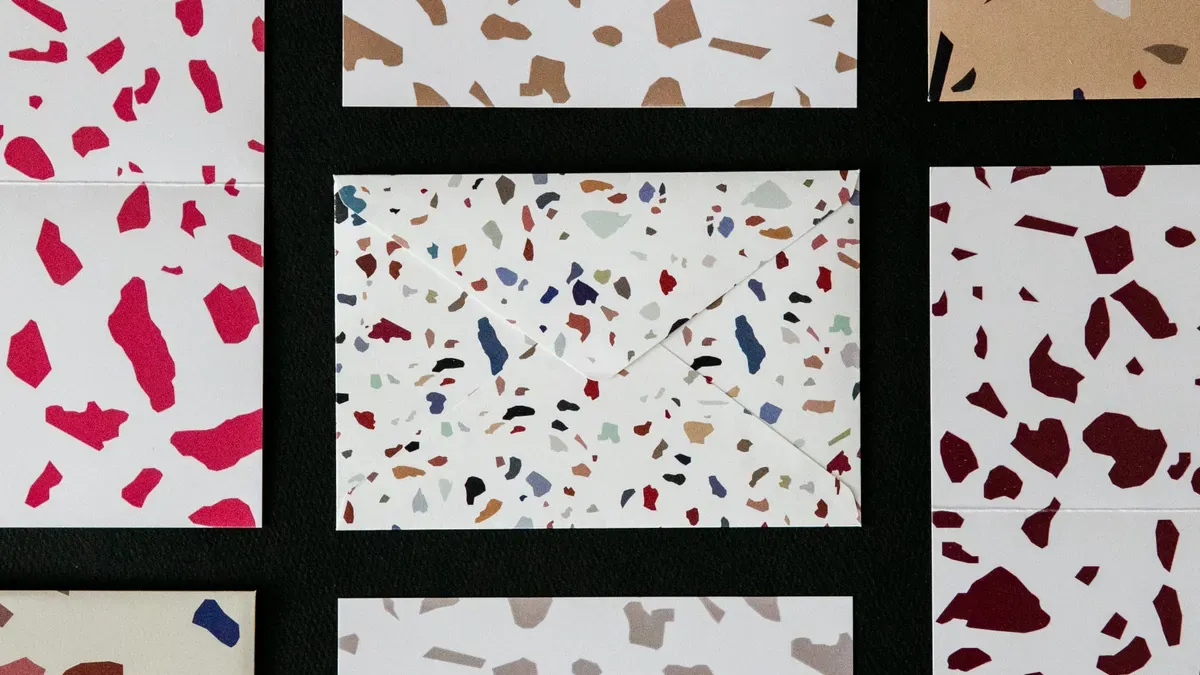
Aggregate selection drives the visual character of any terrazzo surface. The final appearance depends on three connected attributes: base color, aggregate color, and chip density. A white base with fine grey flecks produces a very different result from a beige base with large blue, green, or terracotta chips.
The visual result comes from three connected attributes: base color + aggregate color + chip density.
Chip size controls the design statement. Fine chips create a quieter, more uniform surface. Medium chips provide visible texture without dominating the room. Large chips create a stronger decorative statement. In a small bathroom, very dense or high-contrast terrazzo can become visually busy, whereas a softer pattern retains character without overwhelming the space.
| Variable | Visual Effect |
|---|---|
| Large, prominent chips | Striking visual drama and sculptural quality |
| Finely crushed material | Delicately speckled surfaces |
| Uniform aggregate coloring | Monochromatic presentation |
| Blended multiple shades | Energetic, diverse aesthetics |
| Glass pieces | Brightness and dimension |
| Natural stone fragments | Earthy tones and organic texture |
Signature Aggregates
Designers can choose from marble, glass, granite, quartz, and shell chips. Marble adds organic depth. Glass adds vibrancy and reflectivity. Shell, such as mother of pearl, adds iridescent, organic character. Blending different aggregates creates a semi-exotic, unique outcome. Oversized aggregates generate dramatic visual impact and sculptural quality, best used as focal points supported by simpler surrounding elements. Minimalist terrazzo uses subtle speckles in closely related tones for refined, understated elegance.
Strips, Logos, and Patterns
Wayfinding and Branding
Divider strips can be shaped in any direction and used to separate color changes within logos, patterns, or artwork. This allows branding to be embedded directly in the floor. Terrazzo can match artwork colors at a detailed level, so school and business logos become permanent branded elements of the space. Artists and architects can collaborate to embed custom graphics that reflect a city’s culture and history. Compass designs and free-flowing line patterns can be embedded to guide visitors, support wayfinding, and manage traffic flow through a building.
Custom Metal and Zinc Strips
Metal divider strips—typically brass, zinc, or aluminum—are set into the primer according to the design layout. They separate color fields, define geometric patterns, and form wayfinding paths or branded logos. Because the divider layout determines the final appearance, this step requires precision craftsmanship. Waterjet cutting enables custom logos, letters, numbers, and artistic inlays cut precisely from terrazzo, metals, and other materials. Prefabricated terrazzo logos are assembled off-site and delivered ready to install.
Custom Color Fields with G·ONE
Matching Brand Palettes
Epoxy terrazzo can be made in virtually any color. Custom color matching to Pantone or brand colors is available, and epoxy terrazzo colors do not fade over time. White and light shades include pure white, off-white, cream, vanilla, magnolia, and soft beige. Dark shades include jet black, charcoal, deep navy, and forest green. The color selection process follows a clear path: define design intent, select matrix color, select aggregates, order sample, and review samples.
Custom Samples and Molds
G·ONE offers custom-made solutions including tailored colors, aggregate blends, and molds. The brand provides digital catalogs and design lookbooks as selection resources. These tools offer comprehensive product brochures, technical specifications, and material selection manuals. Designers can review physical samples before writing the full specification.
Performance, Maintenance, and Lifecycle Cost
Longevity and Wear
Service Life by System
Terrazzo delivers exceptional longevity across both binder families. Ancient cementitious terrazzo floors installed in 1309 Venice remain serviceable today. Modern epoxy systems surpass cementitious floors in durability and sustainability, per ProTerrazzo Systems’ documentation. Neither system publishes a numeric lifespan. Both outperform every competing floor covering. The 30-year commercial horizon barely taxes a material engineered for building-long service.
Repair and Restoration
Small cracks or delaminations repair in place. Workers place small batches of terrazzo topping matched to the existing binder and stone chips. Hand-placing chips blends the repair into the surrounding field. Technicians restore worn surfaces by regrinding, grouting, and polishing with fine-grit diamond pads.
Severe damage demands sectional replacement. A performing-arts-center floor showed the method. Workers removed the damaged section, applied a moisture mitigation system and flexible membrane, repoured the area with epoxy terrazzo, then polished to blend.
The sequence runs: assessment, crack repair, diamond grinding, honing, polishing, sealing, then inspection. Field testing may identify material composition before selecting repair products. Contractors address the root cause first.
Maintenance Protocols
Routine Care
Daily terrazzo floor care proves simple. Dust mopping removes grit before traffic abrades the polish. Stubborn stains respond to a neutral cleaner in warm water. Heavily soiled terrazzo floors benefit from machine buffing. Neutral pH products work best; acid-based cleaners etch. Both systems require a breathable sealer. Spills demand immediate cleanup. Epoxy terrazzo floors skip stripping. Cementitious systems strip and reseal semi-annually. Crews polish every 6–12 months with diamond pads.
Long-Term Cost of Ownership
The economic case strengthens with time. Annual cost over a 40-year lifecycle runs $1.50–$2.50 per square foot. Carpet tile costs $3.00–$5.00 and needs replacement every 7–10 years. These figures assume consistent maintenance and care of the terrazzo floor. Many terrazzo floors survive the full building life without replacement. Diligent cleaning preserves gloss for decades.
Lifecycle Cost vs. Alternatives
Initial Cost vs. Replacement
Terrazzo demands a higher initial investment. Installation costs $14.88 per square foot. The complete 30-year lifecycle cost reaches $24.27 per square foot. Vinyl composition tile installs for $3.91 but carries an $18.35 lifecycle cost over ten years. A 30-year horizon requires VCT replacement at least twice. Annual cost tells the truth: $0.81 per square foot versus $1.83 for VCT. Lifespan determines true expense.
Value Engineering
Value engineering must weigh replacement cycles, maintenance labor, and disposal alongside first cost. Longer life eliminates repeated purchases. Seamless terrazzo floors remove grout lines and failure points. G·ONE engineers precast terrazzo floor elements and UHPC panels for wear resistance and weatherability. Compressive strength and abrasion resistance outlast alternatives. Specifiers who calculate lifecycle cost instead of purchase price select terrazzo.
Sustainability and LEED v4
Recycled Content and Transparency
Post-Consumer Glass and Aggregate
Recycled content drives the environmental case for terrazzo. Manufacturers can use terrazzo aggregate with 75% or more post-consumer recycled glass in Portland cement. Recycled glass, recycled porcelain, and recycled concrete aggregates qualify for LEED recycled-content credit opportunities. Local crushing and processing can support regional materials credits within a 500-mile radius. Recycled concrete aggregate contributes to Construction and Demolition Waste Management credits. These pathways show how sustainability and terrazzo connect directly to project certification goals.
Request product-specific documentation from the manufacturer that identifies the recycled percentage and specifies whether the content is post-consumer or pre-consumer.
Environmental Product Declarations
Transparency documentation supports LEED v4 credit achievement. Health Product Declarations provide ingredient-level transparency for material health. Regional sourcing records document aggregate origin for LEED credits. Zero VOC certifications verify indoor air quality performance. Permanent lifecycle data shows no replacement waste over the building lifespan. These documents strengthen submittals for terrazzo floors in certified projects.
VOC Emissions and Indoor Air Quality
Low-Emitting Binders and Sealers
Indoor air quality depends on binder and sealer selection. Epoxy terrazzo contains zero VOCs. Products can be tested and comply with the California Department of Public Health (CDPH) Standard Method V1.1 (2010) or the South Coast Air Quality Management District Rule #1168. Water-based, GREENGUARD Gold, or FloorScore-certified adhesives and sealers should be specified for terrazzo binders. Solvent-heavy laminate and vinyl glues should be avoided. The certificate must cover the as-installed system, not just the tile face.
CDPH and FloorScore Compliance
FloorScore provides third-party certification that products are tested and comply with the CDPH Standard Method for Testing and Evaluating Volatile Organic Chemical (VOC) Emissions. As part of FloorScore certification, manufacturing processes, supply chain, and chemical sources are also verified and audited. Certified products meet strict Indoor Air Quality (IAQ) requirements. LEED v4’s Low-Emitting Materials credit requires general-emissions compliance for both the flooring and any wet-applied adhesive or sealer. FloorScore tile performance can be undermined by a solvent-rich adhesive. Water-based C2 polymer adhesives with low-emission or GREENGUARD declarations should be required in writing.
LEED v4 Credits with G·ONE
Materials and Resources Credits
Terrazzo tiles with recycled content can contribute to MR credits through responsible sourcing and waste reduction strategies. The following MR credits apply:
- Building Life-Cycle Impact Reduction
- Construction and Demolition Waste Management
- Building Product Disclosure and Optimization – Environmental Product Declarations
Indoor Environmental Quality Credits
The zero-VOC epoxy terrazzo system supports the LEED v4 Low-Emitting Materials credit. Additional IEQ areas include:
- Green Cleaning – Products and Materials
- Facility Maintenance and Renovations Policy
- Green Cleaning Policy
Documentation and Submittal Support
G·ONE offers recycled terrazzo and eco-friendly manufacturing under the slogan “Small actions, big impact.” The brand provides documentation and submittal support for LEED projects. Specifiers can request HPDs, regional sourcing records, and VOC certifications to streamline credit achievement for terrazzo floors.
Architects should define performance needs before choosing. The binder system—epoxy or cementitious—drives schedule, moisture tolerance, and installation depth. The format—poured or precast—balances seamless design against modular speed. Confirm custom colors, aggregate blends, and logos early.
Terrazzo def combines durability, low lifecycle cost, and sustainability. It survives 75–100 years with minimal maintenance. Its recycled content and low-VOC systems support LEED v4 certification. No other flooring material matches this combination of permanence and environmental performance.
Coordination matters. Early engagement with G·ONE provides samples, mockups, and documentation submittals. This partnership streamlines decisions on terrazzo systems. Specifying terrazzo with confidence and precision transforms ambitious design into permanent architecture.
FAQ
What is terrazzo made of?
Terrazzo combines aggregates, a matrix, and a binder. Aggregates include marble, glass, granite, or recycled materials. The matrix surrounds the aggregate. The binder—cement or resin—hardens the matrix into a solid surface. Workers then grind and polish the surface smooth.
How long does terrazzo last?
Terrazzo lasts 75–100+ years. Ancient cementitious floors from 1309 Venice remain serviceable. Both epoxy and cementitious systems outperform competing floor coverings. The 30-year commercial horizon barely taxes terrazzo. Many installations survive the full building life without replacement.
Which is better: epoxy or cement-based terrazzo?
Neither system is universally better. Epoxy cures fast and resists chemicals, making it ideal for hospitals and fast-track interiors. Cementitious systems tolerate moisture and suit exteriors. Selection depends on schedule, environment, and maintenance needs. Both deliver durable, long-lasting surfaces.
Can terrazzo go outdoors?
Yes. Cementitious terrazzo excels in exterior and high-moisture environments. Portland cement and polyacrylate matrix terrazzo suits both interior and exterior applications. Rustic terrazzo provides slip resistance for outdoor plazas and walkways. Cementitious systems retain color under sunlight, ideal for facades.
How much does terrazzo cost?
Cement-based terrazzo for facades and flooring can cost from £300 per square meter. Epoxy terrazzo floors range from $40–$150 per square foot. General terrazzo costs often start around $9 per square foot and rise to $35+ per square foot for intricate patterns and premium materials.
Is terrazzo sustainable?
Yes. Terrazzo can use 75% or more post-consumer recycled glass. Recycled porcelain and concrete aggregates qualify for LEED credits. Epoxy terrazzo contains zero VOCs. Low-emitting binders and sealers meet CDPH and FloorScore standards. Terrazzo avoids replacement waste over its long lifespan.
How do architects customize terrazzo?
Architects customize terrazzo through aggregate selection, pigment colors, divider strips, and inlaid patterns. Epoxy terrazzo matches Pantone or brand colors. Waterjet cutting enables custom logos and artwork. G·ONE offers tailored colors, aggregate blends, molds, digital catalogs, and design lookbooks as selection resources.
What maintenance does terrazzo require?
Daily care involves dust mopping and neutral cleaner for stains. Epoxy terrazzo skips stripping. Cementitious systems strip and reseal semi-annually. Crews polish every 6–12 months with diamond pads. Both systems require a breathable sealer. Spills demand immediate cleanup.