
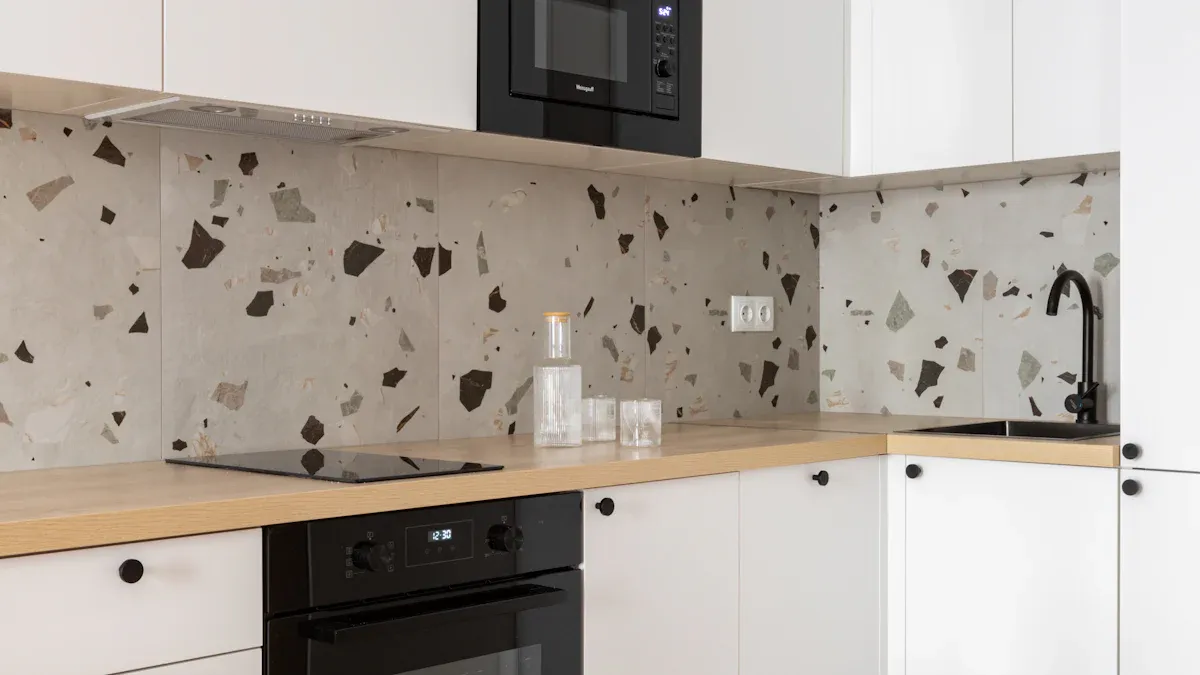
You define terrazzo as a composite material made of aggregate embedded in a cementitious or polymeric matrix, cured, ground, and polished. This ultimate guide to terrazzo assists architects and designers with terrazzo specification, system selection, installation, and sustainability. Modern terrazzo flooring delivers high compressive strength, chemical resistance, and non-porous surfaces. G·ONE sets the technical benchmark for engineered terrazzo solutions.
| Market Metric | Value / Share | Details |
|---|---|---|
| Commercial Application Share | 53% | Proportion of commercial installations. |
| Epoxy Terrazzo Adoption | 44% | Projects specifying epoxy terrazzo. |
Understanding what is terrazzo and terrazzo material composition guides your decisions.
Key Takeaways
- Terrazzo combines crushed stone chips with liquid binder to make durable floors.
- Epoxy terrazzo creates thin lightweight surfaces with high strength and unlimited colors.
- Cement systems offer thick sturdy beds for outdoor spaces and uneven subfloors.
- Daily sweeping and simple damp mopping keep terrazzo clean without harsh chemicals.
- Recycled glass aggregates help projects earn valuable green building credits easily.
What Is Terrazzo and Its Performance Advantages
Definition and Architectural Overview
You define terrazzo as a composite material using a cementitious or resinous matrix binder combined with marble, granite, onyx, or glass aggregates. Specifiers classify this system under CSI MasterFormat Division 09, Section 09 66 23. Contractors pour this mixture on-site or cast it off-site into precast elements. Afterwards, workers grind and polish the cured surface to reveal embedded aggregate chips.
| Specification Category | CSI MasterFormat Details | Architectural Definition & Characteristics |
|---|---|---|
| Classification Code | Division 09 (Finishes), Section 09 66 23 | Standard three-part architectural finish specifications. |
| Material Composition | N/A | Composite material bound by cementitious or resinous matrix. |
| Application Methods | N/A | Poured on-site, cured, and ground, or produced as precast elements. |
This timeless and versatile material offers unlimited terrazzo design flexibility. Designers create custom patterns, logo bands, and striking color combinations across vast interior surfaces. You achieve seamless aesthetics and smooth visual continuity throughout high-traffic commercial applications.
Structural Durability and 100-Year Lifecycle
The advantages of using terrazzo start with extreme structural strength. Epoxy matrix variants achieve a compressive strength above 10,000 PSI, while high Mohs hardness resists heavy foot traffic and wheel loads without cracking.
| Performance Advantage | Technical Details & Operational Impact |
|---|---|
| Structural Strength & Longevity | Exceeds 10,000 PSI compressive strength; spans 40 to over 100 years. |
| Hygiene & Surface Integrity | Nonporous continuous surface suppresses moisture, bacteria, and mold. |
| Environmental Resilience | Features fire resistance, thermal mass, and nonslip texturing. |
You get superior durability and low maintenance costs over a 100-year lifecycle profile. Continuous poured surfaces suppress moisture intrusion, mold, and stain absorption on commercial floors. Building owners preserve pristine terrazzo flooring through simple cleaning routines. These hygienic floors enhance thermal mass performance while maintaining nonslip safety in busy public spaces. Understanding what is terrazzo helps you design beautiful, permanent surfaces.
Terrazzo Material Composition and Aggregate Types
Matrix Binders: Epoxy Resin vs. Cementitious
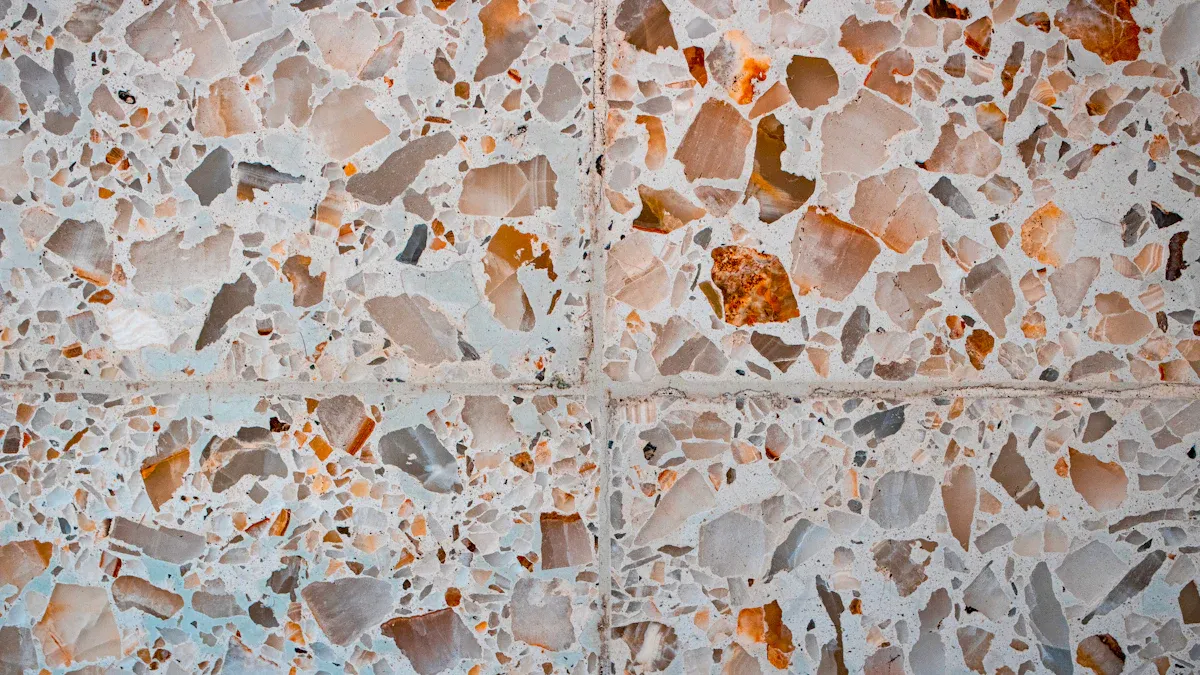
You build terrazzo flooring using three core components. Aggregate chips provide visual character. Matrix binders hold the aggregate together. Surface treatment finishes seal and polish the cured floor.
| Physical Metric | Epoxy Resin Matrix | Cementitious Binder |
|---|---|---|
| Component Ratios | 5:1 ratio of Part A (Base color) to Part B (Hardener) | 2:1 ratio of marble aggregate to cement (white or gray) |
| Pigments & Fillers | Marble dust (filler powder) | Iron oxide (for color additives) |
| Compressive Strength | High (13,260 psi) | Moderate (~4,000 psi) |
| Tensile Strength | High (9,580 psi) | Low (~400–600 psi) |
| Flexural Strength | High (4,100 psi) | Low (~400–600 psi) |
| System Thickness | Thin (1/4″ to 3/8″) | Thick (1/2″ to 3″ depending on system) |
| System Weight | Lightweight (3–4 lbs. PSF) | Heavy (4.5–30 lbs. PSF) |
| Volume Stability | 100% solids with zero shrinkage | Shrinks during curing due to water evaporation |
| Porosity & Moisture | Impermeable and non-porous | Porous; allows moisture vapor transmission |
Your choice of binder dictates performance parameters. Thin-set epoxy systems yield high compressive strength and zero matrix shrinkage. Cementitious options allow natural moisture vapor transmission across thick bed profiles.
Aggregate Selection: Marble, Glass, and Shells
You select aggregate chips to define your final floor aesthetics. Designers mix marble, quartz, granite, glass, mother of pearl, and recycled shell fragments into the binder. These choices control color vibrancy, texture, and light reflection across interior spaces.
| Classification Category | NTMA Chip Size Grade | Dimension / Measurement Range |
|---|---|---|
| Micro | #00 | Micro sizes (smaller than #0) |
| Standard | #0 – #2 | 1/16″ to 3/8″ |
| Venetian | #3 – #5 (or up to #8) | Larger aggregate sizes |
How are terrazzo floors made visually unique? You select distinct chip size grades according to National Terrazzo and Mosaic Association standards. Micro aggregates create dense uniform fields. Standard sizes offer classic patterns. Venetian sizes expose large stone faces for dramatic terrazzo design statements. Proper terrazzo material composition ensures lasting mechanical durability and surface elegance.
Types of Terrazzo Flooring Systems
Thin-Set Epoxy Terrazzo Systems
You choose thin-set epoxy systems when structural loads and subfloor floor elevations restrict deep setting beds. You specify terrazzo floors using CSI MasterFormat Division 09, Section 09 66 23 for thin resinous projects. You review your terrazzo specification to confirm essential physical performance parameters and substrate requirements. This advanced matrix system combines a flexible epoxy resin binder with decorative aggregate chips at a standard nominal thickness of 3/8 inch. You perform shotblasting or mechanical surface profiling to prepare the receiving concrete substrate properly. Field workers conduct comprehensive moisture vapor testing across the concrete slab before applying optional leveling fill and flexible crack-isolation membranes. Crews place metal divider strips precisely along layout lines, mix resin with hardener in a strict 5:1 ratio, and hand trowel the composite mixture over the floor. After curing overnight under ambient room conditions, installers begin grinding, grouting, polishing, and sealing the dense non-porous surface. These interior installations provide superior flexural performance, high compressive strength, and vibrant color consistency across massive commercial spaces.
Cementitious Systems: Sand-Cushion and Monolithic
Traditional cementitious systems provide reliable heavy-duty choices for thick bed applications and challenging exterior structural spaces. You select sand-cushion terrazzo when your building design requires total multi-layered structural isolation from substrate deflection. This robust 3-inch full system profile features a loose sand bed base, an isolation membrane sheet, a wire-reinforced cementitious underbed, and a 0.5-inch cement matrix aggregate topping. The floating base assembly absorbs structural movement smoothly and prevents underlying subfloor stress cracks from telegraphing through the finished surface. Monolithic systems offer a streamlined direct-poured single-layer application applied directly over concrete slabs at 0.5 inches thick. Polyacrylate terrazzo incorporates a specialized liquid acrylic resin modifier into the cementitious formulation, which allows flexible thin-bed applications down to 3/8 inches depth. Cementitious systems require an extended moist curing period of approximately 28 days before skilled workers can grind and polish the surface.
System Comparison: Thickness, Weight, and Flexibility
You select the ideal matrix system by systematically evaluating structural thickness profiles, dead load weight constraints, subfloor tolerances, and installation curing schedules. Thin-set epoxy formulations yield a much lighter topping that minimizes structural weight-loading concerns on elevated multi-story steel framing. Traditional cementitious options require substantially deeper setting beds, adding significant mass and dead load weight to the structural building frame during initial base construction.
| System Type | Nominal System Thickness | System Weight | Polishing Readiness | Architectural Characteristics |
|---|---|---|---|---|
| Thin-set Epoxy | 1/4″ to 3/8″ | Lightweight (3–4 lbs. PSF) | Overnight curing | Ideal for interior renovations with restricted space |
| Monolithic | 0.5 inches | 5 to 7 lbs PSF | ~28 days curing | Poured directly over slab in new construction |
| Polyacrylate | 3/8 inches | 4.5 lbs PSF | ~28 days curing | Modifies cement with acrylic for thin profile |
| Sand-Cushion | 3 inches | 25 to 30 lbs PSF | ~28 days curing | Isolates movement with wire-reinforced bed |
Proper terrazzo specification accurately matches subfloor elevation tolerances to long-term interior design goals. Thin epoxy terrazzo flooring creates light thin seamless floors, while sand-cushion cementitious terrazzo flooring handles severe base structural movement. Understanding these system mechanics helps you design durable terrazzo flooring installations for demanding high-traffic environments. Continuous high-traffic commercial installations showcase how these custom terrazzo flooring systems deliver unmatched aesthetic elegance and structural longevity.
Poured-in-Place vs. Precast Terrazzo
Poured-in-Place Architectural Applications
Poured-in-Place terrazzo flooring gives designers endless creative freedom across large public projects. You create seamless monolithic floors over expansive interior spaces without disruptive grout lines. Skilled crews pour the mixture directly over concrete slabs, allowing custom design layouts with bright aesthetic patterns.
Proper joint placement controls structural expansion and prevents random floor cracks:
- Decorative brass or aluminum divider strips accommodate natural thermal movement across large pours.
- Installers saw-cut pre-existing concrete slab cracks to 1/8 inch width before setting back-to-back L-shaped divider strips over the crack with flexible sealant.
- Cementitious systems require divider strips placed at 4 feet by 4 feet intervals to control material shrinkage during curing.
Precast Elements and Custom Profiles by G·ONE
G·ONE manufactures high-precision precast terrazzo elements under strict factory conditions. You eliminate jobsite variables by specifying factory-cured architectural components. Craftsmen cast custom stair treads, wall claddings, and coved bases using 100% solids two-part epoxy resin mixed with natural marble or glass aggregates.
| Profile Component | Standard Specifications | Custom Architectural Features |
|---|---|---|
| Stair Treads | TERRAZZCO EZPour Epoxy 158 mix; minimum 36-inch length | Curved spiral treads, straight edges, or round edge profiles |
| Safety Features | Embedded silicon carbide nosing surface | 1 to 3 abrasive channels cut directly into the tread surface |
| Wall Bases | Straight and curved wall base units | Vertical cladding panels matching adjacent terrazzo flooring |
Terrazzo Tile Units and Phased Scheduling
You select precast terrazzo tiles when project schedules demand quiet, low-dust interior installations. Precast tile units arrive on-site fully cured and factory-finished. Tile placement cuts down installation dust, grinding noise, and liquid waste in active buildings.
| System Property | Poured-in-Place Systems | Precast Terrazzo Tiles |
|---|---|---|
| Site Preparation | Standard floor slab preparation | Strict subfloor tolerance of 1/8-inch in 10 feet |
| Material Delivery | Fast raw material delivery within a few weeks | Longer manufacturing lead times from off-site plants |
| Site Impact | On-site grinding creates dust and slurry noise | Minimal site finishing noise for phased commercial applications |
Continuous poured installations process quickly when raw materials arrive on site. Tile floors lower on-site labor time during phased building renovations.
Substrate Preparation: How to Guide for Architects
Subfloor Tolerances and Moisture Mitigation
You must prepare concrete slabs carefully before starting any terrazzo installation. Proper surface preparation guarantees long-term adhesion and prevents premature floor failure. You specify mechanical shot-blasting or scarifying to clean the slab profile effectively.
- Prepare concrete substrates to meet the ICRI CSP 3 to CSP 4 standard profile before applying epoxy resin.
- Check subfloor levelness using a ten-foot straightedge to verify maximum deviation remains under one-eighth inch.
- Perform relative humidity testing across concrete slabs according to ASTM F2170 standard procedures.
- Apply a specialized moisture mitigation epoxy membrane when relative humidity readings exceed manufacturer limits.
- Install a flexible crack suppression membrane over non-structural slab cracks to isolate future foundation movement.
Addressing subfloor conditions during initial architectural planning protects your decorative terrazzo investment.
Expansion Joints and Structural Inset Plates
You control structural movement through precise divider strip positioning. Control joints and expansion joints in base concrete slabs must extend directly up through the terrazzo system. This exact alignment prevents mechanical stress buildup across finished floors.
Installers must secure divider strips tightly to underlying concrete surfaces rather than using strips as floor leveling tools.
You select divider strip materials based on matrix compatibility and architectural design criteria:
| Divider Strip Material | Compatibility with Cementitious Terrazzo | Compatibility with Epoxy Terrazzo |
|---|---|---|
| Zinc | Historically and frequently utilized | Less common; white zinc alloy remains usable |
| Brass | Compatible as a durable design feature | Compatible; requires manufacturer confirmation |
| Plastic | N/A | Highly compatible; allows color-matching matrix designs |
You position control joints in finished terrazzo floors so they mirror concrete control joints below. Use 16-gauge white zinc alloy for double L back-to-back construction joints across structural movement locations. Proper placement prevents joint cracking in modern commercial applications.
Finishing Options: Polished vs. Rustic Surfaces
You select surface finishes based on functional traffic requirements and visual aesthetic goals. Interior applications feature standard polished gloss finishes that maximize light reflection and color depth. Installers grind cured floors using coarse diamond-grit disks, fill surface pinholes with matching cementitious or resinous grout, and polish surfaces to desired gloss levels.
- Perform initial mechanical rough grinding using 24 to 80 grit diamond abrasives.
- Grout the floor surface to seal fine pinholes and micro-voids completely.
- Execute final polishing passes using 800 to 3000 grit diamond pads.
- Apply an approved breathable sealer to protect non-porous polished surfaces.
Rustic exterior terrazzo installation considerations require unground or washed surfaces to ensure slip resistance in outdoor plazas. Installers skip heavy diamond grinding passes on rustic installations, exposing naturally textured aggregate chips. This comprehensive how to guide for architects helps you write an accurate terrazzo specification for any building layout. Your terrazzo flooring specification determines long-term performance across demanding installations. Smart architects balance surface slip resistance, substrate preparation, and movement joints to build beautiful, enduring public spaces.
Sustainability and Lifecycle Cost Analysis
Initial Outlay vs. Long-Term Maintenance
Initial capital expenditure for high-performance surfaces offsets quickly over the structural building lifecycle. You invest more capital during initial construction, yet you drastically reduce operational expenditure over time. Superior long-term durability ensures your floor surface lasts for decades without total replacement.
Routine care keeps operational budgets consistently low. Epoxy terrazzo systems eliminate heavy chemical cleaning routines completely. You maintain pristine visual appeal through simple daily care routines, following modern applications and maintenance tips.
| Flooring Type | Annual Maintenance Cost (per sq. ft.) | Maintenance Requirements |
|---|---|---|
| Epoxy Terrazzo | $0.43 | Low maintenance; requires only routine sweeping and damp mopping without any waxing or chemical stripping. |
| Vinyl Composition Tile (VCT) | $1.18 | High maintenance; demands labor-intensive processes including stripping, buffing, and resealing multiple times per year. |
LEED v4 Credits and Recycled Content
This sustainable composite material delivers exceptional environmental advantages for modern green building projects. You earn valuable sustainability credits under USGBC certification frameworks by choosing low-emitting binder systems and post-industrial aggregates.
Incorporate various sustainable aggregates into your matrix design to meet project goals:
- Recycled Glass and Mirror Chips: Derived from consumer bottles, window panes, and industrial scrap, these aggregates provide diverse aesthetic options while directly fulfilling recycled content criteria for USGBC certification.
- Porcelain and Concrete Aggregates: Alternative recycled aggregate choices that boost eligibility under the MR category for sourcing raw materials.
Specifying terrazzo flooring helps project teams meet strict indoor air quality metrics and environmental disclosure goals. You gain credits across several subcategories during project design:
| LEED v4 Credit Subcategory | Compliance Option | Terrazzo Contribution Method |
|---|---|---|
| MR Credit: Building Product Disclosure & Optimization – Material Ingredients | Option 1: Material Ingredient Reporting | Utilizing Health Product Declarations (HPDs) |
| MR Credit: Building Product Disclosure & Optimization – Sourcing of Raw Materials | Option 2: Leadership Extraction Practices | Incorporating post-consumer or pre-consumer recycled aggregates |
High-traffic commercial applications benefit greatly from these verified environmental performance parameters. You reduce total volatile organic compound emissions while delivering durable architectural finishes.
This ultimate guide to terrazzo highlights critical project decisions for modern buildings. You evaluate binder matrix chemistries, aggregate sizes, substrate prep, and movement joints carefully.
| Specification Phase | Required Technical Action |
|---|---|
| CSI Division 09 66 00 | Verify binder chemistry, chip sizes, and slab testing in your terrazzo specification guide. |
| Final Detailing | Confirm joint layouts and precast members within your complete terrazzo specification. |
You balance structural performance and design aesthetics with high precision. Designers craft vibrant visual fields using custom colors and aggregates. Contact technical specialists at G·ONE early during architectural design development. Our experts assist architects with detailed shop drawings, custom color matching, and structural precast detailing.
FAQ
What is terrazzo and how does it function?
You define what is terrazzo as a durable composite surface. Workers embed marble, glass, or shell aggregates into resinous or cementitious binders. This seamless material yields non-porous surfaces, extreme compressive strength, and low maintenance costs across high-traffic commercial spaces.
How are terrazzo floors made during installation?
You ask how are terrazzo floors made on site? Contractors prepare concrete slabs using shotblasting. Workers set divider strips, pour resinous or cementitious aggregate mixtures, and allow proper curing. Afterwards, installers perform diamond grinding, pinhole grouting, polishing, and sealing to reveal embedded chips.
What is terrazzo matrix selection based on for modern projects?
You select thin-set epoxy matrices for lightweight 3/8-inch interior applications requiring flexible installation and vibrant colors. Architects select traditional cementitious matrices for outdoor spaces or thick sand-cushion systems that isolate structural subfloor movement.
What maintenance routines preserve terrazzo over time?
You maintain surfaces through simple daily sweeping and damp mopping. Thin-set epoxy systems eliminate chemical stripping, waxing, or harsh sealers. This easy routine minimizes operational expenditure while preserving pristine non-porous floor finishes throughout a 100-year lifecycle profile.