
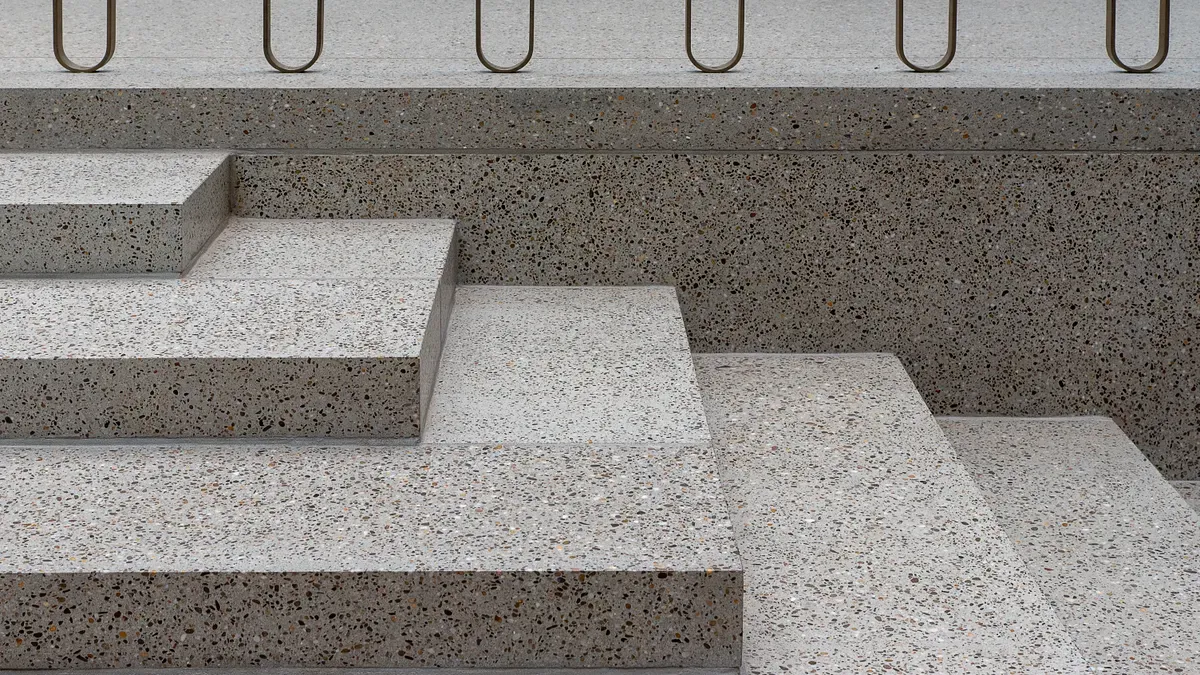
Terrazzo is a composite material of stone, glass, or other aggregates set in a cementitious or epoxy binder and ground to a polished finish. This definition of terrazzo captures durability and design flexibility. It anchors a practical guide to terrazzo selection. Treat this post as your how to guide for architects; it walks you through systems, performance, sustainability, and care. Your ultimate guide to terrazzo offers direct steps for confident specifying. Use this introduction to terrazzo specification for floors, walls, and custom surfaces. Use terrazzo specification to compare precast and poured systems; G·ONE‘s precast terrazzo panels, UHPC plates, and technical resources support your decisions.
Key Takeaways
- Terrazzo combines stone chips with a binder to create a durable, polished surface.
- Choose cementitious terrazzo for wet areas and epoxy for fast curing and thin profiles.
- Specify terrazzo correctly by preparing the substrate, selecting aggregates, and using divider strips.
- Terrazzo floors last 50-100 years, reducing replacement costs over time.
- Recycled glass and regional materials in terrazzo can earn LEED points for green building.
Definition of Terrazzo: Composition Basics
What Is Terrazzo Made Of
The traditional definition of terrazzo describes marble chips mixed with cement. Workers pour this mixture, let it cure, then grind and polish the surface to a uniform texture. This simple recipe explains what is terrazzo at its core: stone aggregate bound in a matrix.
Modern terrazzo expands far beyond marble and cement. Manufacturers now combine granite, quartz, shell, glass, porcelain, concrete, and even metal with a cementitious binder for chemical binding, a polymeric binder for physical binding, or a mix of both. Decorative options include mother of pearl, abalone shell, and recycled glass. Metal strips often separate sections or mark pattern changes. Additional chips may go in before curing to enrich the surface.
Binder choice shapes the material. Cement terrazzo uses a cement matrix. Resinous systems use epoxy or polyacrylate. Each option changes cure time, thickness, and moisture tolerance. Your composition decisions start here.
How Composition Drives Performance
Aggregate hardness and binder type together determine how a terrazzo floor performs. Hard aggregates raise abrasion resistance. Aluminum oxide rates Mohs 9 and delivers outstanding wear resistance, but it is difficult to grind and polish. Quartz rates Mohs 7 and suits most applications. Aggregate gradation matters too. A well-graded medium-hard aggregate with high packing density can outperform a poorly graded hard aggregate. Hardness alone is not decisive.
Aggregate loading influences compressive strength. A range of 65–75% aggregate by weight is optimal. Lower loading reduces compressive strength and raises shrinkage-cracking risk. Higher loading creates voids and delamination risk.
Binder type controls moisture behavior. Epoxy systems are more moisture-sensitive and need aggregate with less than 0.2% moisture. Polyurethane mortar tolerates up to 0.3% and benefits from silanol groups for covalent bonding. A non-hydraulic mineral binder reaches compressive strength of 10,000–12,000 psi (69–83 MPa) and is about 6 times harder than cement. That same binder is moisture-sensitive and suits indoor use only. Compared with Portland-cement terrazzo, the mineral binder expands slightly during curing, avoids shrinkage cracking, and allows much thinner floors (6 mm vs 50–70 mm). Portland-cement versions require divider strips.
Recycled content connects composition to sustainability. Terrazzo flooring can incorporate recycled glass and stone salvaged from other buildings, re-crushed and sieved for use. A floor made with 100% recycled glass may contain up to 75% recycled product by volume. Aluminum strips may include recycled metal.
Your terrazzo specification succeeds when you match aggregate and binder to the project. This unique blend of durability, aesthetics, and sustainability starts with composition. Understand the recipe, and you control the outcome.
Terrazzo History and Specs
From Venetian Origins to Modern Use
You trace the terrazzo story to 16th-century Italy. Venetian workers collected marble offcuts from construction sites. They mixed these stone fragments with cement and polished the surface. This practice turned waste into a durable floor. The technique spread across Europe over the following centuries.
The 1920s marked a turning point. Architects began to recognize terrazzo’s design potential. They moved beyond simple utility and explored color, pattern, and aggregate variety. This era established terrazzo as a finish for prominent public buildings, not just service spaces. The material gained a reputation for both beauty and resilience.
Why Heritage Matters for Restoration
Heritage terrazzo informs your restoration and adaptive reuse specifications. Older buildings often contain cement terrazzo floors with distinctive aggregate blends. These floors carry historical character. You need to match the original composition when planning repairs.
Restoration work demands careful analysis. You examine the existing binder type, aggregate size, and divider layout. Cement terrazzo from the early 20th century may use different cement chemistry than modern products. Matching these details preserves the building’s integrity. Adaptive reuse projects benefit from this approach. You retain the original terrazzo where possible and integrate new sections that respect the historic palette. This strategy satisfies preservation goals and meets current performance standards.
Terrazzo Systems Compared
Cementitious, Epoxy, and Polyacrylate
You face a clear choice among binder families. Each one changes cure time, thickness, moisture tolerance, and cost. The table below compares cementitious terrazzo and epoxy terrazzo on these four factors.
| Property | Cementitious Terrazzo (incl. Polyacrylate) | Epoxy Terrazzo |
|---|---|---|
| Installed Thickness | Sand Cushion: 2.5″–3″; Bonded: 1.75″–2.25″; Monolithic: 1/2″; Polyacrylate: 3/8″ | 3/8″ or 1/4″ |
| Cure Time | Slower installation; longer duration to fully cure | Cures overnight; ready to grind and polish the next day |
| Moisture Tolerance | Porous surface allows moisture to breathe through; performs well below grade and in humid environments | Non-porous; moisture mitigation system recommended above 75% relative humidity |
| Cost | Comparable initial install cost to epoxy, but higher labor and additional material costs | Comparable initial install cost; higher upfront expenses but lower lifecycle cost |
This epoxy vs cement systems comparison shows why you match binder to site conditions. A cement terrazzo floor handles below-grade moisture well. An epoxy terrazzo floor needs a mitigation system in humid spaces. Polyacrylate belongs to the cementitious family and offers a thin 3/8″ profile.
Rustic terrazzo gives you a non-ground, textured option. Workers do not grind or polish the surface. The finish stays matte and slip-resistant. This style suits exterior walkways and rustic interiors. You gain texture and traction without losing the material’s durability.
Poured-in-Place vs. Precast
Your delivery method shapes schedule, quality control, and cost. A poured-in-place terrazzo system cures on site over 4–8 weeks. This approach suits large open floors and delivers seamless results. A poured-in-place terrazzo floor lets you adjust patterns in real time. Complex patterns cost less because you avoid outsourced waterjet cutting.
Precast panels arrive factory-finished. They support strict quality control and suit small, complex, or precision-dependent areas. Precast works well for walls, wainscoting, custom logos, and complex shapes. Lead times run longer because production and transit add time. Joints between panels can harbor dirt, and substrate tolerances must be tight.
G·ONE supplies precast terrazzo, mosaic terrazzo, and custom-made solutions. These products cover both precast and tailored systems. You can order panels in advance to cut on-site installation time. For an epoxy terrazzo installation, precast panels reduce trade coordination on site. Review all types of terrazzo against your project goals before you commit.
Terrazzo Specification Essentials
Substrate, Dividers, and Aggregates
Your terrazzo specification begins with the substrate. A concrete subfloor must be flat, clean, and structurally sound. Cracks, voids, and height deviations need correction before placement. You must evaluate subfloor deflection because terrazzo is rigid and will crack if the substrate flexes. Shot blasting removes the top concrete layer to strengthen the bond between terrazzo and substrate. Divider strips define panel layout and design geometry. Options include aluminum, zinc, brass, and plastic strips. Cement terrazzo can span only 3 to 5 feet, while epoxy terrazzo can cover 20 to 30 feet. You must place a divider strip wherever joints exist beneath the concrete. The designer typically prepares the divider strip drawing, and the terrazzo contractor executes it.
Aggregate selection determines visual character. Terrazzo consists of at least 70% aggregates. Common choices include marble, granite, glass, shells, plastics, and metal chips. Chip size is expressed numerically in millimeters. Small chips (0, 1, 2) create a refined surface, and large chips (5 through 8) create a dramatic mosaic. Most installations mix two or three chip sizes. Standard sizes 0 to 2 suit epoxy terrazzo floors. Larger Venetian chips (sizes 3 to 8) typically increase thickness and cost. Recycled mirror and glass chips can contribute to LEED points.
How to Specify Terrazzo Floors
When you specify terrazzo floors, follow a clear sequence. First, prepare the floor by checking for cracks, moisture, and unevenness. Use flexible membranes, moisture mitigation systems, or fill epoxy as needed. Second, set divider strips to control expansion joints and separate colors or patterns. Third, combine marble, glass, or other decorative aggregates with a cementitious or epoxy binder. Fourth, pour the mixture evenly with a hand or power trowel, using separate batches for multiple colors, then cure. Fifth, grind with diamond-plated pads to transform the surface from rough to smooth. Sixth, grout to fill pinholes. Seventh, polish and seal for shine and protection. For cement terrazzo, sealing follows polishing. Epoxy terrazzo requires no sealing after polishing.
Your terrazzo specifications should require an approved physical sample as the controlling reference for appearance. Acknowledge that natural variation between the sample and the installed field is expected. Specify divider-strip layout as a design decision. Clarify that decorative strips do not prevent cracking. Coordinate movement-joint and crack-control requirements with concrete and project documents. State that specific tests, tolerances, and mitigation steps derive from the specified system and project documents.
Early coordination with trades prevents costly delays during terrazzo installation. G·ONE supports your work with digital catalogs, design lookbooks, and technical specifications. These resources help you compare aggregate blends, binder options, and finish samples before you finalize your terrazzo floor package.
Performance and Lifecycle Cost
Wear, Impact, and Moisture Behavior
A terrazzo floor responds to wear, impact, and moisture in ways tied to its binder. Cementitious terrazzo absorbs vapor and lets it escape, so it works well below grade and in humid environments. Epoxy terrazzo floors are non-porous and need a moisture mitigation system when slab conditions exceed 75% relative humidity. This distinction affects substrate preparation before placement.
Wear resistance depends on aggregate quality and loading. A well-graded blend with 65–75% aggregate by weight compresses densely, which improves abrasion resistance. Epoxy terrazzo floor systems cure overnight, returning traffic quickly. Cement terrazzo cures slower but forms a rigid slab that survives decades of impact. You must control substrate deflection, because terrazzo carries no flexibility. Thicker systems handle heavier loads, while thin systems demand a stable substrate. Match each system to the room’s function.
Lifecycle Cost vs. Competing Finishes
The material carries a high first cost, yet long service life changes the math. A cementitious terrazzo system can last 50–100+ years, while polished concrete lasts 20–50+ years. New installation for terrazzo runs $25–$80 per square foot depending on binder. Polishing an existing concrete slab costs $4–$24. Restoration later adds $4–$12 for the material and $4–$8 for concrete.
| Cost category | Terrazzo | Polished concrete |
|---|---|---|
| New installation cost per sq ft | $25–$60 (cementitious); $35–$80 (epoxy) | $4–$24 (polishing existing slab) |
| Restoration cost per sq ft | $4–$12 | $4–$8 |
| Expected service life | 50–100+ years | 20–50+ years |
| Annual maintenance cost | Low to moderate | Low |
A 30-year model shows why assumptions matter. Portland cement terrazzo totals $34.30 per square foot in one source, while unglazed porcelain tile averages $0.39 per square foot per year and VCT averages $1.85. Another 50-year healthcare model places the same system at $80.30 versus VCT at $112.80. These numbers show you need project-specific modeling. Run your own scenario with your local labor rates and cleaning schedule.
Reduced replacement frequency gives you value. The cementitious system often serves 50 years or more. A resinous system can match that span with lower maintenance than VCT, which wears sooner. Tile carries a lower annual cost, while VCT’s annual cost stays highest in the comparison. Polished concrete offers low upkeep, but its shorter life shortens the replacement cycle. Choose your system by modeling decades, not the first bid.
Applications by Building Type
Education, Healthcare, and Transit
You match terrazzo systems to traffic levels, hygiene needs, and acoustic requirements. Schools and universities need surfaces that resist heavy student traffic for decades. Terrazzo delivers a 50+ year track record in education. You can incorporate school colors or mascots into the design. Healthcare facilities require nonporous surfaces that reduce bacterial buildup. A seamless terrazzo floor supports infection control because it has no grout lines to trap soil. Transit terminals benefit from large-format seamless installations with custom design programs. These spaces absorb extreme foot traffic and often outlast the first renovation cycle.
Slip resistance matters in wet areas and stairs. You can add non-slip sealers or carborundum to improve traction. For acoustic performance in multistory buildings, pair terrazzo with sound-attenuation underlayment. This approach addresses sound transmission while retaining durability and hygiene benefits. The applications of terrazzo in these sectors show why specifiers choose it for demanding environments.
Corporate, Retail, and Hospitality
Corporate headquarters and offices use terrazzo for branded executive lobbies and open-plan floor continuity. Retail spaces handle rolling and point loads while offering tenant branding. Hospitality projects feature lobby statement floors and custom patterns tied to brand identity. G·ONE materials appear in hotel lobbies, luxury retail boutiques, facades, and public landmarks. These projects demand premium aesthetics and long-term performance.
Epoxy terrazzo floors cure overnight and offer a wide color range for decorative artwork. Cement terrazzo provides a rigid slab that survives decades of impact. You can specify terrazzo for walls, stairs, custom benches, and even logos. G·ONE also supplies UHPC plates for exterior facades and high-wear zones. These panels provide exceptional strength and weather resistance. When you need a terrazzo floor that reflects light fixtures and elevates prestige, recycled mirror glass adds an elegant effect while supporting green building goals.
Sustainability and LEED Contributions
Recycled Content and Regional Materials
You can earn LEED v4 points when you specify terrazzo with recycled and regional materials. Recycled glass, porcelain, and concrete aggregates qualify for Materials and Resources credits. Pre-consumer and post-consumer aggregates both count. If your aggregate is 100% recycled glass, recycled content by volume can reach roughly 75%. Salvaged stone or marble re-crushed for aggregate also contributes. Recycled aluminum strips add another source. The credit calculation uses the dollar value of raw materials. You need 10% recycled content for one point and 20% for two points.
Regional sourcing works the same way. Aggregates, cement, and binders are available in many U.S. regions. Suppliers within 500 miles of your project site support regional materials credit. You need 10% of building materials extracted, harvested, recovered, and manufactured within 500 miles for one point. Twenty percent earns two points. This calculation uses the cost of raw materials.
Indoor environmental quality matters too. Cement terrazzo uses inorganic binders with no VOCs. Epoxy systems use 100% solids and zero-VOC resins. Sealers generally comply with VOC limits. These features help you satisfy EQ Low-Emitting Materials requirements.
| LEED v4 credit pathway | Terrazzo contribution |
|---|---|
| MR – Recycled content | Recycled glass, porcelain, and concrete aggregates qualify for MR credits. |
| MR – Regional sourcing | Aggregates processed within 500 miles support regional materials credits. |
| EQ Low-Emitting Materials | Zero-VOC resins and low-VOC sealers reduce indoor air emissions. |
| Durability / life-cycle | Terrazzo floors last 75–100+ years and can be refinished. |
G·ONE Green Specification Support
G·ONE supplies recycled terrazzo and follows eco-friendly manufacturing processes. The brand’s recycled terrazzo uses salvaged materials to reduce waste. This approach connects sustainability and terrazzo in a practical way. You gain a product that meets green building standards without sacrificing performance.
The brand slogan “Small actions, big impact” reflects this commitment. Each specification decision you make adds up. Choosing recycled aggregate, regional suppliers, and low-VOC binders reduces embodied carbon over the floor’s life. G·ONE supports your green specification with digital catalogs and technical resources. These tools help you document recycled content and regional sourcing for LEED submittals.
Maintenance and Care
Routine Cleaning and Protection
You protect your terrazzo floor investment with a consistent cleaning routine. Daily care starts with dry mopping to remove dust and debris. This step prevents abrasive particles from scratching the surface. Damp mopping with a neutral pH cleaner maintains the shine. You should spot-clean spills immediately to prevent staining.
Entry matting plays a critical role in surface protection. Place runners inside and outside entrances. Door mats and area rugs add another barrier. These mats trap sand, dirt, and grit that act like sandpaper on your floor. Approximately eight steps on a mat removes debris from shoes. Non-slip undersurfaces keep mats in place and prevent accidents.
Your cleaning product choices matter. Neutral pH cleaners keep the surface intact. Avoid all-purpose cleaners, soaps with soluble salts, and products with harmful alkali or acids. Never clean above 800 PSI. Allow cleaner to react several minutes on the surface, but do not let it dry. For epoxy terrazzo floors, use only surface sealers. Cementitious terrazzo accepts impregnating sealers that absorb into the cement matrix and seal pores.
Protective treatments extend the life of your terrazzo. Penetrating sealers create a barrier against water, oils, and contaminants. This barrier reduces staining, slows wear, and eases cleaning. Apply an impregnating sealer after honing and polishing. New floors require two or more coats lasting 45–60 days. Choose a sealer with a UL slip-resistant rating of at least 0.5. Customize your protective treatment based on traffic levels in each space.
The table below summarizes recommended maintenance frequencies for both terrazzo types.
| Frequency | Cementitious terrazzo | Epoxy terrazzo | General procedures |
|---|---|---|---|
| Daily | Dry mop 2–3 times, damp mop with pH-neutral cleaner (pH 7–10) where needed | Same dust/damp mopping; avoid acidic spills; use pH-neutral products | Dust mop, spot-clean spills immediately, maintain entry matting |
| Weekly | Auto-scrub with pH-neutral cleaner at 4–6 oz/gal; burnish traffic lanes | Auto-scrub with pH-neutral cleaner at 2–4 oz/gal; burnish traffic lanes | Inspect for staining or sealer wear; prevent contamination transfer |
| Monthly | Deep-clean with terrazzo-specific cleaner; scrub edges manually; inspect/touch-up sealer | Same deep-clean and edge scrubbing; check worn sealers and etches | Inspect transitions and wet environments; log maintenance |
| Quarterly | Deep clean and mechanical polish (175–300 RPM); professional assessment | Deep clean and mechanical polish; use diamond honing if needed | Touch-up minor damage; reapply high-wear topical treatments |
| Annual | Reseal after thorough cleaning using silicone/siloxane/fluoropolymer sealer; apply two coats and allow 24–48h curing | Diamond-hone with progressively finer abrasives (400 to 3000+ grit) to remove scratches and restore clarity | Glossmeter check (40–60 units), full restoration, documentation |
Repair and Long-Term Renewal
Damage to your terrazzo floor does not mean replacement. You can repair most issues in place. The approach differs between cementitious and resinous systems. Identify the binder type first. This step tailors your repair method to the material.
For cementitious terrazzo, repair in situ using small-batch topping. Match the existing cementitious matrix and stone-chip size, type, gradation, and color. Patch with white Portland cement grout or tinted cement plus aggregate. After about 12 hours of curing, level the patch with 30–80 grit diamond pads. Increase grits gradually to blend with the surrounding floor. For full restoration, grind with 30–40 grit pads through roughly 3000 grit. Fill pinholes with cement slurry. Polish with compound and water. Apply a penetrating sealer to finish.
For epoxy terrazzo, repair in situ using small-batch topping that matches the epoxy matrix and stone-chip characteristics. Fill cracks with tinted epoxy. Wipe overspill while wet and allow full cure. Simple crack fills need no further grinding. For larger damage, use matching aggregate in an epoxy binder. Grind the cured patch flush. Polish the whole floor and seal with a penetrating sealer. If stripping and resealing is needed, first verify sealer chemistry. Use products designed for terrazzo, then reseal and repolish.
Crack and chip repair follows a clear process. Route out cracks and fill with color-matched epoxy resin mixed with matching aggregate chips. Patch missing aggregate with matched size, color, and density. Grind the repair flush with the surrounding surface. For grinding and honing, use coarse-grit diamond pads to strip damaged surface layers and old coatings. Switch to finer grits to hone and polish to a reflective finish. Apply an impregnating sealer to protect against staining while allowing the floor to breathe.
Proper care extends the lifecycle of your cement terrazzo or resinous system. Regular maintenance preserves appearance and delays costly replacement. A well-maintained terrazzo floor can serve for decades. Your commitment to routine care and timely repairs protects that investment.
Cost Considerations and Planning
Budget Drivers and Value Engineering
You control terrazzo costs by understanding four primary drivers: binder type, aggregate selection, divider complexity, and site conditions. Binder choice shapes the cost structure. Cement-based bonding agents cost less per pound than epoxy resin options. However, cementitious terrazzo requires greater placement thickness and more aggregate volume per square foot. Labor hours for mixing, placing, and finishing also rise. Epoxy terrazzo carries a higher material price, yet its thin-set profile and faster cure often offset that premium.
| Cost Driver | Epoxy-Based Terrazzo | Cement-Based Terrazzo |
|---|---|---|
| Binder material price | Higher per unit | Lower per pound |
| Placement thickness | Thin-set, shallower build-up | Greater thickness |
| Aggregate volume per sq ft | Lower | Higher |
| Labor hours | Reduced | Increased |
| Cure window | Faster, compressed | Slower |
| Net cost effect | Material premium often offset by thinner section and faster cure | Cheaper binder offset by greater volume and labor |
Aggregate selection moves your budget significantly. Marble chips often cost $25–$100 per 50-lb bag. Colorful glass chips and Mother of Pearl shells carry a premium. For 3/8″ epoxy terrazzo, standard sizes #0–#2 are most cost-efficient. Larger Venetian-style aggregates cost more. Divider strip material matters too. Aluminum strips are the most cost-effective and widely accepted. Zinc and brass strips are more expensive, and brass requires careful installation to avoid a blue discoloration with light epoxy colors.
Value engineering does not mean compromising performance. You can adjust aggregate size, simplify divider patterns, or phase installation to manage costs. Site conditions such as subfloor preparation, moisture mitigation, elevator access, and occupied-space phasing also drive labor hours. Regional labor costs and economies of scale on larger projects affect the final price. A terrazzo floor that lasts 50–100+ years justifies its investment through reduced replacement frequency.
Phasing, Lead Times, and Contingency
Your delivery method determines schedule and contingency needs. Poured-in-place terrazzo requires 4–6 weeks from surface prep through final polishing. This timeline depends on project size and cure time. Moisture management, including vapor barriers and moisture testing, is essential before installation, especially in humid locations. Precast terrazzo tiles typically install in 2–3 weeks for large areas. They are manufactured off-site in a controlled facility, then transported and installed. This approach offers consistency and faster on-site installation.
Phasing supports occupied facilities. You can break work into manageable sections with containment systems, temporary walls, negative air pressure, and dust collection. This isolates work areas and keeps facilities operational. Precast also suits phased installation, but standardized design limits may affect coordination. Joint lines remain and may create maintenance challenges in high-traffic healthcare settings.
In a value-engineering comparison, a tile manufacturer faced a production and delivery delay of at least two months before installation could start. The terrazzo raw materials reached the job within two weeks, allowing the terrazzo work to finish faster than the tile was projected to arrive. The project used careful phasing so that the airport could keep operating during the terrazzo installation. This approach is standard practice in similar occupied-facility situations. Build contingency for lead times and coordinate material delivery with facility operations.
Finding Qualified Contractors and Resources
What to Look For in an Installer
You need to verify several credentials before you award a terrazzo installation contract. Start with years of industry experience and project references in your specific facility type, such as healthcare, airports, or universities. Request a detailed proposal covering substrate preparation specifications, material sourcing, installation timeline, warranty terms, and post-installation maintenance protocols. Ask about insurance, licensing, and whether the contractor offers ongoing maintenance services.
Confirm current general liability and workers’ compensation insurance. Request proof of bonding for the project value. Check whether the contractor has completed similar-scale projects and ask about their quality control approach. For custom inlay work, request references specifically for comparable custom design projects, not just general installations. Site visits to at least two comparable projects completed within the last three years give you direct evidence of workmanship.
Mockups establish the quality standard for your terrazzo floor. Require approved samples for aggregate blend, matrix color, and divider layout. On larger projects, require a mockup to establish the accepted appearance. Each worker proposed for the project should prepare a mockup panel of each activity they will perform. Workers whose mockups are not approved should not work on the project. Approved mockups become part of the work and serve as the quality standard for all similar work.
Industry Resources and G·ONE Support
Industry associations and technical guides give you a framework for evaluating contractors. ASTM standards define rigorous requirements for substrate preparation, aggregate selection, and curing protocols. Contractors who exceed these standards deliver flooring that withstands high-traffic environments without premature cracking. Your terrazzo specification should reference these standards and require documented compliance verification.
G·ONE supports your terrazzo specifications with tailored consultations, project samples, and expert engineering support. The brand provides digital catalogs and design lookbooks that help you compare aggregate blends and binder options. Whether you specify epoxy terrazzo or cementitious systems, G·ONE’s technical resources help you document performance criteria and sustainability claims. Use these tools alongside industry guides to build a complete terrazzo specification package.
Terrazzo is a composite of aggregates set in a binder and ground to a polished finish. That definition of terrazzo explains why the material performs and adapts across projects. You now have the criteria to select a system: composition, binder type, delivery method, performance, sustainability, maintenance, and cost. Confident terrazzo specification comes from matching these factors to your project goals. Use this ultimate guide to terrazzo as a checklist during design development. Review each section as your project evolves. Engage qualified contractors early to align mockups, schedules, and budgets. G·ONE supports your work with precast terrazzo, UHPC panels, and specification resources.
FAQ
What distinguishes terrazzo from polished concrete?
Terrazzo combines decorative aggregates with a cementitious or resinous binder, then workers grind and polish the surface. Polished concrete treats the existing slab itself. The definition of terrazzo centers on that added aggregate layer, which gives you far greater control over color, pattern, and chip size than concrete alone offers.
How do I choose between cementitious and epoxy systems?
Match the binder to your site conditions. Cementitious terrazzo tolerates moisture well and suits below-grade spaces. Epoxy cures overnight and offers a thinner profile. Your terrazzo specification should reflect humidity levels, schedule demands, and substrate preparation needs before you commit to either system.
Can I install terrazzo in occupied buildings?
Yes. Phased installation with containment systems, temporary walls, and dust collection keeps facilities operational. Precast panels reduce on-site time because they arrive factory-finished. Poured-in-place work requires more coordination. Plan your phasing strategy early and build contingency for lead times.
What maintenance does terrazzo require?
Daily dry mopping and damp mopping with a neutral pH cleaner preserve the surface. Entry matting traps abrasive debris. Avoid acidic or alkaline products. Annual resealing for cementitious systems and periodic diamond honing for epoxy systems extend the floor’s service life considerably.
How does terrazzo support LEED certification?
Recycled glass and porcelain aggregates contribute to Materials and Resources credits. Regional sourcing within 500 miles supports additional points. Zero-VOC resins and low-VOC sealers help satisfy indoor environmental quality requirements. Document your material sourcing for submittals.