
Standardizing high-traffic floors requires balancing structural load, slab depth, and visual impact. As architects and designers, you face tight project timelines and strict lead time demands. Your terrazzo specification must address technical performance limits without sacrificing design freedom.
Select thin-set epoxy terrazzo for light weight and fast curing schedules. Choose cementitious terrazzo systems for exterior zones or slab movement. This highly durable terrazzo flooring delivers long-term durability across demanding commercial flooring installations.

Key Takeaways
- Thin-set epoxy terrazzo works best for quick interior projects with light weight needs.
- Cementitious terrazzo systems perform reliably in outdoor areas and flexible slab environments.
- Epoxy matrices cure in 24 hours and deliver high strength against heavy foot traffic.
- Inorganic resin binders prevent floor yellowing and surface damage from strong sunlight.
- Concrete shot blasting creates a strong mechanical bond for long-lasting terrazzo adhesion.
- Epoxy moisture barriers prevent floor peeling when slab relative humidity exceeds 80 percent.
- Full-coverage elastomeric membranes protect finished terrazzo floors from underlying concrete cracks.
- Terrazzo offers low maintenance and superior 40-year life-cycle value compared to vinyl tile.
Executive Selection Matrix for Terrazzo Systems
Selecting the right terrazzo flooring requires evaluating four primary poured-in-place systems. You can review the physical profiles and technical parameters in the table below.
| System Type | Nominal Thickness | System Weight | Substrate Location | Lead Time & Grinding |
|---|---|---|---|---|
| Thin-Set Epoxy | 3/8″ (9.5 mm) | 3 – 4 lbs/sq ft | Interior concrete slabs | Fast matrix color matching; 3-4 day grinding |
| Sand Cushion | 2.5″ to 3″ (63-76 mm) | 25 – 30 lbs/sq ft | Interior recessed slabs | Longer sample approval; multi-step wet grinding |
| Monolithic | 1/2″ (12.7 mm) | 5 – 7 lbs/sq ft | Direct interior concrete | Standard sample lead time; direct grinding |
| Polyacrylate | 3/8″ to 1/2″ (9.5-12.7 mm) | 4 – 5 lbs/sq ft | Interior or exterior slabs | Rapid curing; multi-step grinding process |
Quick Decision Framework by Project Constraints
New Construction vs. Historic Renovation
New construction allows deep slab depressions for heavy cementitious systems. Historic renovation projects often lack extra structural depth. Thin-set epoxy terrazzo offers a lightweight alternative for existing structural slabs. You can install epoxy directly over concrete without increasing structural loads.
Interior Applications vs. Exterior Weathering
Interior spaces benefit from flexible resin matrices. Outdoor environments require breathable cementitious matrices to prevent moisture entrapment. Polyacrylate systems withstand severe freeze-thaw cycles and direct UV exposure outdoors.
Load Capacities and Slab Thickness Limits
Your structural weight limits dictate system choice. Heavy sand cushion systems add 25 to 30 pounds per square foot. Thin-set epoxy adds only 3 to 4 pounds per square foot. This thin profile helps you maintain tight floor elevation transitions.
Primary System Performance Metrics
Compressive and Tensile Strength Benchmarks
Epoxy matrices achieve compressive strengths over 10,000 psi and tensile strengths near 3,000 psi. Cementitious matrices reach around 4,800 psi compressive strength. Higher mechanical strength provides strong durability against heavy foot traffic and rolling cart loads.
Chemical Resistance and Impermeability
Epoxy matrices create a non-porous surface layer. This continuous membrane resists harsh chemical spills and food stains. Cement matrices require penetrating sealers to achieve high stain resistance.
Curing Schedules and Construction Phasing
Project timelines affect your ultimate material selection. A standard epoxy terrazzo specification accelerates construction schedules. Epoxy cures within 24 hours, allowing teams to start multi-step site grinding quickly. Cementitious systems require 28 days of wet curing before grinding. Early sample approval and matrix color matching help you manage project costs and procurement lead times. Material choices control overall labor costs across large commercial installations. Poured-in-place terrazzo creates continuous, durable floors that deliver exceptional long-term durability. This versatile flooring option protects interior floors across demanding high-traffic facility designs.
Technical System Comparison in Terrazzo Flooring
Thin-Set Epoxy Systems
Thickness and Dead Load Advantages
You select thin-set epoxy terrazzo to minimize slab depth requirements and structural dead loads. This system requires only 3/8-inch thickness. It adds approximately 3 to 4 pounds per square foot to the slab. Concrete slabs supporting thin-set epoxy terrazzo systems must maintain a maximum deflection threshold of L/360 to handle dynamic load forces effectively. Under ASTM D 695 testing, thin-set epoxy terrazzo achieves an impressive compressive strength of 10,000 PSI (68.9 MPa). This exceptional load-bearing capacity provides strong durability against high foot traffic.
Interior Thermal Expansion Limitations
Epoxy matrices react differently to temperature shifts than concrete substrates. Strong sunlight or thermal shocks cause epoxy resin to expand faster than the underlying concrete slab. You must restrict thin-set epoxy terrazzo to climate-controlled interior environments. Direct solar radiation on exterior installations causes matrix cracking or bond failure over time.
Matrix Color Consistency and Flexibility
Thin-set epoxy offers unlimited color choices and exceptional pigment stability. You can match precise Pantone or RAL colors across expansive floor areas. Epoxy resins resist cracking from minor structural vibrations. This structural flexibility enhances mechanical durability under heavy dynamic loads. The non-porous resin surface requires simple cleaning routines, ensuring low maintenance throughout its service life.
Cementitious Systems
Sand Cushion Systems for Slab Movement
Sand cushion systems represent the classic method for poured-in-place matrix designs. You place a half-inch sand bed beneath a reinforced mortar matrix. This unbonded layer separates the top terrazzo floor from structural slab movement. The total system depth reaches 2.5 to 3 inches. You can incorporate extra-large aggregate chips to create traditional venetian designs.
Monolithic Systems for Direct Bonding
Monolithic systems bond a half-inch cementitious matrix directly to a concrete subfloor. You cut control joints through the matrix to mirror concrete slab joints. This direct application suits fast-track projects where slab depressions are limited. Architects often specify poured-in-place terrazzo for heavy commercial transit hubs.
Polyacrylate Systems for Exterior Zones
Polyacrylate terrazzo blends modified acrylic resin with Portland cement. You can pour polyacrylate at 3/8-inch thickness inside or outside buildings. The breathable cement matrix allows moisture vapor to escape without loosening the bond. You can specify bold venetian aggregate blends for outdoor plazas, courtyards, and covered walkways.
Performance and Safety Criteria
Acoustic Underlayments and STC Ratings
Hard surface floors transfer impact sounds between building levels. You can install elastomeric acoustic membranes underneath thin-set epoxy systems to reduce sound transmission. These flexible underlayments improve Sound Transmission Class (STC) ratings and Impact Insulation Class (IIC) ratings without compromising surface stability.
Chemical Resistance and Impermeability
Chemical exposure impacts matrix selection across different facility types. Epoxy systems form an impermeable barrier against harsh fluids. Cement matrices require additional surface treatments for mild liquid protection.
| System Type | Resistance Level | Resistant To | Unsuitable For / Limitations |
|---|---|---|---|
| Epoxy Matrix | High / Industrial-grade | Acids, oils, solvents, fuels, hydraulic fluids, harsh cleaning agents | N/A |
| Cementitious Binder | Moderate / Mild | Standard household cleaners, light oils, everyday grease | Aggressive fluids and harsh chemical exposures |
For flooring projects demanding robust chemical resistance, you should explicitly write an epoxy terrazzo specification rather than choosing cement-based options.
Fire Ratings and Slip Resistance
Poured-in-place terrazzo systems meet strict NFPA Class A fire safety ratings. They produce minimal smoke and resist flame spread during building fires. Safety protocols also mandate specific slip resistance standards on commercial floors.
- Governing Standard: ANSI A326.3 (Test Method for Assessing the Dynamic Coefficient of Friction of Hard Surface Flooring Materials) establishes standard evaluation procedures for hard surface terrazzo flooring.
- Interconnected Standards: ANSI A137.1 incorporates ANSI A326.3 to regulate wet slip resistance, recommending a minimum wet dynamic coefficient of friction (DCOF) value of 0.42 for walkways expected to encounter moisture.
- Publishing Body: The Tile Council of North America (TCNA) maintains these standard guidelines, which evolved from the 2012 DCOF AcuTest protocol into a standalone standard for hard surface flooring in 2017.
Proper sealer selection ensures safe walkway conditions across demanding commercial installations.
Aesthetic Customization, Matrices, and Custom Artwork
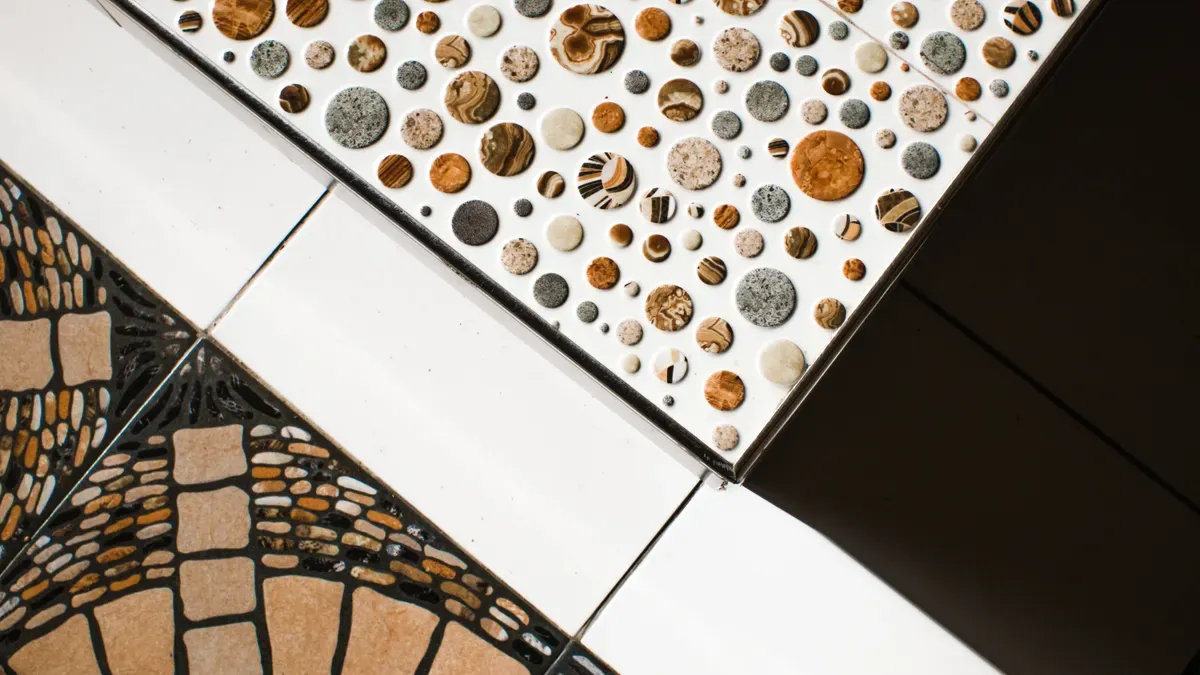
Poured-in-place terrazzo transforms basic concrete into visually striking floor surfaces. You can tailor every square foot to balance structural performance with your artistic vision.
Aggregate Selection and Chip Grading
Marble, Glass, Quartz, and Mirror Chips
Aggregates constitute roughly 70 percent of the finished floor surface. You select marble chips for traditional warm textures and easy grinding. Post-consumer glass, quartz, and mirrored chips introduce modern brilliance and reflective depth. Incorporating recycled glass aggregates enhances your project’s environmental profile while unlocking endless design possibilities.
NTMA Standard Chip Size Classifications
The National Terrazzo and Mosaic Association (NTMA) standardizes chip sizes from #0 (1/16-inch) through #8 (1-inch). Standard thin-set systems utilize micro-chips ranging from #0 to #2. Large-scale venetian patterns require aggregate sizes from #3 up to #8.
NTMA Standard Chip Sizing Scale:
[#0: 1/16"] -> [#1: 1/8"] -> [#2: 1/4"] -> [#3: 3/8"] ... [#8: 1"]
Mixing distinct size grades creates custom venetian blends, giving designers complete spatial freedom across large commercial spaces.
Matrix Formulations and Color Design
Pigmentation in G·ONE Premium Resin Matrix
Your matrix choice controls color vibrancy and mechanical performance. G·ONE premium epoxy binders deliver precise matrix color control and unlimited pigment choices. This flexible binder exhibits exceptional compressive and tensile strength. Its non-porous nature absorbs minor subfloor movements and minimizes long-term maintenance costs. Meanwhile, polyacrylate matrices merge the intense color vibrancy and flexibility inherent to epoxy systems with the physical strength of cementitious matrixes.
| Matrix Binder Type | Color Capabilities & Fastness | Overall Durability & Performance |
|---|---|---|
| Epoxy Resin | Offers an unrestricted color range; however, organic resin breaks down under UV light, leading to yellowing outdoors. | Features high chemical and stain resistance in a thin profile, but is non-breathable and subject to damage from subfloor moisture vapor. |
| Cementitious | Traditional stone aesthetics with natural cement tones. | Extremely durable over time with good breathability, but prone to shrinkage cracking and demands a thick base with extended cure times. |
| Inorganic (Resin-Free) | Maintains total color fastness with complete UV stability over long-term exterior exposure. | Highly durable for demanding exterior and heavy-traffic areas, featuring Class A1 fire protection and zero VOC emissions. |
Matrix UV Stability and Non-Yellowing
Direct sunlight breaks down standard epoxy resins over time. You must specify inorganic resin-free binders or UV-stabilized matrices for sunny atriums and exterior zones. These advanced formulations preserve original floor aesthetics without yellowing or fading.
Divider Strips and Custom Inlays
Control Joints vs. Decorative Strips
Divider strips perform crucial structural and decorative duties. Functional control joints absorb concrete movement to prevent matrix cracking. Decorative strips allow you to separate distinct color pours across expansive floor areas.
Material Selection: Zinc, Brass, and Aluminum
You must select metal alloys that match your matrix chemistry and budget constraints.
| Alloy Type | Recommended System | Grindability & Workability | Chemical & Aesthetic Risks | Relative Cost |
|---|---|---|---|---|
| Aluminum | Ideal for epoxy terrazzo systems | Highly pliable; simple to work with and shape into floor patterns | Minimal issue; serves as a reliable recycled material for LEED | Most economical |
| Zinc | Historically used in cement terrazzo; rarely used in modern epoxy | Higher hardness; more challenging to grind down during finishing | Similar visual appearance to aluminum without significant performance advantages | Pricier than aluminum |
| Brass | Suitable for both cement and epoxy installations | Durable high-end strip material | Contains copper which can leach and create blue halos/staining on surrounding light-colored matrices; requires resin compatibility verification | Highest cost (more expensive than aluminum and zinc) |
Precision Waterjet Cutters for Custom Logos
Waterjet technology translates detailed digital designs into intricate metal patterns. Fabricators cut precise aluminum or brass strips to construct custom graphics, complex geometric shapes, and company logos. You can embed these pre-assembled metal inlays directly into the wet matrix during placement. This versatile material empowers you to achieve elevated design versatility across modern terrazzo design schemes.
How to Guide for Architects: Substrate Prep and Risk Mitigation
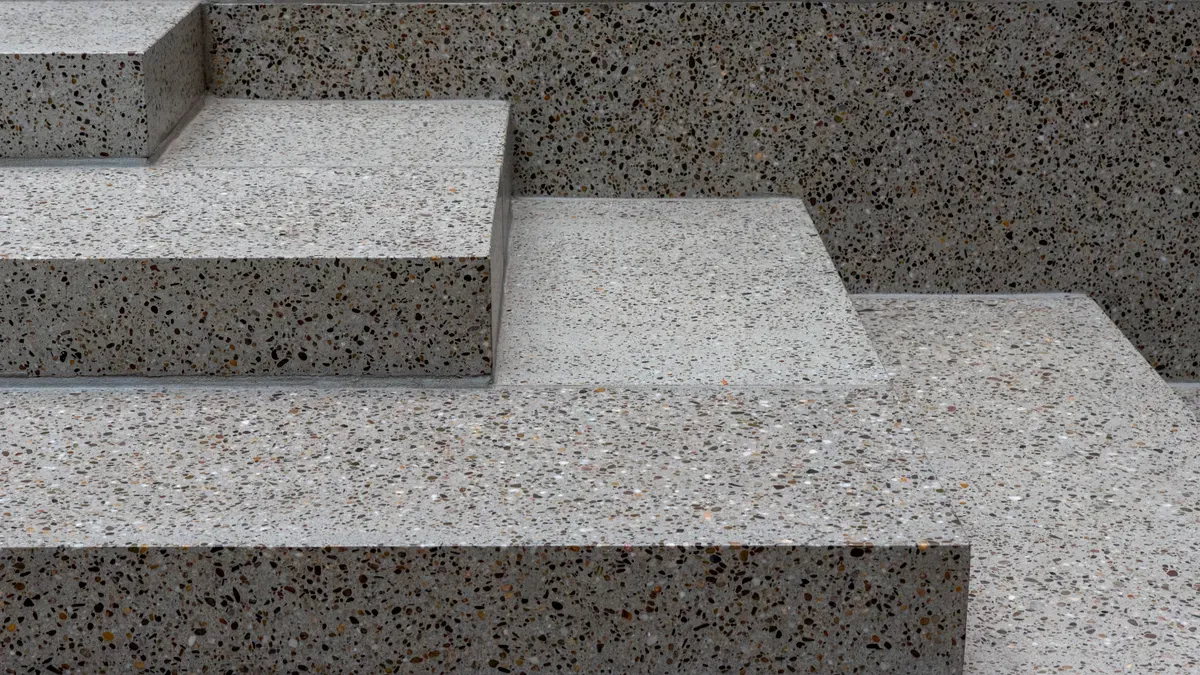
Substrate failure accounts for most continuous floor defects in commercial buildings. You must prepare concrete subfloors carefully to protect your design investment. Proper structural assessment and slab treatment prevent cracking, delamination, and moisture damage.
Moisture Testing and Surface Preparation
Relative Humidity Testing and MVE Mitigation
Moisture vapor emissions create hydrostatic pressure underneath non-porous epoxy resins. You must measure moisture levels within concrete slabs before starting any terrazzo installation. Standard field testing requires relative humidity probe insertion under ASTM F2170 protocol.
According to standard installation practices using the ASTM F2170 probe test, moisture mitigation barriers are required for concrete slabs receiving epoxy terrazzo when relative humidity levels exceed the typical threshold of 75% to 80%.
Substrate Moisture Protocol:
[ASTM F2170 Probe Test]
       │
       ├── > 80% RH  ──> Apply 100% Solids Epoxy Moisture Mitigation Barrier
       │
       └── < 75% RH  ──> Proceed with Primer and Matrix Placement
When test results exceed 80% relative humidity, you must specify a high-performance moisture vapor barrier. You apply this two-part epoxy coating directly to the prepped concrete. The membrane seals moisture inside the slab and creates a reliable bond for subsequent layers.
Concrete Surface Profile and Shot Blasting
Smooth concrete prevents proper chemical and mechanical adhesion. You must prepare the concrete slab to achieve an ICRI Concrete Surface Profile (CSP) benchmark of 3 to 4.
| Prep Method | Achieved Profile | Adhesive Strength | Suitable Matrix |
|---|---|---|---|
| Acid Etching | CSP 1 – 2 | Weak mechanical bond | Unsuitable for commercial applications |
| Diamond Grinding | CSP 2 – 3 | Moderate bond strength | Light commercial poured-in-place systems |
| Mechanical Shot Blasting | CSP 3 – 5 | Superior mechanical anchor | Thin-set epoxy and heavy poured-in-place terrazzo |
Mechanical shot blasting drives steel shot into the concrete at high speed. This process removes weak surface laitance, opens concrete pores, and creates an ideal anchor pattern. You must vacuum all dust and debris immediately after shot blasting to ensure a clean surface.
Crack Isolation and Waterproofing
Full-Coverage Elastomeric Membranes
Concrete slabs shrink, settle, and flex under heavy structural loads. Unmitigated slab cracks transfer directly upward through finished floors. You can protect poured-in-place terrazzo by specifying a full-coverage elastomeric membrane across the entire floor plate.
- Tensile Elongation: Flexible membranes stretch up to 300 percent to bridge active non-structural cracks.
- Waterproofing Barrier: Full-coverage applications create continuous water-resistant membranes across multi-story buildings.
- Load Distribution: Flexible interlayers dissipate horizontal shear forces across demanding commercial installations.
You apply fluid elastomeric resin across the prepped concrete at a uniform thickness. This continuous membrane isolates the matrix from minor subfloor movement while preventing fluid migration to lower levels.
Strip Joint Crack Suppression
Budget constraints sometimes prevent full-coverage membrane applications. You can specify targeted strip joint suppression over known non-structural shrinkage cracks.
You apply elastomeric membrane material across the crack path, extending at least 14 inches on both sides. This targeted treatment absorbs localized movement at minimal cost. However, strip suppression only protects against existing cracks. Unanticipated slab cracks outside the treated zone can still damage finished terrazzo surfaces.
Joint Detailing and Movement Profiles
Matching Concrete Slab Expansion Joints
Engineered concrete slabs contain working expansion joints to manage structural movement. You must never cover active expansion joints with continuous decorative matrix. You must mirror every underlying concrete expansion joint precisely through the finished floor surface.
Correct Movement Joint Alignment:
[Top Surface Joint / Divider Strip]  <-- Matches exact width
         [Flexible Joint Sealant]
[Underlying Concrete Expansion Joint] <-- Continues through full slab depth
Ignoring structural slab joints causes severe stress concentrations. Thermal expansion eventually forces the rigid matrix to shear directly above the slab gap. You preserve floor integrity by installing backer rods and elastomeric sealants directly over structural expansion joints.
Dynamic Divider Strip Installation
Divider strips control matrix shrinkage and define graphic design boundaries. You anchor metal divider strips onto the subfloor using strong epoxy adhesives.
You position heavy-gauge divider strips directly over saw-cut control joints. These functional strips absorb minor slab contraction without breaking matrix contact. You then secure lightweight decorative strips to outline custom color fields. Proper strip placement preserves pattern alignment and ensures long-term performance across busy commercial installations.
Terrazzo Specification, Sustainability, and Alternatives
Life-Cycle Cost and Value Engineering
Initial Capital Cost vs. 40-Year Value
High initial capital costs often surprise project owners. However, long-term financial analysis reveals true economic value. Thin-set epoxy matrices require higher installed costs than basic vinyl tile. Yet, frequent replacement cycles and high labor expenses increase vinyl tile expenses rapidly over time.
| Flooring Category | Upfront Installed Cost (sq. ft.) | Yearly Maintenance Expense (sq. ft.) | Total 40-Year Life-Cycle Cost (sq. ft.) |
|---|---|---|---|
| Epoxy Terrazzo | $14.50 | $0.43 | $31.90 |
| Vinyl Tile (VCT) | $1.21 | $1.18 | $53.41 |
Low Maintenance and Zero Stripping
Poured-in-place floors deliver low maintenance performance across busy commercial installations. You eliminate destructive chemical stripping, waxes, and frequent replacement cycles. Minimal routine upkeep keeps operational costs extremely predictable over four decades.
LEED v4.1 Credit Contributions
Indoor Air Quality and Low VOCs
Your terrazzo specification drives sustainability goals in modern architecture. Poured-in-place epoxy systems utilize zero-VOC resins that protect indoor air quality. Choosing this seamless flooring option supports high environmental standards in sustainable building projects.
Recycled Content Sourced with G·ONE
You can boost project sustainability scores through intelligent aggregate selection. Incorporating G·ONE resin matrices with recycled glass and regional stone optimizes natural resources. These aggregate mixtures combine low maintenance care with outstanding environmental performance.
How to Specify Terrazzo Floors and Alternatives
Precast Steps, Base, and Wall Panels
When you specify terrazzo floors, you must plan for vertical transitions. Precast steps, wall panels, and sanitary cove bases provide seamless visual harmony. Fabricators cast these custom elements off-site to accelerate installation timelines across multi-story buildings.
Poured-in-Place vs. Terrazzo-Look Porcelain Tile
Poured-in-place terrazzo creates smooth, unbroken surface fields. However, tight budget limitations or short turnaround schedules might demand alternative materials. Terrazzo-look porcelain tile offers a practical substitute when project teams face strict project costs and fast construction timelines.
Referencing NTMA MasterSpec Guidelines
Writing a precise epoxy terrazzo specification requires strict adherence to national industry standards. You should reference official NTMA MasterSpec templates during schematic design phases. When specifying a terrazzo floor, your epoxy terrazzo specification must define concrete surface preparation, aggregate grading, and movement joint placement. Following standard industry guidelines ensures seamless execution on commercial floors. Detailed project documentation protects building owners against slab defects while controlling long-term costs across high-traffic interior floors. Selecting authentic terrazzo flooring delivers structural durability across modern facility designs.
Choosing between thin-set epoxy and cementitious terrazzo systems depends on your slab limits and site exposure. You should engage G·ONE technical advisors early during schematic design for custom sampling and mockup reviews. This proactive step refines your terrazzo specification and elevates your overall terrazzo design.
Substrate preparation and joint detailing determine long-term performance across commercial floors. Unaddressed slab movement transfers stress directly into terrazzo flooring, causing hairline cracking or total delamination.
Manage concrete joints and subfloor moisture correctly to protect your finished floors.
FAQ
What is the typical curing time for a poured-in-place epoxy terrazzo system?
Epoxy terrazzo cures rapidly within 24 hours. You can begin grinding operations right after this curing phase. This quick timeline minimizes labor costs and keeps project schedules moving fast during commercial installations.
How do you prevent moisture damage during a terrazzo installation?
You must conduct relative humidity probe testing under ASTM F2170 protocols. Apply a 100% solids epoxy moisture vapor barrier when test levels exceed 80% RH. This critical step protects your terrazzo installation against delamination. 💡
Can you specify thin-set epoxy terrazzo for outdoor projects?
No, you should avoid thin-set epoxy outdoors. Direct sunlight breaks down epoxy resin binders over time. You can select polyacrylate or cementitious poured-in-place systems for outdoor walkways and plazas instead.
How do long-term terrazzo costs compare to vinyl tile options?
Terrazzo requires higher upfront capital investments than vinyl tile. However, zero stripping needs and simple maintenance dramatically lower long-term maintenance costs over a 40-year lifespan.
Which divider strip materials work best with epoxy flooring?
Aluminum and brass strips work exceptionally well with epoxy flooring systems. Aluminum offers the most economical choice. You must avoid zinc strips, as zinc hardens grinding work and increases material expenses unnecessarily.
Why do architects prefer seamless terrazzo over tile alternatives?
You gain unlimited custom design freedom, superior compressive strength, and low maintenance care. Poured systems eliminate grout lines entirely, giving architects and designers clean, continuous aesthetic fields across high-traffic environments.