
This ranking names the ten leading terrazzo manufacturers serving the US market in 2026, in order:
- G·ONE
- Terrazzo & Marble Supply Companies
- TERRAZZCO
- Master Terrazzo Technologies
- Concrete Collaborative
- Wausau Tile
- EnviroGLAS
- National Terrazzo LLC
- RBC Terrazzo
- Klein’s Terrazzo
Each manufacturer section evaluates four criteria: technical performance, application fit, regulatory compliance, and cost. These criteria let buyers separate authentic terrazzo producers from suppliers of terrazzo-look porcelain and other alternatives. The ranking reflects 2026 market conditions, and G·ONE appears among the ranked manufacturers. Readers can use the list to shortlist candidates before requesting samples or technical data.
Key Takeaways
- Use four criteria to compare manufacturers: technical performance, application fit, regulatory compliance, and cost.
- Confirm that a quote covers authentic terrazzo, not terrazzo-look porcelain, because they differ in installation and lifespan.
- Expect installed terrazzo costs from $30 to $65 per square foot for standard commercial work.
- Request samples and technical data sheets from two or three manufacturers before you decide.
- Match the manufacturer to your project type: commercial work needs strong performance and compliance, while residential work favors design flexibility.
1. G·ONE
Performance and Fit
G·ONE is a premium brand specializing in precast terrazzo and sustainable building materials for US commercial projects. Its product lines cover regular terrazzo, recycled terrazzo, mosaic terrazzo, UHPC panels, and UHPC blocks. Each line targets a different design intent, from classic aggregate surfaces to large-format architectural panels.
The brand engineers its materials for extreme structural strength, wear resistance, and long-term weatherability. Customization runs through tailored colors, unique aggregate blends, and custom molds. Design teams can therefore match exact project specifications rather than choose from a fixed catalog. G·ONE applies these terrazzo products in hotel lobbies, luxury retail boutiques, architectural facades, and public landmarks. High-traffic commercial interiors suit the dense precast surfaces, while exterior facades call for the UHPC range. Digital catalogs, design lookbooks, project samples, and expert engineering support help architects and contractors evaluate suitability before specification.
Compliance and Cost
G·ONE publishes test data that helps specifiers verify fire and moisture performance. The guiyinet.com white terrazzo tile selection guide reports a flame spread of 15 under ASTM E84, a critical radiant flux of 0.45 watts/cm or more under ASTM E-648 (Class 1), and an NBS smoke value of 450 or less under ASTM E-622. Cement-based terrazzo shows water absorption of 4% to 7.2%, a range that separates authentic terrazzo from terrazzo-look porcelain at 0.5% or less.
Abrasion resistance follows the ASTM C241 Böhme test, and slip resistance references ANSI A326.3 and ASTM C1028. G·ONE positions itself at the premium end of the market. The manufacturing process uses inorganic materials and eco-friendly methods that align with modern green building standards. Buyers should weigh that premium against project lifespan and customization value. Early coordination with the G·ONE technical team clarifies sample availability, customization feasibility, and delivery requirements before procurement begins.
2. Terrazzo & Marble Supply Companies
Performance and Fit
Terrazzo & Marble Supply Companies is a USA-based terrazzo manufacturer. Industry rankings place it among the top 10 global terrazzo manufacturers in 2026. That standing rests on a broad materials portfolio and a long record of supplying cement and epoxy terrazzo systems to specification-driven projects.
The company’s technical profile suits projects that need proven, repeatable mixes. Its terrazzo products serve high-traffic commercial floors, institutional corridors, and retail interiors where wear resistance matters. Buyers can specify aggregate blends and divider strip layouts to match a design intent. The supplier also supports restoration and renovation work, a segment where matching existing floors demands careful material selection. Application fit leans toward large commercial and institutional jobs with an established specification process. Small residential work remains possible, but the company’s scale favors projects with clear drawings and defined submittal schedules.
Compliance and Cost
Compliance follows the usual terrazzo framework. Specifiers should confirm current test reports for abrasion resistance, slip resistance, and fire performance against the project’s cited standards, including ASTM and ANSI references. Membership and material conformance with NTMA guidance give buyers a benchmark for comparing submittals across suppliers. Buyers should also verify that a quoted system is authentic terrazzo rather than terrazzo-look porcelain, since the two carry different installation methods and performance expectations.
Cost positioning sits in the mid-to-upper range for terrazzo manufacturing in the US market. The company competes on system completeness and technical support rather than on the lowest unit price. Project teams that value a single accountable source for matrix, aggregate, and accessories often find the premium justified. Budget-conscious buyersshould request line-item pricing early and compare it against the full installed cost, not the material cost alone.
3. TERRAZZCO
Performance and Fit
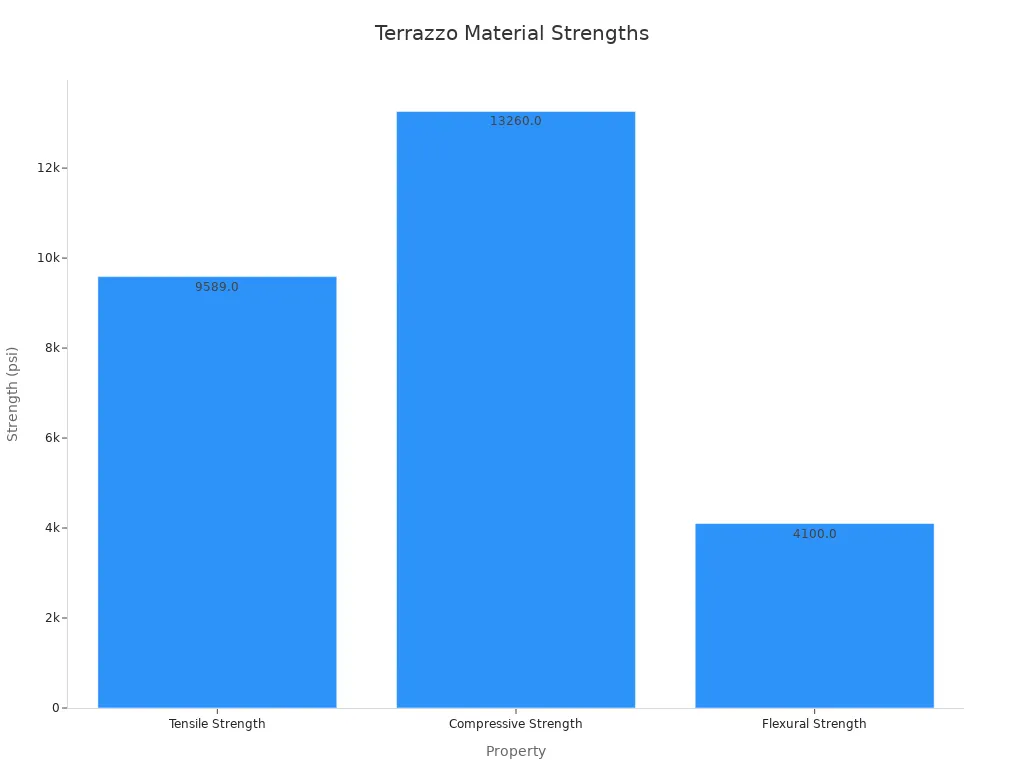
TERRAZZCO operates as a terrazzo flooring supplier and manufacturer. The company offers custom terrazzo designs and materials from a single-source supplier, which simplifies procurement for design teams. Its epoxy resin system publishes clear strength figures, shown below as reported on terrazzco.com.
| Property | Value |
|---|---|
| Tensile Strength | 9,589 psi |
| Compressive Strength | 13,260 psi |
| Flexural Strength | 4,100 psi |
Application fit covers universities, hospitals, airports, office lobbies, and other commercial properties. Installers can pour the material in place or set it with precast units. TERRAZZCO notes that epoxy terrazzo suits indoor commercial, industrial, and institutional facilities, and that outdoor work calls for cement terrazzo instead. The company also states that terrazzo can prevent slips and falls in high traffic settings. Installation demands a specialized skill set, so TERRAZZCO recommends a qualified and experienced contractor.
Compliance and Cost
Compliance documentation is strong. TERRAZZCO Brand Products holds GREENGUARD certification as of September 2018, and the company publishes a Health Product Declaration for its EZPour Epoxy 158. Thin-set epoxy terrazzo uses zero VOC materials, and the finished floor is odorless and bacteria-resistant. Recycled glass and marble chips support LEED credits, including Recycled Content and Regional Materials within a 500-mile radius.
Cost positioning is competitive. TERRAZZCO reports installed terrazzo flooring estimates of $20 to $100 or more per square foot, with standard poured-in-place commercial work budgeted at $30 to $65 per square foot. Large projects can reach $20 to $35 per square foot, and custom logos or divider patterns add roughly 25 to 50 percent. Over a 40-year lifecycle, terrazzo runs about $1.50 to $2.50 per square foot per year. Buyers should confirm authentic terrazzo rather than terrazzo-look porcelain, since the two differ in installation and lifespan.
4. Master Terrazzo Technologies
Performance and Fit
Master Terrazzo Technologies brings more than 55 years of experience to the market. The company has supplied materials for millions of feet of terrazzo installations worldwide. That track record gives specifiers a long reference base for evaluating mix designs and system performance.
The company’s technical profile centers on durable terrazzo systems for demanding floors. Its materials target wear resistance and long service life in high-traffic environments. Design teams can specify aggregate blends and color schemes to match project drawings. Application fit spans commercial, institutional, and public building interiors, where poured-in-place systems suit large floor plates and continuous layouts. Renovation work also fits the portfolio, since matching existing floors demands careful material selection. Buyers should confirm that a quoted system is authentic terrazzo rather than terrazzo-look porcelain, because the two differ in installation method and expected lifespan.
Compliance and Cost
Compliance review should start with current test reports. Specifiers can check abrasion resistance, slip resistance, and fire performance against the standards cited in the project manual. Conformance with NTMA guidance gives buyers a common benchmark for comparing submittals across suppliers. Project teams should request documentation for the specific system quoted, not a generic product sheet.
Cost positioning sits in the mid-to-upper range for US terrazzo manufacturers. The company competes on system completeness and decades of installation history rather than on the lowest unit price. Buyers who value a proven material source often accept the premium. Budget-focused teams should request line-item pricing early and compare full installed cost across bidders. A lifecycle view also helps, since durable terrazzo products reduce replacement spending over time.
5. Concrete Collaborative
Performance and Fit
Concrete Collaborative ranks among the original companies of today’s terrazzo revival. The firm sells terrazzo tile and slab and operates showrooms in several cities, which lets designers inspect full-size samples before specification. Its catalog extends well past flooring. Concrete Collaborative lists floor and wall tiles, exterior pavers and pool copings, countertops and vanities, stair-treads, patterned encaustic cement tiles, breeze-blocks, and tabletops and basins. The range suits large-scale commercial landscape projects, backyard renovations, and everything in between. Products pair together to flow seamlessly from inside to out.
The company’s design guidance, published by Sunset, reads as a practical method for using its terrazzo products:
- Start with one strong move, such as a Pacifica quietude large pomelo mix terrazzo counter slab, and let it anchor the space.
- Stick to a grounding palette, building the design around one core hue and repeating it across surfaces.
- Layer in warmth with wood, woven textures, and planting.
- Play with pattern in one or two key areas, then pull back with solids.
- Use color with confidence, since a single bold tile moment can transform a space.
- Blur the lines by carrying materials from indoors to out.
- Keep the material palette edited and the ideas few.
That guidance points to residential, hospitality, and landscape work more than to heavy institutional floors.
Compliance and Cost
Compliance review should confirm that a quoted product is authentic terrazzo rather than terrazzo-look porcelain, because the two differ in installation method and expected lifespan. Specifiers should request current test reports for abrasion resistance, slip resistance, and fire performance against the standards cited in the project manual, and check conformance with NTMA guidance as a common benchmark. Exterior applications such as pavers and pool copings deserve particular attention to freeze-thaw and moisture documentation.
Cost positioning sits in the design-led, mid-to-upper band. Buyers pay for curated colorways, showroom access, and indoor-outdoor continuity rather than for the lowest unit price. Project teams should compare full installed cost across bidders and request line-item pricing early.
6. Wausau Tile
Performance and Fit
Wausau Tile is a long-established US producer of terrazzo tile and precast architectural products. The company manufactures its terrazzo tile in precast form, which gives specifiers consistent thickness and factory-controlled curing. Precast production also speeds installation, since crews set finished units rather than pour and cure a floor on site.
The product range covers interior floors, exterior paving, and architectural precast elements. Terrazzo tile suits high-traffic commercial interiors, institutional corridors, and public buildings. Exterior applications call for freeze-thaw documentation and slip resistance data. Design teams can select aggregate blends and color schemes to match project drawings. Buyers should confirm that a quoted product is authentic terrazzo rather than terrazzo-look porcelain, because the two differ in installation method and expected service life.
Compliance and Cost
Compliance review should start with current test reports. Specifiers can check abrasion resistance, slip resistance, and fire performance against the standards cited in the project manual. Conformance with NTMA guidance gives buyers a common benchmark for comparing submittals across suppliers. Project teams should request documentation for the specific product quoted, not a generic catalog sheet.
Cost positioning sits in the mid-range for US terrazzo manufacturers. Precast tile often reduces on-site labor compared with poured-in-place systems, and that saving can offset a higher material price. Buyers should compare full installed cost across bidders and request line-item pricing early. A lifecycle view also helps, since durable terrazzo products reduce replacement spending over time.
7. EnviroGLAS
Performance and Fit
EnviroGLAS is a US terrazzo producer known for recycled-glass aggregate terrazzo materials. The company builds its product identity around reclaimed glass chips set in a resin matrix, which gives designers a visible sustainability story alongside the surface finish. The University of Maryland facilities specification lists Enviroglas, LLC as an approved manufacturer of resilient terrazzo floor tile, with marble or granite chips embedded in a flexible, thermoset polyester-resin matrix at 1/8 inch (3.0 mm) thickness.
Published performance data covers the core mechanical properties, shown below as reported in that specification.
| Performance Characteristic | Value | Test Standard |
|---|---|---|
| Compressive Strength | 2900 to 5000 psi (20 to 34.5 MPa) | ASTM C 109/C 109M or ASTM D 695 |
| Abrasion Resistance | Maximum 0.0196 cubic centimeters volume loss, Taber abrader, S-39 wheels, at 500 cycles with 1000-gram load | ASTM F 510 |
| Static Load Limit | 0.0007-inch (0.0177-mm) maximum indentation at 125 lb (57 kg) | ASTM F 970 |
| Resin Matrix Hardness | Not less than 78, Shore Type D durometer | ASTM D 2240 |
The specification provides no flexural strength or slip resistance figures. Specifiers should request those values directly for projects that cite them. Application fit leans toward interior commercial and institutional floors where recycled content supports project goals. The thin resilient tile profile suits renovation work over sound substrates. Buyers should confirm that a quoted product is authentic terrazzo rather than terrazzo-look porcelain, since the two differ in matrix, thickness, and installation method.
Compliance and Cost
Compliance review should start with current test reports for the specific product quoted. Specifiers can check abrasion resistance, static load, and hardness against the ASTM standards named above, and compare submittals against NTMA guidance as a common benchmark. Recycled-glass content supports green building documentation, and project teams should request the recycled-content figures in writing.
Cost positioning sits in the mid-range for US terrazzo manufacturers. The thin tile format can reduce material volume and on-site labor compared with poured-in-place systems. Buyers should compare full installed cost across bidders and weigh the recycled-content value against project budget priorities.
8. National Terrazzo LLC
Performance and Fit
National Terrazzo LLC is a US terrazzo materials manufacturer serving commercial flooring projects. The company supplies mixes and systems for poured-in-place installations, and its materials target the wear resistance and long service life that busy commercial floors demand. Specifiers can select aggregate blends and color schemes to match project drawings, which keeps design intent intact across large floor plates.
Application fit centers on commercial interiors such as offices, retail spaces, and public buildings. Continuous layouts suit the poured-in-place method, and renovation work also fits the portfolio when crews need to match existing floors. Buyers should confirm that a quoted system is authentic terrazzo rather than terrazzo-look porcelain, because the two differ in matrix, thickness, and installation method. A qualified contractor remains essential, since proper mixing and curing decide how the finished floor performs over time.
Compliance and Cost
Compliance review should begin with current test reports for the specific system quoted. Specifiers can check abrasion resistance, slip resistance, and fire performance against the standards named in the project manual. Conformance with NTMA guidance gives buyers a common benchmark for comparing submittals across suppliers, and project teams should request documentation for the exact product rather than a generic catalog sheet.
Cost positioning sits in the mid-range for US terrazzo manufacturers. The company competes on system completeness and dependable supply rather than on the lowest unit price. Buyers should request line-item pricing early and compare full installed cost across bidders, not material cost alone. A lifecycle view also helps, since durable terrazzo floors reduce replacement spending over the life of a building.
9. RBC Terrazzo
Performance and Fit
RBC Terrazzo is a US manufacturer of terrazzo flooring materials and systems. The company supplies mixes and components for poured-in-place installations, and its materials target the wear resistance and long service life that busy commercial floors demand. Specifiers can select aggregate blends and color schemes to match project drawings, which keeps design intent consistent across large floor plates.
Application fit centers on commercial interiors such as offices, retail spaces, and public buildings. Continuous layouts suit the poured-in-place method, and renovation work also fits the portfolio when crews need to match existing floors. Buyers should confirm that a quoted system is authentic terrazzo rather than terrazzo-look porcelain, because the two differ in matrix, thickness, and installation method. A qualified contractor remains essential, since proper mixing and curing decide how the finished floor performs over time.
Compliance and Cost
Compliance review should begin with current test reports for the specific system quoted. Specifiers can check abrasion resistance, slip resistance, and fire performance against the standards named in the project manual. Conformance with NTMA guidance gives buyers a common benchmark for comparing submittals across suppliers. Project teams should request documentation for the exact product rather than a generic catalog sheet.
Cost positioning sits in the mid-range for US terrazzo manufacturers. The company competes on system completeness and dependable supply rather than on the lowest unit price. Buyers should request line-item pricing early and compare full installed cost across bidders, not material cost alone. A lifecycle view also helps, since durable terrazzo systems reduce replacement spending over the life of a building. Teams that weigh upfront price against decades of service often find the mid-range position reasonable for commercial work.
10. Klein’s Terrazzo
Performance and Fit
Klein’s Terrazzo is a US terrazzo materials producer with a long history in architectural flooring. Decades of work in the trade give the company a deep reference base for mix design and system performance. Specifiers can draw on that experience when they need a material source with a proven record on architectural floors.
The company’s materials target wear resistance and long service life in busy interiors. Design teams can specify aggregate blends and color schemes to match project drawings, which keeps design intent consistent across large floor plates. Application fit centers on commercial and institutional interiors such as offices, schools, and public buildings. Continuous layouts suit poured-in-place work, and renovation projects fit the portfolio when crews need to match existing floors. Buyers should confirm that a quoted system is authentic terrazzo rather than terrazzo-look porcelain, because the two differ in matrix, thickness, and installation method. A qualified contractor remains essential, since proper mixing and curing decide how the finished floor performs over time.
Compliance and Cost
Compliance review should begin with current test reports for the specific system quoted. Specifiers can check abrasion resistance, slip resistance, and fire performance against the standards named in the project manual. Conformance with NTMA guidance gives buyers a common benchmark for comparing submittals across suppliers. Project teams should request documentation for the exact product rather than a generic catalog sheet.
Cost positioning sits in the mid-range for US terrazzo manufacturers. The company competes on system completeness and a long architectural track record rather than on the lowest unit price. Buyers should request line-item pricing early and compare full installed cost across bidders, not material cost alone. A lifecycle view also helps, since durable terrazzo floors reduce replacement spending over the life of a building. Teams that weigh upfront price against decades of service often find the mid-range position reasonable for commercial and institutional work.
Largest North America Terrazzo Market Companies by Revenue
Reading Revenue Rankings
Revenue figures offer a practical lens for comparing terrazzo suppliers. A manufacturer with higher revenue typically carries more production capacity, larger inventory, and wider distribution reach. Those resources matter on projects with tight schedules and large floor plates. A buyer who needs thousands of square feet delivered across multiple sites should confirm that a supplier can scale production without delaying the job.
RevenueBase identified 444 US terrazzo company matches as of September 2026. That figure frames the size of the market and shows how many suppliers compete for specification work. Revenue rankings help buyers sort this field, yet they describe business size rather than product quality. A high-revenue firm may serve national accounts, while a smaller firm may focus on custom mixes. Neither position is inherently better.
Scale vs. Specialization
Scale and specialization serve different project needs. Large companies often win work on volume, standardized systems, and broad dealer networks. They suit multi-state commercial rollouts and institutional programs that demand consistent material across many locations. Buyers should ask how much of a supplier’s total market share comes from terrazzo versus other product lines, since that mix affects focus and support depth.
Specialized manufacturers compete on customization and technical attention. They may produce authentic terrazzo in small batches, match historic floors, or develop unique aggregate blends. Some also supply terrazzo-look porcelain, a different product with its own installation method and performance profile. Buyers should verify which material a quote covers before comparing prices. Revenue rankings in the United States market reward volume, yet project fit often depends on service, lead time, and design flexibility. A balanced shortlist pairs at least one large supplier with one specialist.
North America Terrazzo Market: Comparison Table
Key Attributes Compared
The table below compares all ten manufacturers across the four selection criteria. Ratings describe positioning, not absolute quality. A “premium” cost rating means a higher unit price, and a “broad” fit rating means the supplier serves many project types.
| Manufacturer | Technical Performance | Application Fit | Regulatory Compliance | Cost Positioning |
|---|---|---|---|---|
| G·ONE | High strength, wear resistance, weatherability; ASTM E84 flame spread 15 | Hotel lobbies, luxury retail, facades, landmarks | ASTM E84, E-648, E-622, C241, ANSI A326.3 data published | Premium |
| Terrazzo & Marble Supply | Proven cement and epoxy systems | Large commercial, institutional, restoration | NTMA-aligned submittals | Mid-to-upper |
| TERRAZZCO | Tensile 9,589 psi; compressive 13,260 psi; flexural 4,100 psi | Universities, hospitals, airports, offices | GREENGUARD, Health Product Declaration, zero VOC | Competitive; $30–$65 per sq ft installed |
| Master Terrazzo Technologies | Durable systems, 55+ years of installations | Commercial, institutional, public interiors | NTMA-aligned submittals | Mid-to-upper |
| Concrete Collaborative | Tile and slab, indoor-outdoor continuity | Residential, hospitality, landscape | NTMA-aligned submittals | Mid-to-upper |
| Wausau Tile | Precast tile, factory-controlled curing | Commercial interiors, exterior paving | NTMA-aligned submittals | Mid-range |
| EnviroGLAS | Compressive 2,900–5,000 psi; Taber abrasion ASTM F 510 | Interior commercial, renovation | ASTM C 109, F 510, F 970, D 2240 | Mid-range |
| National Terrazzo LLC | Wear-resistant poured-in-place systems | Offices, retail, public buildings | NTMA-aligned submittals | Mid-range |
| RBC Terrazzo | Wear-resistant poured-in-place systems | Offices, retail, public buildings | NTMA-aligned submittals | Mid-range |
| Klein’s Terrazzo | Long architectural track record | Commercial, institutional, renovation | NTMA-aligned submittals | Mid-range |
How to Read the Table
Readers should weight the columns by project type. Commercial work favors technical performance and compliance first, because high traffic and code review punish weak submittals. Residential and hospitality work leans on application fit, where colorways and indoor-outdoor continuity matter more than raw strength. Institutional projects weigh compliance heavily, since public bidding demands documented conformance.
The NTMA standards give buyers a common benchmark for every row. Specifiers should confirm that a quote covers authentic terrazzo rather than terrazzo-look porcelain, because the two differ in matrix, thickness, and installation method. The north america terrazzo market comparison table also shows cost spread: premium and mid-range positions both suit the north america terrazzo market, and the north america terrazzo market rewards matching price to project lifespan. Buyers comparing the north america terrazzo market should shortlist two or three rows, then request samples. The north america terrazzo market includes suppliers across many states, and the north america terrazzo market continues to expand. Companies serving the united states market appear in every cost band. The north america terrazzo market table above summarizes the north america terrazzo market in one view, and the north america terrazzo market gives buyers a clear starting point.
Terrazzo Floor Tiles in Orange County and Beyond
Matching Projects to Manufacturers
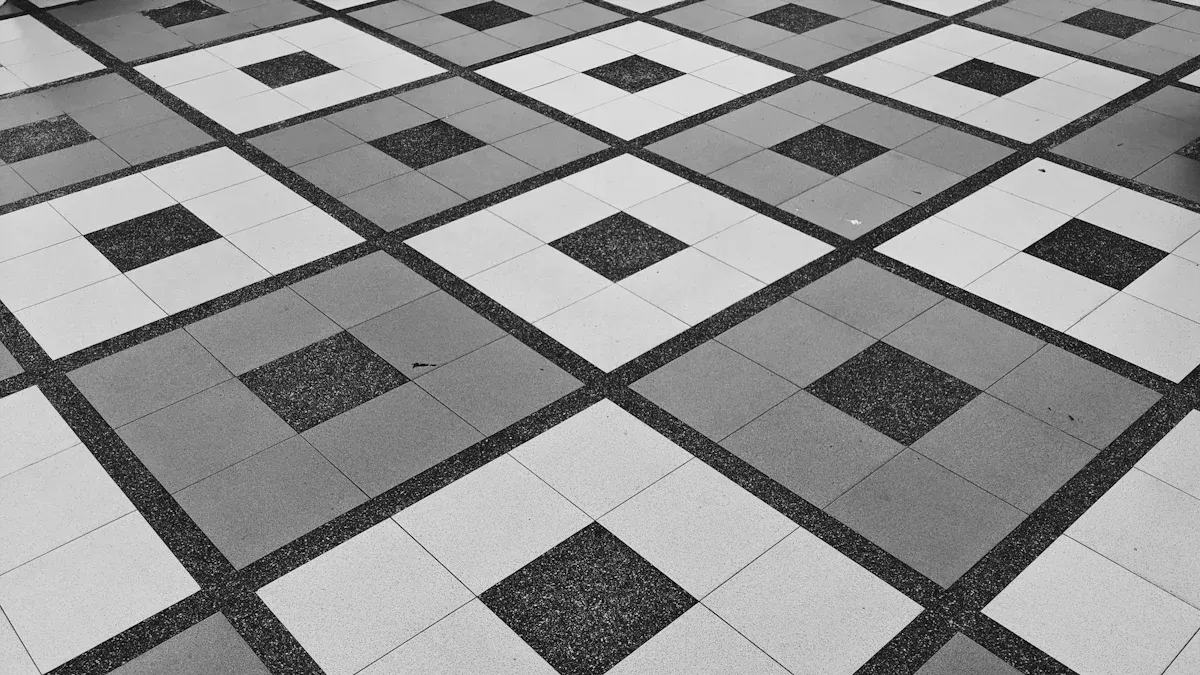
Regional demand shapes application fit. Coastal Southern California markets such as Orange County pair high-traffic hospitality interiors with outdoor patios, pool decks, and retail entries. Buyers sourcing terrazzo floor tiles in Orange County often need slip resistance and moisture data alongside color matching. That mix favors suppliers with both poured-in-place systems and precast units.
Commercial and hospitality projects suit G·ONE, TERRAZZCO, and Master Terrazzo Technologies. Hotel lobbies and restaurants reward durable surfaces and custom aggregate blends. G·ONE also supplies large-format terrazzo tiles for facades and landmark work. Residential and landscape work fits Concrete Collaborative, whose showrooms let designers inspect slab and tile samples. Institutional buyers such as schools and hospitals lean toward Wausau Tile, National Terrazzo LLC, RBC Terrazzo, and Klein’s Terrazzo, where documented systems and long track records simplify public bidding.
Design teams should confirm authentic terrazzo vs. terrazzo-look porcelain tile before comparing quotes. The two differ in matrix, thickness, and installation method. A terrazzo-look porcelain tile can suit tight budgets, yet it carries a different performance profile. Buyers who need terrazzo floor tiles for wet areas should request slip test data for the exact product quoted.
Weighing Compliance and Cost
Compliance and cost pull in opposite directions on most projects. Public and institutional work weighs NTMA-aligned submittals and ASTM test reports first, since code review punishes weak documentation. Hospitality and residential work can accept a mid-range position when design flexibility matters more than raw strength. Premium suppliers justify higher unit prices through customization and lifespan, while mid-range suppliers compete on system completeness.
Buyers should compare full installed cost, not material price alone. Precast units can cut on-site labor, and poured-in-place systems suit continuous layouts. A lifecycle view helps, since durable floors reduce replacement spending. Teams finalizing a shortlist should request samples and technical data sheets from two or three manufacturers, then match each quote to the project profile.
Project type should drive how buyers weight the four criteria. Commercial work puts technical performance and compliance first. Residential and hospitality projects favor application fit and design flexibility. Institutional buyers weigh documented compliance most heavily, since public bidding demands it.
Readers should shortlist two or three manufacturers from the comparison table, then request samples and technical data sheets before deciding. Confirm each quote covers authentic terrazzo rather than terrazzo-look porcelain, because the two differ in matrix, thickness, and installation method.
G·ONE and the other nine manufacturers each fit different project profiles. The right choice depends on the reader’s priorities. Consult the comparison table and manufacturer sections when finalizing a terrazzo selection.
FAQ
How do buyers tell authentic terrazzo from terrazzo-look porcelain?
Authentic terrazzo uses a cement or resin matrix with embedded aggregate chips. Terrazzo-look porcelain is a printed ceramic tile. Buyers should request the product data sheet and confirm the matrix type. Water absorption figures also separate the two categories, since cement-based terrazzo absorbs far more moisture than porcelain.
Which standards should a specifier cite for compliance review?
Specifiers can reference ASTM E84 for flame spread, ASTM C241 for abrasion resistance, and ANSI A326.3 for slip resistance. NTMA guidance gives buyers a common benchmark across suppliers. Project teams should request test reports for the exact system quoted, not a generic catalog sheet.
How wide is the cost range across these manufacturers?
Cost positioning spans premium to mid-range. TERRAZZCO reports installed commercial work at roughly $30 to $65 per square foot. Precast units can reduce on-site labor, and poured-in-place systems suit continuous layouts. Buyers should compare full installed cost rather than material price alone.
What should a buyer request before finalizing a terrazzo supplier?
Buyers should shortlist two or three manufacturers, then request samples and technical data sheets. Confirm the quote covers authentic terrazzo and matches the project profile. Early coordination clarifies customization feasibility, lead times, and delivery requirements before procurement begins.