
Terrazzo concrete is a composite of marble, granite, quartz, or glass aggregate set in a cementitious or epoxy binder, then ground and polished to a seamless finish. This ultimate guide to terrazzo serves as a practical specification guide for architects and designers who must justify every material decision on the record. You will find each option compared neutrally, so you can match a system to your project conditions instead of defaulting to habit. A sound terrazzo specification ties binder, performance, and installation choices to real site constraints. G·ONE supplies samples and specification support to help you confirm fit before you commit.
Key Takeaways
- Choose the binder first: epoxy for fast indoor projects, cementitious for exterior or high-moisture areas.
- Terrazzo lasts over 40 years and offers lifecycle savings despite higher initial costs.
- Design flexibility allows custom colors, aggregates, and logos to match branding.
- Proper maintenance—daily cleaning and annual resealing—keeps terrazzo looking new.
- Engage manufacturers early for samples and specification support to avoid rework.
Specifying Terrazzo Concrete
What Defines Terrazzo
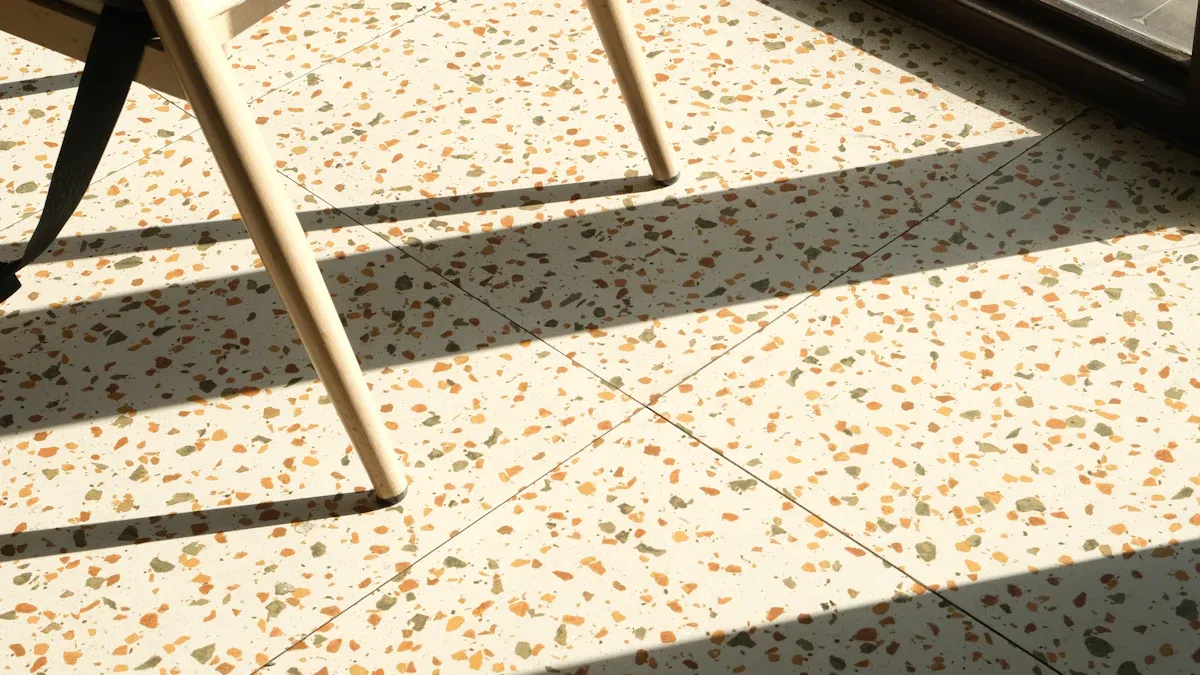
Terrazzo concrete is a composite material. You combine aggregates such as marble, granite, quartz, or glass with a binder matrix. The binder is either cementitious or epoxy. Workers pour or place the mix, then grind and polish the cured surface. The result is a seamless, impermeable surface with no joints for dirt to collect.
This composition gives you a material with real range. Aggregate size, color, and density all change the final look. The matrix color sets the background tone. A terrazzo floor can read as quiet and uniform or as bold and expressive. The surface stays smooth and closed, so moisture and stains stay at the top where you can clean them.
Why Specifiers Choose It
Architects specify terrazzo for four practical reasons. First, design flexibility: you control aggregate blend, matrix color, and divider layout. Second, compressive strength: a cured terrazzo system carries heavy loads in high-traffic areas. Third, abrasion resistance: the polished surface resists wear from foot traffic and equipment. Fourth, long-term appearance retention: the color runs through the full depth, so the surface keeps its look as it ages.
Designers also value the seamless finish. A terrazzo floor has few joints, so it reads as one continuous plane. That quality suits lobbies, corridors, and retail spaces where visual calm matters. The same properties support a durable terrazzo specification for demanding projects. You can document each choice against project conditions, and that record makes the material decision easy to defend. Terrazzo systems reward early planning, because binder, aggregate, and installation method all interact. Treat the terrazzo specification as a single coordinated document, not a list of separate parts.
Binder Choice: Epoxy vs. Cementitious
The first fork in any terrazzo specification is the binder. You choose among cementitious, epoxy, or a combination of both. This decision shapes thickness, schedule, substrate prep, and moisture strategy. Both binders host the same aggregate palette, so the visual result need not change. Let project conditions, schedule, and substrate drive the choice.
Epoxy Matrix Fit
An epoxy resin binder suits indoor work with tight timelines. The material cures by accelerated chemical reaction, so an epoxy terrazzo system delivers the quickest pour-to-grind window. Thin-set epoxy terrazzo floors run 3/8″ or 1/4″ thick and weigh 3-4 lbs per square foot, per Terrazzco. That low weight fits multi-story buildings and elevator cabs. The epoxy terrazzo system also bonds well with specialty aggregates such as glass, metal, and shells.
Moisture control is the critical step. Test every slab before you place epoxy terrazzo, following ASTM-F-2170 probe readings of 3 pounds per 1,000 square feet per 24 hours, as Doyle Dickerson Terrazzo advises. The common threshold is 75% to 80% relative humidity. Where the probe test is not possible, an ASTM-F-1960 calcium chloride test is acceptable. The system is not breathable, so a moisture mitigation barrier may be required. Epoxy terrazzo is not recommended for exterior use.
Cementitious Matrix Fit
Cement terrazzo remains the traditional choice for exterior exposure and restoration work. Cement terrazzo thickness ranges from 1/2″ to 3″ depending on the system, per Terrazzco. It suits slabs without an active vapor barrier beneath them. Cementitious terrazzo also handles high-moisture and below-grade conditions without a mitigation layer.
Installation method drives the depth. A sand cushion system runs 2.5″ to 3″ thick over an isolation sheet and sand layer, with divider strips roughly 4 feet on center, per Terrazzco. A bonded system runs about 1 3/4″ to 2 1/4″ thick and helps where slab flatness is less than ideal. A monolithic system runs about 1/2″ thick and depends heavily on slab quality and joint placement.
The differences between cementitious and epoxy terrazzo extend to strength and design range. Terrazzco reports epoxy compressive strength of 13,260 psi against roughly 4,000 psi for cement terrazzo. The chart below, published by Terrazzco, compares compressive, tensile, and flexural strength across both binders.
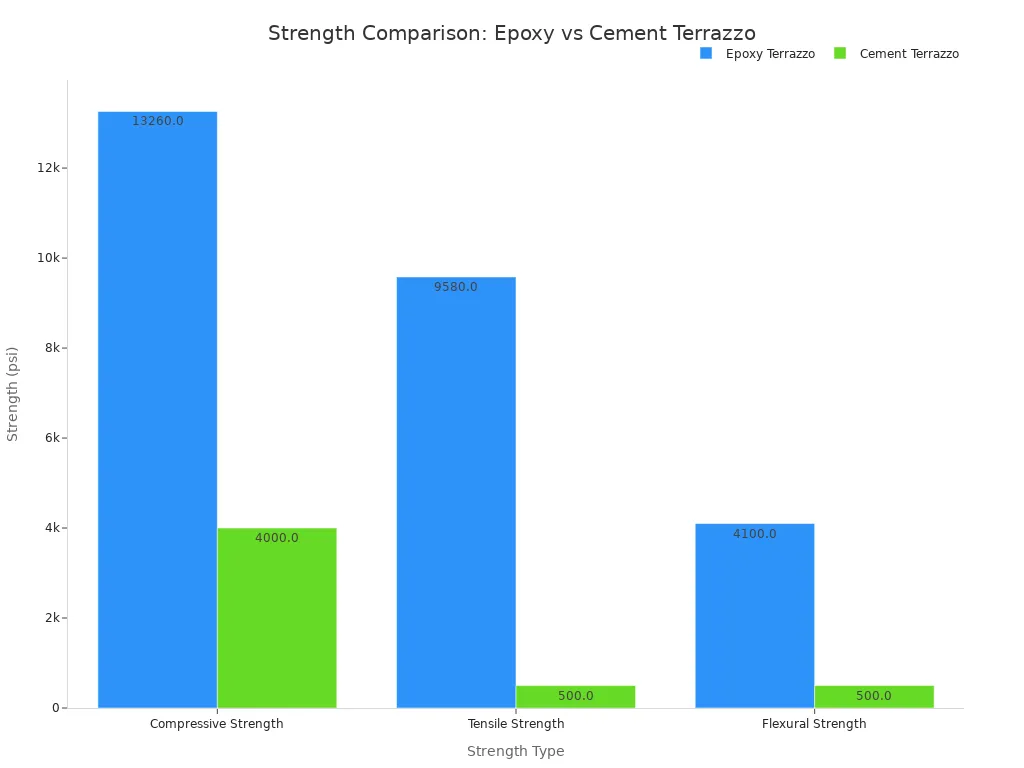
Cement terrazzo limits strip geometry to squares and rectangles at smaller spacing, while epoxy allows unlimited shapes at wider spacing. Both types of terrazzo systems last 40+ years, per Terrazzco. Match the binder to the site, and the terrazzo concrete will perform as specified.
The Ultimate Guide to Terrazzo Performance
Durability and Maintenance
Performance starts with measurable criteria. You evaluate compressive strength, abrasion resistance, slip resistance, and impermeability against recognized test methods. Reference ASTM and ANSI standards in your terrazzo specification so contractors can verify each property. A dense, polished surface resists wear and limits moisture penetration. Slip resistance depends on the finish and the sealer you approve, so confirm the coefficient of friction for your application.
Maintenance and care follow a predictable rhythm. The SECOIN terrazzo floor maintenance guide sets out this regime:
- After installation, strip the construction sealer, then apply two coats of water-based base sealer and at least two coats of sealer polish.
- Daily, sweep or vacuum the floor and treat scuffs with neutral cleaner diluted in warm water.
- Weekly, damp mop light soil and machine scrub heavy soil, then rinse and buff.
- Monthly, apply a top coat of sealer and buff with a white pad no sooner than 24 hours later.
- Annually, strip all polish and sealer and reapply.
The NTMA Terrazzo Maintenance Guide adds daily dust mopping and prompt spill removal. Use pH-neutral products on marble-bearing terrazzo, and avoid vinegar or acidic descalers. Change dirty mop water so grit leaves the surface instead of spreading. Impregnating sealers improve stain resistance, yet no sealer makes stone stain-proof. Follow the sealer supplier’s renewal instructions rather than a fixed interval.
Sustainability and Terrazzo
Sustainability and terrazzo align well. Terrazzo systems accept post-consumer glass, post-industrial marble and granite chips, recycled porcelain, and recycled concrete, per Terrazzco. Plastic chips can contain as much as 20% recycled plastic material. A floor built with 100% recycled glass aggregates may hold as much as 75% recycled raw material by volume. Doyle Dickerson Terrazzo notes that local sourcing lowers transport emissions, and epoxy terrazzo contains zero volatile organic compounds with little to no off-gassing.
Both cementitious terrazzo and epoxy terrazzo use zero-VOC materials, per ProTerrazzo Systems. Binders make up roughly 25% to 30% of floor volume, with aggregates, pigments, and fillers filling the rest. On-site manufacturing cuts commercial waste and freight. Green building programs reward these choices: Terrazzco reports LEED points for materials distributed within 500 miles of a project site. EU standards and certification programs likewise credit recycled content and low emissions. G·ONE recycled terrazzo and inorganic materials offer one example among many options. This unique blend of durability, aesthetics, and sustainability makes terrazzo concrete a defensible specification choice.
Applications of Terrazzo by Project Type
Commercial and Retail Spaces
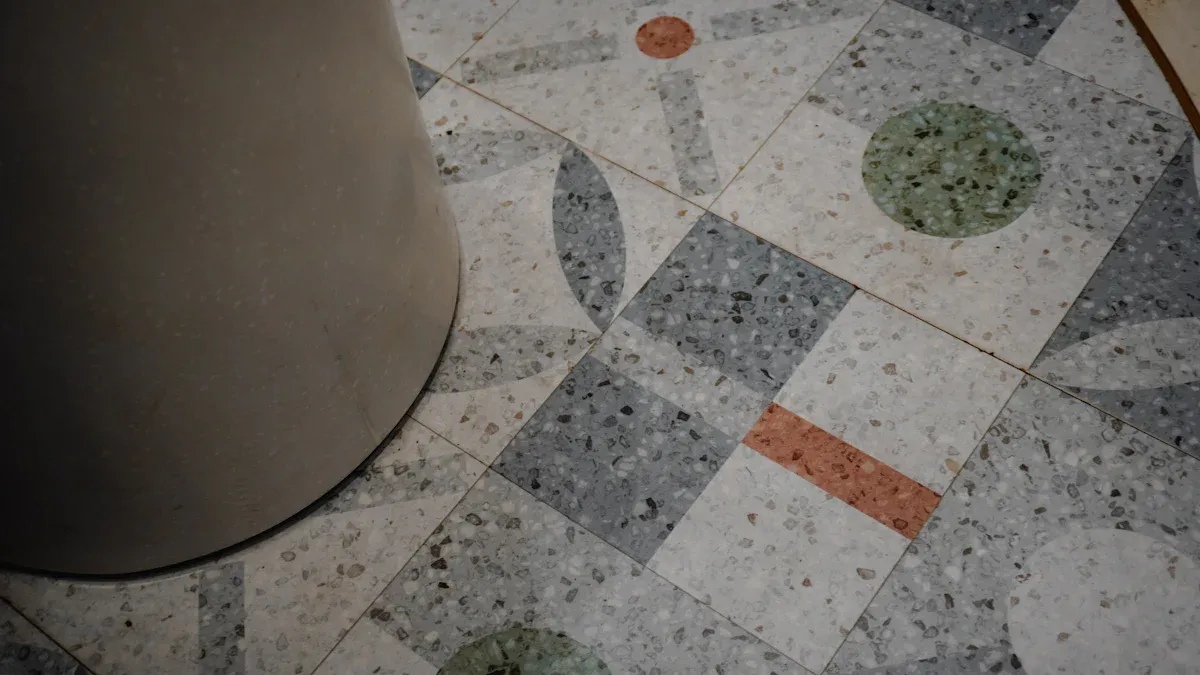
Hotel lobbies, luxury retail, healthcare, education, transit, and residential projects all use terrazzo, yet each building type stresses the material differently. Doyle Dickerson Terrazzo reports that floors and stairs remain the most popular use, and the same source notes that terrazzo walls and countertops suit shower rooms, backsplashes, and commercial kitchens that demand high sanitation. Andreola Terrazzo lists hospitals, schools, hotels, retail stores, government buildings, and convention centers among the spaces where terrazzo excels. A terrazzo floor lasts 40+ years, per Andreola Terrazzo, so the surface outlives several cycles of other flooring.
Retail design adds branding to the list. iTerrazzo describes custom logos, directional icons, and thematic borders embedded directly into entryway flooring, where they resist fading better than vinyl or decals. Color-blocking separates checkout, lounge, and service zones. A non-porous surface cleans with sweeping and mopping, which suits grocery stores, pharmacies, and medical offices. Dongxing Group advises epoxy terrazzo for interior retail, office, and hotel work where design flexibility and fast installation matter. Specify cementitious terrazzo or inorganic terrazzo where sunlight, moisture, or exterior exposure enters the program.
Facades and Public Landmarks
Exterior work moves terrazzo beyond the floor plane. Coverings Etc notes that terrazzo can clad walls and harmonize with facades inside and out. The National Terrazzo and Mosaic Association describes transportation terminals as a natural fit, where divider strips and inset metal art direct passengers and grout-free surfaces handle luggage carts quietly. The same association reports vertical applications such as curbs, bases, plinths, stair treads, benches, and even ceilings. Public art projects also use terrazzo for free-form floors, walls, and sculptures.
Weather resistance and structural strength decide the panel system. Boyang Urban explains that a dense, fiber-reinforced UHPC matrix resists freeze-thaw cycling, UV exposure, and moisture migration, and that fiber reinforcement gives panels genuine flexural strength. That strength lets a facade panel cast thinner, span longer, and resist wind load without the cracking conventional terrazzo develops outdoors. G·ONE UHPC panels and terrazzo stand as suitable options for these conditions. Confirm fixing details and panel thickness with your fabricator before you finalize the facade specification.
Design Flexibility and Customization
Aggregates, Color, and Dividers
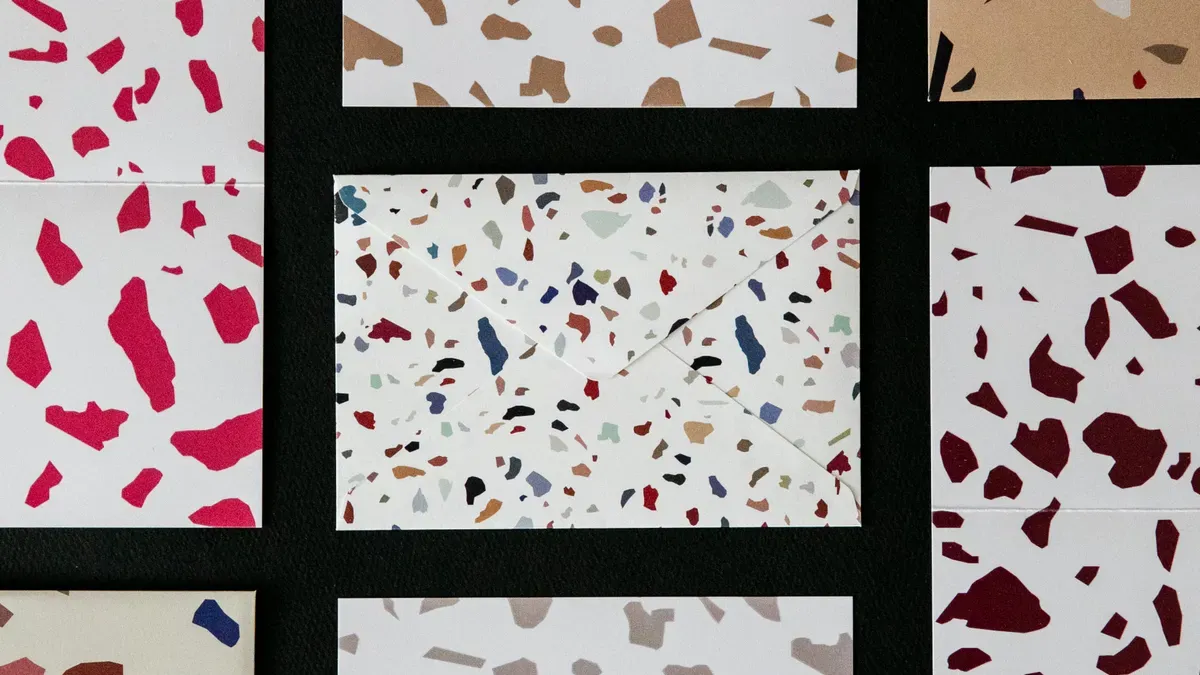
Aggregate selection gives you the first design lever. Terrazzco lists marble, granite, glass, porcelain, shell, plastic, metal, and pebble chips as options, with marble, glass, and shell chips the most common in modern work. Marble chips come in many tints, shades, and tones, and glass chips add vibrant color. Size matters too. Terrazzco grades aggregates from size 0 to size 8. Standard sizes 0, 1, and 2 suit a 3/8″ epoxy terrazzo floor. Venetian terrazzo uses sizes 3 through 8, and the thicker build carries a premium cost. You can blend sizes freely, such as 50% Georgia White at size 1 with 50% at size 2.
Color comes from two sources. Terrazzco explains that the resin forms the base color and the aggregates set the character, with ratios adding up to 100%. Change the resin alone and the same blend reads as a new scheme. Designers typically lock colors before production, so approve physical samples under project lighting. Master Terrazzo Technologies cautions against clear or light glass as most of the aggregate in a dark matrix, because fracturing can produce a frosty look.
Master Terrazzo Technologies limits clear and light glass in dark matrices to a design minimum, since large sizes aggravate the effect.
Divider strips carry both form and function. Terrazzco notes that strips separate colors, with projects using 2 to 20+ colors poured between them. Strips also control cracking. The National Terrazzo and Mosaic Association requires alignment with all control joints and expansion joints. Epoxy terrazzo strips span 15-20 feet between joints, while cement terrazzo limits spacing to 4 feet.
Custom Graphics and Mosaics
Logos, mascots, and artwork move terrazzo design into brand territory. Waterjet cutting turns AutoCAD files into precise shapes, and Terrazzco reports that the process cuts metal inlays, bronze castings, and terrazzo itself. Prefabricated logo services label each piece so installers assemble the artwork quickly. Epoxy terrazzo also pours without strips for seamless free-form patterning.
Project examples show the range. The Jacksonville International Airport terminal expansion embedded over 100 sea fossil themed glass mosaics in a 225,000 square foot terrazzo floor, per TM Supply. A central medallion there used tone-on-tone resin changes with a fixed aggregate mix. G·ONE mosaic terrazzo, custom colors, aggregate blends, and molds support this work, and its digital catalogs and design lookbooks serve as specification resources.
Installation Methods and Coordination
Poured-in-Place vs. Precast
Site conditions, substrate readiness, and schedule decide the method before design begins. Craftsman Concrete Floors notes that system selection depends on the project specification, substrate and moisture conditions, exposure, design intent, intended use, and the maintenance plan. Review those variables together, so selection starts with project conditions instead of a preferred product.
The table below compares the two paths, drawing on TERRAZZCO guidance.
| Aspect | Poured-in-place | Precast tile |
|---|---|---|
| Lead times | Materials about 2 to 4 weeks in peak season | Stocked tile may ship next day; custom tile takes several weeks |
| Installer qualifications | NTMA recommends a certified terrazzo installation company | Any tile installation company can place prefabricated material |
| Installation duration | A crew can turn over 2,500-3,000 square feet in about 10 days | Quicker and easier installation |
Poured-in-place work suits large commercial flooring where a certified crew is available. Precast suits tight sites and trades without terrazzo skills. A thin-set epoxy terrazzo system demands mixing, troweling, grinding, and polishing skills. Cement terrazzo and epoxy terrazzo both reward an experienced hand. Cement terrazzo also builds thicker, so confirm slab height early. Epoxy terrazzo cures fast, so the crew must move quickly.
Lead Times and Site Planning
True terrazzo can take three to four months from approval to completion. TERRAZZCO reports that customized precast tile may take several weeks before production starts. Engage the manufacturer at schematic design. Early contact lets you approve the mix design and procure materials for the contractor. TERRAZZCO lists mix design validation, budget guidance, specification language, and sample development as benefits of early collaboration.
Plan drawings, quantities, and delivery dates together. Schedule the terrazzo installation after wet trades finish. G·ONE precast terrazzo and engineering support help you review project samples and fabrication details before you lock the terrazzo specification. Confirm the epoxy terrazzo installation window against other trades. A realistic schedule protects the flooring budget and the terrazzo surface.
Cost and Terrazzo Specification Planning
First Cost vs. Lifecycle Value
Five variables drive your first cost, per TERRAZZCO. Project size brings economies of scale. System type matters, since epoxy terrazzo installs faster and weighs less than cementitious terrazzo. Material selection rewards domestic sources and standard marble chips. Design complexity adds roughly 25-50% for logos and divider patterns. Location sets labor rates. Craftsman Concrete Floors puts a simple 1,000 sq. ft. project at $30+ per square foot and a simple 30,000 sq. ft. project at $18 per square foot. Substrate condition, site access, and premium aggregates such as mother-of-pearl at $80-$100 per 50 lb bag also shift the bid.
Lifecycle value reframes that number. The National Terrazzo and Mosaic Association reports a 40-year life cycle cost of $30 per square foot for terrazzo against $50 per square foot for VCT, with break-even near 12.5 years.
“While terrazzo’s installation costs and lead time can be higher than those of vinyl composition tile (VCT), the greater initial investment more than pays off over time,” the National Terrazzo and Mosaic Association states.
Flowcrete Asia notes total flooring cost can reach 35 times the initial installation price over a building’s life. Your terrazzo specification should weigh that horizon, not just the bid date.
Building the Specification
Assemble the document in a fixed order. State performance criteria first, then cite the ASTM and ANSI standards that verify them. Define scope clearly: substrate prep, mockups, protection, and closeout, as Andreola Terrazzo advises. Request physical samples so you can approve chip blends, matrix colors, and finishes under project lighting. TERRAZZCO offers free samples to the design community.
Mockups turn approval into a quality standard. The GSA terrazzo repair guidance requires test patches no larger than 6 inches by 6 inches, then mockup panels that become part of the work. Each worker prepares a mockup of every activity, and rejected mockups come out entirely. Apply the same discipline to new work. Coordinate submittals early, including product literature, safety data sheets, and care requirements. G·ONE digital catalogs and technical specifications serve as reference materials as you draft terrazzo specifications. A complete epoxy terrazzo specification and a complete cement terrazzo specification both name the binder, the aggregate blend, and the mockup standard. That structure keeps terrazzo systems comparable across bidders.
Your selection path runs in a fixed order. Start with the binder, then confirm terrazzo performance and compliance, then match applications, design, installation, and cost. Each step narrows the next.
A well-built terrazzo specification ties every choice to project conditions. Binder, aggregate, and method follow the site, the schedule, and the substrate. Habit alone cannot justify a material decision on the record. Document each choice, and the specification defends itself at bid time.
Take one practical step now. Request samples from G·ONE, or ask for a specification review. Compare the options against your drawings before you commit. A short review now saves rework later. Small actions, big impact.
FAQ
Which binder should you choose for an indoor project?
Epoxy suits indoor work with tight schedules and thin builds. Cementitious handles exterior exposure and high-moisture slabs. Both accept the same aggregate palette. Let substrate conditions and your timeline decide, then confirm moisture readings before you place the terrazzo.
How long does a terrazzo installation take?
True terrazzo can run three to four months from approval to completion. Custom precast tile may need several weeks before production starts. Engage the manufacturer at schematic design, and schedule the work after wet trades finish. Early coordination protects both your budget and your opening date.
Does terrazzo cost more than other flooring?
First cost runs higher than vinyl composition tile in many cases. Lifecycle value tells a different story. The National Terrazzo and Mosaic Association reports a 40-year cost of $30 per square foot against $50 for VCT, with break-even near 12.5 years. Weigh that horizon against the bid date.
What maintenance does a terrazzo floor need?
Sweep or vacuum daily, damp mop weekly, and buff with a white pad monthly. Strip and reseal annually. Use pH-neutral cleaners on marble-bearing terrazzo, and avoid acidic descalers. Prompt spill removal and clean mop water keep the surface looking new for decades.
Can you use terrazzo outdoors?
Yes, with the right system. Cementitious terrazzo suits exterior exposure and restoration work. For facades and public landmarks, a fiber-reinforced UHPC panel resists freeze-thaw cycling, UV exposure, and moisture migration. Confirm fixing details and panel thickness with your fabricator before you finalize the specification.