
You face a tough question when specifying terrazzo: how do you satisfy performance, aesthetics, and budget at the same time? Liquid terrazzo flooring delivers seamless installation and design flexibility. Yet correct selection depends on matching resin chemistry to your project conditions.
Early coordination with manufacturers and contractors during design development prevents costly specification errors. Brands like G·ONE provide technical support and samples to guide your decisions.
You need precise information to specify with confidence. The right partnership and the right data make all the difference.

Key Takeaways
- Match the resin to your project conditions. Epoxy works for dry interiors. Cementitious or polyacrylate suits wet or outdoor areas.
- Test for moisture before you specify. High moisture can ruin the floor. Use a moisture-blocking primer if needed.
- Liquid terrazzo is thin and light. It installs at 1/4 to 3/8 inch. This saves floor height and reduces structural load.
- Plan for sustainability and cost. Recycled content earns LEED credits. Terrazzo lasts 40+ years with low maintenance.
- Coordinate with manufacturers early. They provide samples and technical support. This prevents costly mistakes.
What Is Liquid Terrazzo Flooring
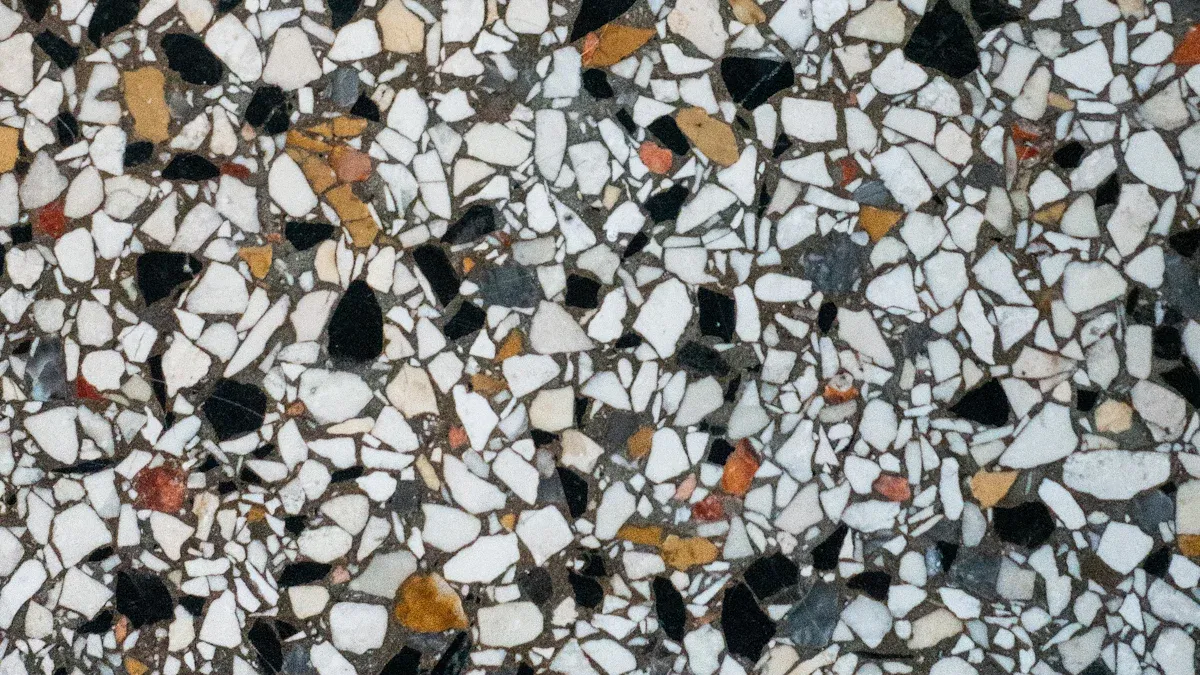
Liquid terrazzo flooring is a seamless, liquid-applied system. You mix a resin or cementitious binder with aggregates such as marble, granite, quartz, glass, or shell chips. The mixture pours in place, cures, and then you grind and polish it to reveal the aggregate pattern. This creates a continuous surface without joints or seams.
You can apply this material to floors, walls, and countertops. Architects and designers specify it for hotel lobbies, retail boutiques, and public landmarks. The poured application adapts to complex geometries and curved spaces. You achieve a monolithic look that tile or stone cannot match.
Composition and Binder Systems
The binder determines the system’s performance. Epoxy resins cure through a chemical reaction. Cementitious binders cure through hydration. Polyacrylate systems offer another option for specific moisture conditions. Each chemistry delivers different strength, flexibility, and moisture tolerance.
Aggregate selection drives the visual outcome. You choose chip size, color, and blend ratio. A fine marble chip creates a subtle texture. A large glass or shell chip produces a bold, reflective surface. The binder-to-aggregate ratio also affects durability and finish.
Advantages Over Traditional Terrazzo
Traditional cement terrazzo requires significant thickness. Sand cushion systems need 2.5 to 3 inches of depth. Bonded systems require 1.75 to 2.25 inches. Liquid epoxy systems install at just 3/8 inch or 1/4 inch. This thinner profile suits multi-story buildings where floor height matters.
Cure time separates these systems dramatically. Epoxy cures overnight. You can grind and polish the next day. Traditional cement terrazzo needs a longer duration to fully cure, which extends project timelines.
“At 3/8 or 1/4″ thickness, it’s ideal for multi-story buildings”
“Epoxy cures overnight, accelerating project completion”
You gain greater design freedom with the liquid system. The seamless surface eliminates divider strips unless you want them for aesthetic effect. Installation moves faster. The thinner profile reduces structural load. These factors make liquid terrazzo flooring a practical choice for tight schedules and weight-sensitive structures.
Decision Framework for Project Selection
You need a clear framework to match liquid terrazzo flooring to your project conditions. Three constraints drive every specification decision: project type, exposure conditions, and structural load. Use the matrix below to guide your early evaluation.
| Constraint | Key Question | Specification Impact |
|---|---|---|
| New construction | Is the substrate clean and cured? | Full system flexibility; standard primer |
| Renovation | Does the existing slab have cracks or contamination? | Requires assessment and repair before overlay |
| Interior | Is moisture vapor transmission controlled? | Standard moisture-blocking primer |
| Exterior | Does the system face UV and freeze-thaw cycles? | Requires weather-resistant binder chemistry |
| High load | Will forklifts or heavy traffic cross the surface? | Higher compressive strength and thicker build |
New Construction vs. Renovation
New construction gives you the advantage of a clean, controlled substrate. You specify the concrete mix, cure schedule, and surface profile from the start. This control simplifies primer selection and bonding.
Renovation projects demand a more rigorous approach. You must conduct a meticulous floor assessment to evaluate the substrate’s structural condition, levelness variations, existing crack patterns, and contamination issues. Perform moisture testing at the same time to identify dampness concerns that could compromise adhesion. Check for substrate movement and determine if specialized reinforcement measures are necessary.
Not every cracked or damaged slab is a candidate for resurfacing. Cleaning removes surface contamination but does not resolve structural movement or an unstable slab. An on-site evaluation is appropriate when movement, moisture, drainage, or unknown coatings raise concerns.
A concrete overlay is a thin, polymer-modified cementitious topping bonded over an existing sound slab. It ranges from a feather edge to about 5/8 inch. You should recommend this approach only where the slab is structurally sound and bondable.
Address deep cracks with epoxy injection repairs. Fill minor surface imperfections with appropriate patching compounds to establish a stable, level foundation. Based on substrate type, perform shotblasting, diamond grinding, or acid etching procedures. Follow with thorough cleaning to remove all dust, debris, and contaminants that would prevent proper bonding.
Interior, Exterior, and Load Requirements
Interior applications benefit from stable temperature and humidity. You still must verify moisture vapor transmission rates. Excessive moisture during primer application leads to primer delamination and coating failure. Select a moisture-blocking primer when testing reveals elevated vapor transmission. Apply an additional bonding coat to enhance adhesion between the primer and subsequent layers.
Exterior installations expose the system to UV radiation, freeze-thaw cycles, and thermal movement. You should design structural inset expansion plates between areas where major movement is anticipated. These plates absorb stress and prevent random cracking across the field.
Load capacity dictates your binder and aggregate choices. High-traffic commercial spaces need superior compressive strength and abrasion resistance. Warehouses and industrial floors require thicker build and tougher aggregate blends.
Moisture control and substrate compatibility are gating factors. No specification proceeds until you verify both. Ensure the entire substrate achieves complete dryness and cleanliness before primer application. Any moisture or contamination during this phase undermines the entire system.
Technical Performance Metrics
Strength, Chemical, and Abrasion Resistance
You need hard numbers to specify liquid terrazzo for commercial spaces. Compressive strength tells you how much load the floor carries before failure. Epoxy terrazzo systems reach 10,000 psi to 12,000 psi depending on the formulation and test method. These values come from ASTM D695 and ASTM C579. High-traffic areas demand this level of strength.
| Terrazzo System | Compressive Strength | Taber Abrasion Resistance |
|---|---|---|
| Sherwin-Williams Epoxy Terrazzo #1100 | 10,000 psi (ASTM D695) | 70–90 mg lost (ASTM 4060) |
| Epoxy Terrazzo System (Resinous Flooring spec) | 12,000 psi (ASTM C 579) | 90–100 mg lost (ASTM D 4060, CS-17 Wheel, 1,000 cycles) |
Abrasion resistance determines how well the surface handles foot traffic and abrasive soil. Lower mg loss means better wear resistance. ASTM C1027 assigns abrasion classes from 0 to 5. Class 4 and Class 5 suit heavy commercial entrances, workrooms, and exhibition halls. Specify Class 4 or higher for any space with abrasive dirt or constant foot traffic.
Chemical resistance matters for cleaning and spill exposure. ASTM C650-04 exposes samples to chemicals for 24 hours, then rates the surface as resistant or non-resistant. Terrazzo requires pH-neutral cleaning chemistry. Alkaline cleaners dull the surface. Acidic cleaners etch the aggregate and cause permanent pitting. Always verify cleaner compatibility with the specific binder and aggregate blend before you specify maintenance products.
Curing, VOC, and Slip Resistance
Curing time affects your project schedule directly. Epoxy systems cure overnight. You can grind and polish the next day. This speed gives you a major advantage on tight timelines. Cementitious systems need longer cure windows before you expose them to traffic.
VOC content drives indoor air quality compliance. Low-VOC and zero-VOC formulations help you meet green building requirements and protect occupant health. Check the manufacturer’s technical data sheet for exact VOC values.
Slip resistance protects building users and satisfies code. You measure it as the coefficient of friction, or COF. Higher COF values indicate better slip resistance. Specify flooring that meets the COF threshold your local code requires for the intended use. Wet areas and ramps need higher values than dry office floors. Always confirm the COF test method matches your jurisdiction’s acceptance criteria.
Comparing Liquid Terrazzo Flooring Systems
Three binder chemistries dominate the market. Each one changes your depth, moisture strategy, and performance ceiling. The table below summarizes the key differences.
| System | Thickness | Moisture Tolerance | Durability |
|---|---|---|---|
| Thin-set epoxy | 1/4″–3/8″ (approx. 6–8 mm); weighs 3–4 psf | Vapor-impermeable; traps moisture, risk of delamination; requires slab RH testing and possibly a moisture mitigation membrane | Compressive strength 10,000–13,260 psi; flexural strength resists cracking; cures in ~24 hours; no sealing needed; non-porous, chemical/stain resistant |
| Cementitious | Sand cushion 2.5″–3″; bonded 1.75″–2.25″; monolithic 1/2″; weighs 18–30 psf | Breathes naturally through porous matrix; handles moisture vapor well; suited to uncertain moisture conditions | Compressive strength ~4,000–4,800 psi; requires 28-day wet curing; porous, needs periodic sealing; prone to shrinkage cracking |
| Polyacrylate liquid | ~3/8″ | Breathable acrylic-cement matrix; suitable for exterior/moisture-exposed zones | Withstands freeze-thaw cycles and direct UV exposure; UV stable for outdoor use |
Thin-Set Epoxy Systems
Epoxy matrices reach compressive strengths over 10,000 psi and tensile strengths near 3,000 psi. They cure within 24 hours. You can grind and polish the next day. Thin-set epoxy adds only 3–4 psf versus 25–30 psf for heavy sand cushion cementitious systems. This low dead load suits multi-story buildings and weight-sensitive structures.
Epoxy is vapor-impermeable. It traps moisture below the surface. You must test slab relative humidity and may need a moisture mitigation membrane. Epoxy is restricted to climate-controlled interiors because thermal expansion can cause cracking or bond failure under sunlight.
Cementitious and Polyacrylate Systems
Cementitious terrazzo is a traditional system that is heavier and thicker than epoxy alternatives. It can be used for both interior and exterior applications. It is not affected by moisture vapor transmission, making it breathable. Cementitious matrices reach around 4,800 psi compressive strength. They require 28 days of wet curing before grinding. The porous surface needs periodic sealing and is prone to shrinkage cracking.
Monolithic terrazzo is a nominal 1/2-inch cement matrix applied seamlessly. It bonds directly to a sound concrete slab without a sand cushion. This reduces weight and depth while keeping the breathable, exterior-rated performance of cementitious systems.
Polyacrylate liquid terrazzo uses a breathable acrylic-cement matrix at roughly 3/8 inch. It withstands severe freeze-thaw cycles and direct UV exposure outdoors. The specification recommends a 10 mm matrix thickness with aggregate chip sizes up to No. 2. The concrete slab must cure for at least 28 days before you apply the polyacrylate topping.
Selecting Binder, Aggregate, and Grid Layout
Match the binder to your exposure conditions first. Choose epoxy for climate-controlled interiors with verified low moisture. Choose cementitious or polyacrylate for exterior zones and uncertain moisture. Then select your aggregate blend. Chip size, color, and ratio drive both durability and appearance. Finally, plan your grid layout. Divider strips control crack locations and shape the visual rhythm of the floor. A well-planned grid turns a functional necessity into a design feature.
Aesthetic Customization with G·ONE
Aggregates, Matrix Colors, and Divider Strips
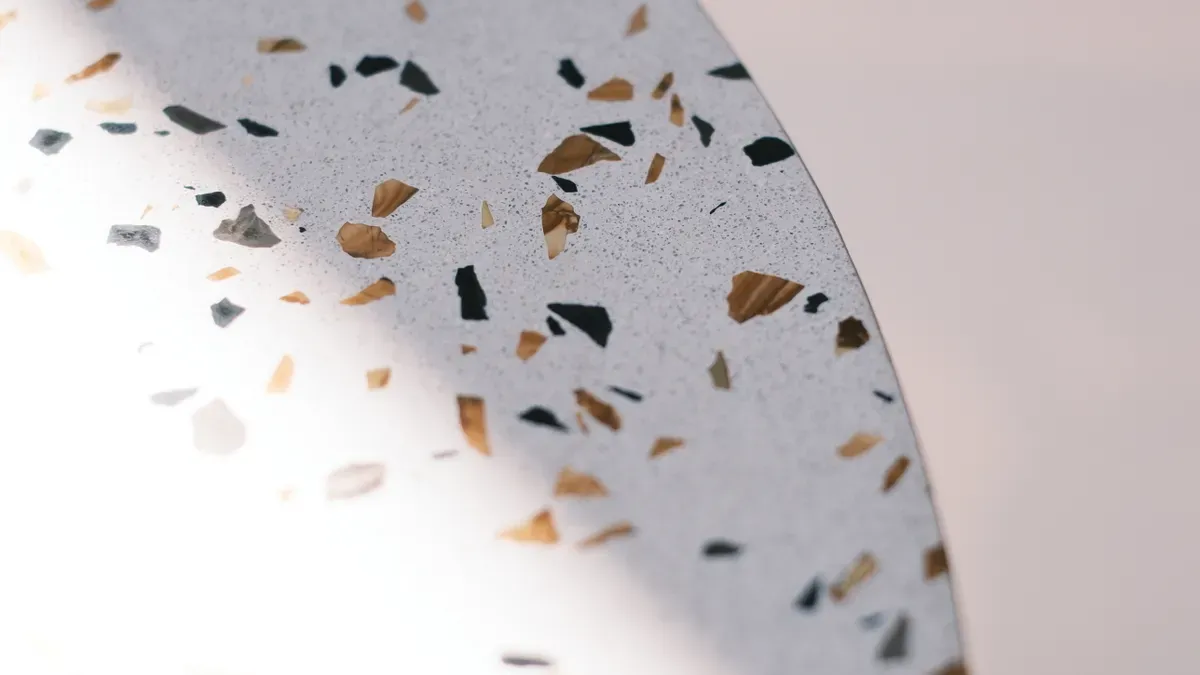
G·ONE builds each terrazzo surface around your design intent. You select the aggregate type, chip size, and blend ratio. Marble, granite, quartz, glass, and shell chips each produce a distinct visual texture. A fine marble chip yields a subtle, uniform field. A large glass chip creates bold reflectivity and depth. The matrix color then frames every chip. You can specify a neutral base for understated elegance or a saturated tone for dramatic contrast.
Divider strips shape both performance and appearance. These strips control crack locations and define the floor’s visual rhythm. A square grid produces a classic, formal pattern. A running bond or herringbone layout introduces movement and direction. You can also eliminate strips entirely for a fully seamless look. That choice depends on your substrate conditions and movement expectations.
Custom Blends and Design Flexibility
G·ONE offers tailored colors, aggregate blends, and molds to match your project. You are not limited to a standard catalog. The brand’s product lines cover regular terrazzo for durable, high-traffic surfaces, recycled terrazzo for eco-conscious projects, mosaic terrazzo for intricate artistic compositions, and UHPC plates for exceptional strength and weather resistance. Each line supports custom formulation.
This flexibility extends to liquid terrazzo flooring as well. You can request project samples to evaluate aggregate blends under your actual lighting conditions. G·ONE provides digital catalogs and design lookbooks with technical specifications and material selection manuals. These resources help you compare options before you commit to a specification. Early collaboration with the G·ONE team ensures your aesthetic goals align with the technical demands of the binder system you choose.
Substrate Preparation and Risk Mitigation
Substrate Evaluation and Moisture Testing
Your substrate determines the success or failure of any liquid terrazzo installation. You must evaluate the concrete slab before you specify the binder system. Start with a visual inspection. Look for cracks, spalling, and surface contamination. Then perform moisture testing to measure vapor transmission rates. High moisture levels compromise adhesion and lead to delamination.
You have several moisture test methods available. The calcium chloride test measures vapor emission rate. The relative humidity probe test measures moisture within the slab itself. Each method produces different data. You need to match the test to your project conditions and the binder system you plan to use. Epoxy systems are vapor-impermeable. They trap moisture below the surface. Cementitious systems breathe naturally and tolerate higher moisture levels.
Substrate flatness also demands attention. You must verify the slab meets the flatness tolerance your system requires. A thin-set epoxy system cannot bridge significant surface irregularities. You will need to grind high spots and patch low areas before installation. Crack isolation is equally critical. Structural movement transfers through the substrate into your terrazzo surface. You must address active cracks with epoxy injection and install crack isolation membranes where movement is anticipated.
Installation Pitfalls to Avoid
Several common mistakes undermine liquid terrazzo projects. You can prevent each one with early coordination and careful planning.
- Skipping moisture testing leads to primer failure and delamination. Always test before you specify.
- Ignoring substrate contamination prevents proper bonding. Oil, grease, and curing compounds must be removed completely.
- Applying primer to a damp slab causes adhesion failure. The substrate must be fully dry before you proceed.
- Failing to address cracks allows them to telegraph through the finished surface. Repair and isolate before installation.
- Selecting the wrong binder for the environment creates premature failure. Match chemistry to exposure conditions.
You mitigate these risks by engaging your manufacturer and installer during design development. Request a pre-installation meeting. Review the substrate evaluation data together. Confirm the primer selection and application sequence. This coordination costs little time but prevents expensive rework. Your manufacturer can provide technical guidance on moisture thresholds and substrate preparation. Your installer brings field experience that identifies site-specific challenges before they become problems.
The most successful projects treat substrate preparation as a design phase, not a construction afterthought. You verify conditions, document findings, and align your specification with reality. That discipline protects your design intent and your client’s investment.
Sustainability and Life-Cycle Cost
LEED Credits and Green Certifications
You can pursue multiple LEED v4 credits when you specify liquid terrazzo flooring with recycled content. The MR – Building Product Disclosure and Optimization credit rewards projects that incorporate recycled glass, shells, stone, porcelain, or metal chips. This reduces demand for virgin materials. The MR – Regional Materials credit applies when your suppliers extract and manufacture materials within 500 miles of the project site. You earn one point at 10% recycled content and a second point at 20% by material value. A floor with 100% recycled glass may contain up to 75% recycled product by volume.
Material transparency documentation strengthens your submission. An Environmental Product Declaration (EPD) for epoxy terrazzo documents cradle-to-gate global warming potential of 39.03 kg CO2e/m² and a 60-year reference service life. A Health Product Declaration (HPD) provides full ingredient disclosure. GREENGUARD Gold certification confirms low VOC emissions. The EQ – Low-Emitting Materials credit recognizes these certifications. G·ONE supports your sustainability goals through recycled terrazzo production and eco-friendly manufacturing processes.
Upfront Cost vs. Long-Term Value
Terrazzo carries a higher initial installation cost than VCT, carpet, or porcelain tile. That upfront premium often gives clients pause. The long-term picture changes the calculation entirely. Terrazzo delivers the lowest lifecycle cost of any commercial flooring system. Its lifespan exceeds 40 to 75 years. Maintenance stays minimal: sweeping, mopping, and auto-scrubbing. You never need waxing or stripping.
| Flooring Type | Initial Cost | Lifecycle Cost (40+ years) | Annual Maintenance | Lifespan |
|---|---|---|---|---|
| Terrazzo | Higher than VCT, carpet, porcelain tile | Lowest of any commercial flooring | Minimal (no waxing/stripping) | 40–75+ years |
| VCT | Lower | Higher than terrazzo | Higher (waxing/stripping) | Shorter |
| Carpet | Lower | Higher than terrazzo | Higher (replacement, cleaning) | Shorter |
| Porcelain Tile | Lower | Higher than terrazzo | Moderate (grout maintenance) | Moderate |
You should present this comparison to clients during design development. The durability of terrazzo eliminates repeated replacement cycles. That durability protects your client’s capital investment over decades of use.
Specification Tips and Alternatives
Writing Clear Specifications
Your specification document translates design intent into an installable system. Start with performance requirements, not product names. State the compressive strength, abrasion class, and slip resistance your project demands. Reference the applicable ASTM standards so contractors measure compliance objectively. Then define the binder chemistry based on your moisture testing and exposure conditions. This approach prevents substitutions that compromise durability.
Coordinate with your manufacturer during design development, not after you issue the drawings. G·ONE provides several resources that streamline this process:
- Tailored consultations: Project-specific guidance from concept through installation.
- Project samples: Physical samples and mockups you verify before installation.
- Digital catalogs: A lookbook with brochures and technical specifications.
- Engineering support: Confirmation of specification details and project-specific consultation.
Request samples early. Evaluate aggregate blends under your actual lighting conditions. A chip that looks striking in a showroom may disappear in a dim corridor. Verify the matrix color against your paint and fabric selections. Then document your choices with clear language. Specify the aggregate type, chip size, blend ratio, and divider strip layout. Include the primer system and moisture mitigation strategy. Your contractor needs this detail to price the work accurately and install it correctly.
When to Consider Alternatives
Liquid terrazzo does not suit every project. You should evaluate alternatives when specific conditions undermine its advantages. A severely deteriorated slab with active structural movement may require complete replacement rather than an overlay. If your timeline cannot accommodate substrate preparation and moisture testing, a floating floor system might fit better.
Budget constraints sometimes force a different choice. Terrazzo carries a higher upfront cost than VCT or carpet. If your client plans to occupy the space for fewer than ten years, the lifecycle savings may not justify the premium. In those cases, specify a less durable system and document the trade-off.
Exterior applications demand careful binder selection. Standard epoxy systems fail under UV exposure. If your project requires a thin profile outdoors, confirm your manufacturer offers a UV-stable formulation. Otherwise, consider cementitious or polyacrylate systems that tolerate direct sunlight.
Your specification should always include a pre-installation meeting. Bring your manufacturer, installer, and general contractor together. Review the substrate data, confirm the primer sequence, and align expectations. This meeting costs one hour and prevents months of potential rework.
Match your resin chemistry to project conditions first. Verify substrate readiness through moisture testing before you specify any system. Align performance metrics—compressive strength, abrasion class, slip resistance—with your actual use case. Balance aesthetic goals against budget realities from the start.
Early coordination with manufacturers like G·ONE and experienced installers remains your strongest risk mitigation strategy. Their technical guidance prevents specification errors that lead to costly rework.
Apply the decision framework we’ve outlined to evaluate liquid terrazzo flooring with confidence. You now have the criteria to select systems that perform, endure, and inspire. This material stands at the forefront of sustainable, high-performance design—ready for the next generation of architectural excellence.
FAQ
How do I choose between epoxy and cementitious terrazzo?
Match the binder to your environment first. Epoxy suits climate-controlled interiors with verified low moisture. Cementitious systems handle exterior exposure and uncertain moisture conditions. Consider your timeline too. Epoxy cures overnight. Cementitious requires 28 days of wet curing before grinding.
What moisture testing do I need before installation?
Perform calcium chloride or relative humidity probe testing before you specify any system. Epoxy is vapor-impermeable, so it traps moisture below the surface. High readings demand a moisture mitigation membrane. Cementitious systems breathe naturally and tolerate higher moisture levels without additional protection.
Can liquid terrazzo work for exterior applications?
Yes, but you must select the right chemistry. Standard epoxy fails under UV exposure. Choose cementitious or polyacrylate systems instead. These withstand freeze-thaw cycles and direct sunlight. Design structural inset expansion plates between areas where major movement is anticipated to prevent random cracking.
How thick is liquid terrazzo compared to traditional systems?
Thin-set epoxy systems install at just 1/4 to 3/8 inch. Traditional sand cushion cementitious systems require 2.5 to 3 inches of depth. This thinner profile reduces structural load and suits multi-story buildings where floor height matters. You gain significant weight savings without sacrificing durability.
Does liquid terrazzo support LEED certification?
Yes. Recycled glass, shell, or stone chips contribute to LEED v4 MR credits. You earn points at 10% and 20% recycled content by material value. An Environmental Product Declaration documents global warming potential. GREENGUARD Gold certification confirms low VOC emissions for the EQ credit.