
You face a critical choice when you select terrazzo and stone for architectural projects. Two primary axes shape this decision: binder type, epoxy versus cement, and installation method, poured versus precast or tile. Each path delivers distinct performance and aesthetic outcomes. Stone selection follows a parallel logic of performance, aesthetics, and context.
This specification guide serves as a practical decision-support tool for architects and designers. You need actionable guidance, not theory. The global terrazzo flooring market grows at 5.62% CAGR from 2022 to 2030, reflecting rising demand for durable, expressive surfaces.
G·ONE‘s experience with precast terrazzo and sustainable materials informs this how to guide for architects. You will learn to navigate epoxy terrazzo, poured-in-place terrazzo, and specification choices with confidence. This specification guide helps architects align design intent with technical performance.
Key Takeaways
- Choose epoxy binders for indoor projects that need fast curing and chemical resistance; choose cement binders for outdoor use and moisture control.
- Select poured-in-place terrazzo for seamless floors that last 40–100 years; select precast tiles for smaller projects with easier installation.
- Customize your terrazzo with different aggregates, colors, and finish options to match your design vision and performance needs.
- Plan early with your supplier to control costs and align design intent with technical performance for long-term value.
- Invest in terrazzo for a floor that lasts 75–100 years with simple maintenance and strong sustainability benefits.
Understanding Terrazzo and Stone
What Terrazzo Is Today
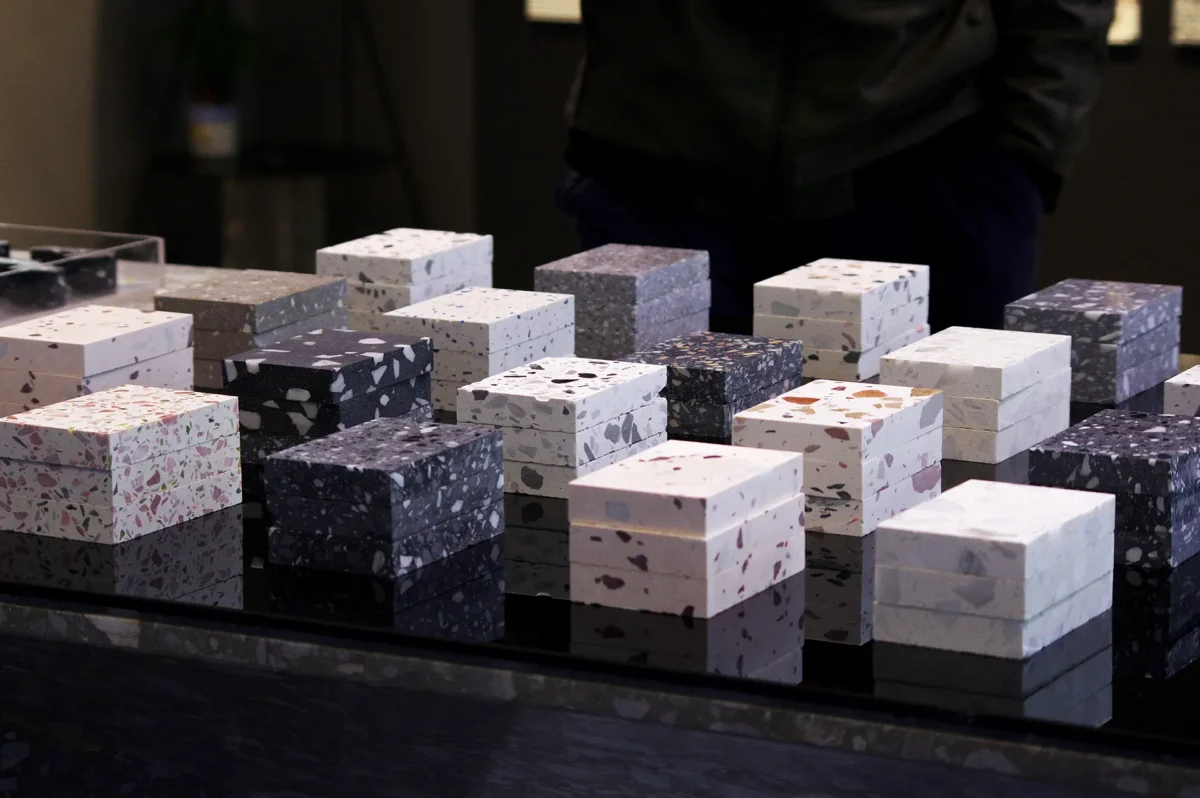
Terrazzo is a composite material made from three components: aggregates, a binder, and pigment. Workers mix these elements, pour or press them into forms, and then grind and polish the surface to reveal the aggregate pattern. This material has a long history in architectural projects, and it has returned to prominence in 2026 for its durability, sustainability, and design flexibility.
Modern terrazzo and stone selection now includes recycled content and large-format panels. Manufacturers incorporate production offcuts into new formulations, aligning with a circular production ethos. One example, Terrazzo Selva, features 25 percent recycled content. These products are free from silica, nanoparticles, formaldehyde, and VOCs, ensuring a safe choice for any installation. The HIMACS Terrazzo collection features five colors recognized with the Red Dot Design Award 2026 for merging elegance with sustainability. Each color incorporates SCS-certified pre-consumer recycled materials.
Key Terms for Specifiers
You need precise vocabulary when you write a terrazzo specification. The table below defines the core terms you will encounter.
| Term | Definition |
|---|---|
| Venetian terrazzo | Terrazzo that uses oversized aggregates, specifically sizes 3 through 8, to create greater contrast and draw more attention to the aggregate itself. |
| Palladiana terrazzo | Terrazzo that uses chunks of marble slab in the aggregate rather than small rocks, creating a paver-like effect. |
| Precast terrazzo | Terrazzo base that is precast in long sections and then field-applied, as opposed to being poured in place. |
The four basic types of terrazzo are traditional, cementitious, epoxy, and thin-set. Each type offers different performance characteristics. For example, epoxy terrazzo delivers a compressive strength of 10,000 psi per ASTM D 695 and an abrasion resistance of 70-90 mg loss per ASTM D 4060 (CS-17 wheel). These values help you compare terrazzo specifications across product lines.
Terrazzo and stone offer high customization in color, aggregate, and pattern. This flexibility is central to their appeal for architects and designers. You can specify poured-in-place terrazzo for seamless floors or choose thin-set epoxy terrazzo for faster installation. The choice depends on your project requirements.
Terrazzo Specification: Binder and Installation
Epoxy vs. Cement Binders
Your binder choice shapes performance, cost, and application scope. Epoxy terrazzo dominates roughly 90% of installations because it offers superior design flexibility, faster cure times, and lighter weight. You can specify epoxy terrazzo for indoor projects that need vibrant colors and large spans reaching 20 to 30 feet. This binder cures in approximately 24 hours, allowing crews to grind and polish the next day. Epoxy terrazzo also delivers excellent chemical resistance, making it ideal for laboratories, hospitals, and food service areas. The non-porous surface resists acids, oils, and cleaning agents.
Cement terrazzo serves different needs. You should specify this binder for outdoor applications, restoration projects without vapor barriers, and situations where moisture remains a concern. Cement terrazzo breathes, handles sunlight without fading, and costs less upfront. However, it requires a multi-day cure schedule and periodic sealing to block stains. Acidic spills etch the surface over time.
| Factor | Epoxy Terrazzo | Cement Terrazzo |
|---|---|---|
| Application | Indoor only | Indoor and outdoor |
| Cure time | Roughly 24 hours | Multi-day schedule |
| Chemical resistance | Excellent | Limited; requires sealing |
| Cost per sq ft | $25–$90 | $15–$35 |
| Thickness | 3/8 in. | 1/2–1 in. |
Poured vs. Precast Terrazzo Floors
Your installation method affects seam visibility, maintenance demands, and project scale. Poured-in-place terrazzo creates a seamless, monolithic surface with no grout lines. This method suits high-traffic areas like hospitals, schools, and airports. A seamless floor eliminates locations for bacteria and microbial growth. Crack suppression membranes can address reflective cracking concerns. Poured-in-place terrazzo lasts 40 to 100 years with minimal repairs.
Precast terrazzo tiles offer advantages for smaller projects. You can install terrazzo tiles like ceramic tile, which reduces on-site skill requirements. Precast terrazzo tiles typically last 10 to 15 years because grout joints make edges prone to chipping. These joints also demand more maintenance than seamless alternatives.
G·ONE specializes in precast terrazzo, offering regular, recycled, and mosaic options suited to different project scales. Their products support architects who need quality terrazzo floors with sustainable credentials.
Maintenance for terrazzo floors follows a simple routine. Dry mop daily. Wet mop weekly with a pH-neutral cleanser. Reseal yearly to prevent staining. This low-maintenance profile helps building owners save on yearly costs.
When you specify terrazzo floors, weigh installation requirements against project timelines. Poured-in-place terrazzo needs on-site preparation and specialized grinding equipment. Precast terrazzo tiles arrive manufactured and ready for installation. Both approaches deliver durable results when you coordinate with experienced contractors early.
Material Components and Customization
Aggregates: Size, Type, and Source
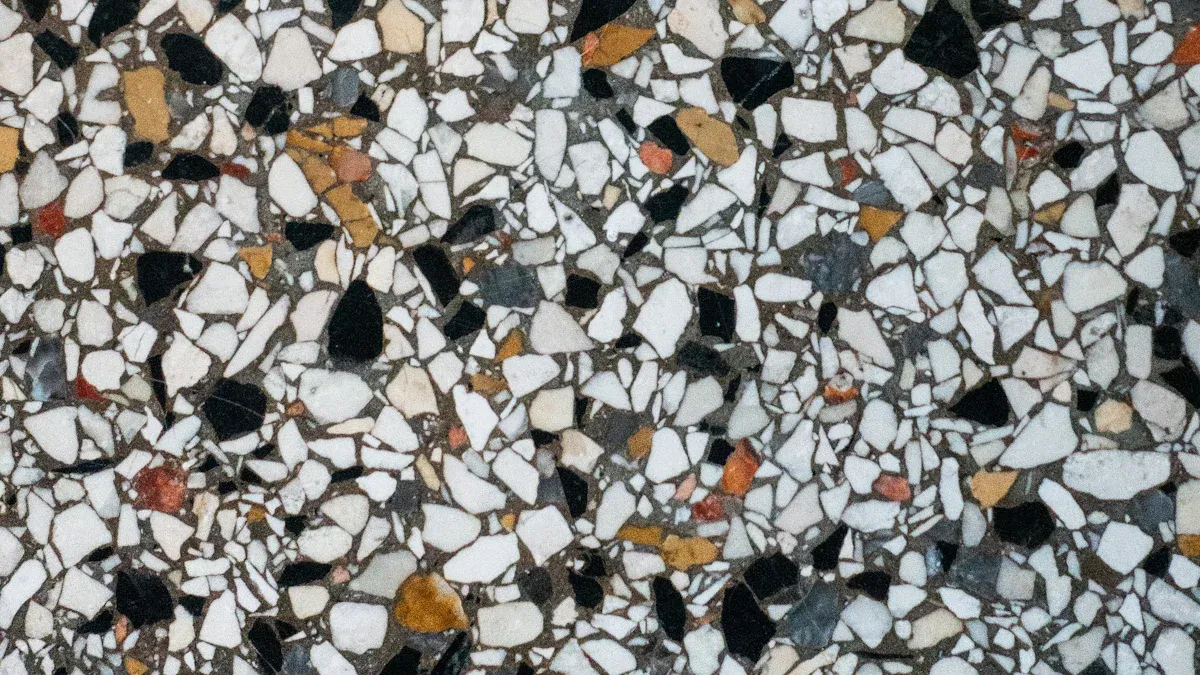
Aggregates shape how your terrazzo looks and performs. They make up as much as 70% of the mix, so their characteristics drive durability, lifespan, and cleanability. Marble chips remain the classic choice, available in sizes from fine to large with natural color variation. Glass adds reflective sparkle and comes in recycled or virgin form. Mother of pearl delivers an iridescent effect for luxury hospitality work. You can also combine aggregates for a custom look.
Size and shape change the visual result. Smaller chips, such as 1.6–5 mm granite and flint or 1–5 mm glass, produce a finer surface. Larger aggregates create a classic, mosaic-like appearance. Crushing technique matters too: a cone crusher yields rounded edges, while a jaw crusher produces elongated, jagged shapes. Source affects both cost and carbon footprint. Domestic marble chips sit at the lower end of the price scale, while mirror, colorful glass, and silver-coated glass cost more. Locally sourced aggregates crushed within 300 miles of the production facility reduce emissions and support budget-friendly terrazzo tiles.
Binders, Pigments, and G·ONE Custom Solutions
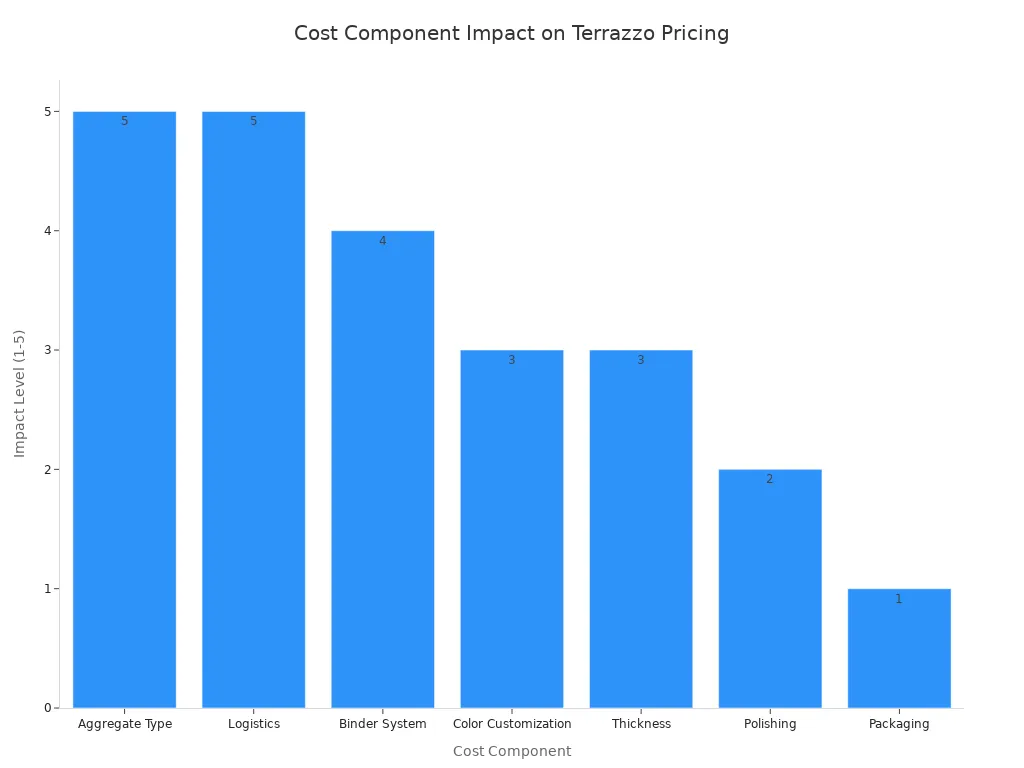
Binder and pigment choices carry real cost weight. Aggregate type and logistics drive pricing hardest, followed by the binder system, then color customization and thickness. Polishing and packaging matter less. Custom premium mixes with rare marble chips, glass, mirror aggregates, or special color systems run $75–$150+ per m². Standard colors need a 100–200 m² minimum order with the fastest production. Custom Pantone or RAL colors require a 300–500 m² minimum, plus color testing and batch adjustments.
Custom premium mixes cost $75–$150+ / m², including rare marble chips, glass, mirror aggregates, or special color systems.
G·ONE builds custom-made solutions around your specification. The team tailors colors, aggregate blends, and molds, and supports your design work with digital catalogs and design lookbooks. G·ONE’s recycled terrazzo and UHPC plates serve facades and high-traffic interiors as sustainable, high-performance options. These products open design possibilities that standard ranges cannot match.
Design Considerations for Terrazzo Floors
Aggregate Grading, Dividers, and Patterns
Aggregate grading controls the visual texture of your terrazzo floors. You select chip sizes from fine dust to large marble chunks. A uniform grade uses similar-sized chips for a consistent appearance. A graded mix combines multiple sizes for a denser surface. Your choice affects both aesthetics and material cost. This decision opens many design possibilities for architectural projects.
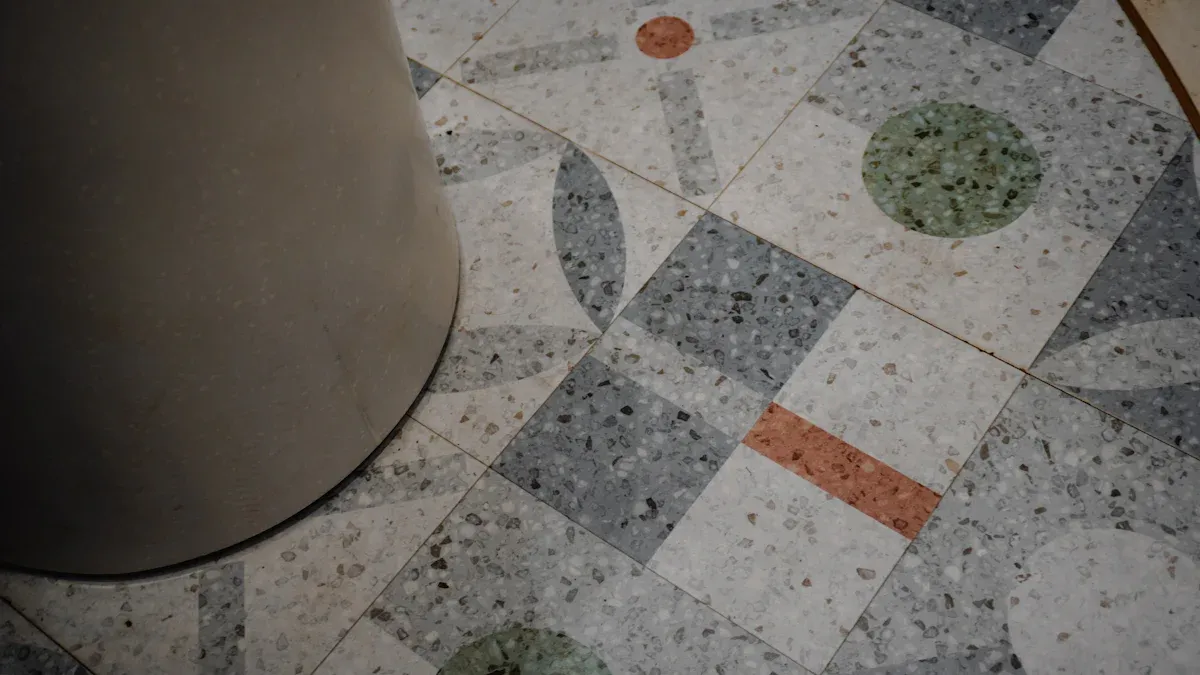
Dividers serve structural and decorative roles. Brass, zinc, or plastic strips control movement joints and create patterns. These strips handle thermal expansion and prevent random cracking. You define borders, logos, or repeated motifs across the floor. Palladiana terrazzo uses large marble slab fragments for a bold effect. These design options give you flexibility for any architectural vision. Precast terrazzo tiles also accommodate these patterns well. Early alignment with room dimensions ensures cohesive terrazzo floors. Epoxy terrazzo accepts these patterns due to its workability. Epoxy terrazzo allows fine detail in divider layout. Modern design often incorporates these strips as visual features. Creative design extends the capabilities of your chosen floor system.
Finish Options: Polished, Honed, and Slip-Resistant
Your finish choice affects appearance and safety. A polished floor delivers high reflectivity. Grinding creates a smooth, glossy surface. This floor works for lobbies and showrooms. Polished terrazzo becomes slippery when wet. A honed floor provides a matte surface. Finer abrasives reduce gloss. This finish hides minor wear over time. It suits retail spaces and offices.
Slip-resistant finishes address safety in wet zones. A light sandblast creates the necessary texture. Epoxy terrazzo accepts these treatments well. Epoxy terrazzo preserves color integrity across large areas. The epoxy binder system works reliably for demanding applications. Architects specify the right finish during early planning phases. You receive a floor that meets safety standards without sacrificing design. Room moisture and traffic levels guide your selection. This integration defines successful terrazzo floors. Spirit of innovation in terrazzo floors continues to inspire modern design. Epoxy terrazzo remains a top choice for complex patterns in architectural projects. Your specification choices directly affect long-term project outcomes.
Performance and Installation Coordination
Wear Resistance and Substrate Prep
You need to verify wear resistance before you specify any terrazzo product. The ASTM F 510 test measures abrasion resistance using a Taber abrader with S-39 wheels under a 1000 g load for 500 cycles. A quality terrazzo floor must show a maximum volume loss of 0.0196 cm³. This threshold ensures your floor withstands heavy foot traffic in commercial applications.
Slip resistance matters equally for safety. A properly sealed epoxy terrazzo floor achieves a Static Coefficient of Friction of 0.6 or higher, meeting ADA recommendations for level surfaces. The final sealer determines slip resistance, not the material itself.
A properly sealed epoxy terrazzo floor achieves a Static Coefficient of Friction (SCOF) of 0.6 or higher, meeting or exceeding ADA recommendations for level surfaces in commercial settings. The final sealer, not the material, determines slip resistance.
Substrate preparation determines long-term durability. You must achieve a Concrete Surface Profile between CSP-3 and CSP-5. Thin-set systems may accept CSP-3, while bonding-agent systems favor CSP-4 or CSP-5. Flatness tolerance must not exceed 1/4 inch deviation over a 10-foot straightedge span. Moisture testing follows ASTM F2170 with in-situ probes. Relative humidity must not exceed 75% for most systems. Test at least 3 locations per 1,000 sq ft at a probe depth of roughly 40% of slab thickness.
Coordinating with Contractors
Professional installation is required for all terrazzo installations. You should coordinate with contractors and suppliers early to prevent costly delays. Terrazzo installations demand specialized grinding equipment and skilled labor. Early coordination ensures your project timeline stays realistic.
G·ONE provides expert engineering support and project samples as resources for your specification and installation planning. These resources help you align design intent with technical performance. Early planning with your supplier reduces installation considerations that could derail your schedule.
Cost and Lifecycle with G·ONE
Upfront Costs and Early Planning
Terrazzo carries a higher initial cost than many flooring alternatives. Installation complexity adds to that investment. You control the budget through early planning. Engage a terrazzo manufacturer during schematic design. This timing lets you approve the mix design and procure materials before the contractor mobilizes.
Early collaboration delivers concrete savings. You can focus on large areas with simple designs using cost-effective aggregates such as recycled glass or 100 percent marble. Limit decorative elements to key spots. Use precast terrazzo for small or difficult areas like stair landings or elevator cabs. This approach saves labor and reduces waste. As aggregate size increases, so does system thickness and cost. A manufacturer can confirm design choices, provide budget guidance, supply specification language, and develop custom samples. Terrazzo materials also offer quicker delivery times than many manufactured flooring products, giving you schedule flexibility.
Long-Term Value and Maintenance
Terrazzo rewards that upfront investment over decades. A properly installed terrazzo floor has an expected lifespan of 75 to 100 years, compared to vinyl composition tile at 10-15 years, commercial carpet at 7-10 years, and ceramic tile at 25-40 years. Routine care requires only sweeping, damp mopping, periodic polishing, and occasional resealing. The non-porous surface has no grout lines, so it stays cleaner and more hygienic. When damage occurs, you can repair, regrind, and polish the existing surface instead of replacing it.
The NTMA study below compares 40-year total costs across flooring types.
| Flooring Type | Install Cost (per sq ft) | Annual Maintenance (per sq ft) | Replacement Frequency | 40-Year Total Cost (per sq ft) |
|---|---|---|---|---|
| Epoxy Terrazzo | $14.50 | $0.43 | 40 years | $31.90 |
| Sand Cushion Terrazzo | $16.11 | $0.52 | 40 years | $37.06 |
| Monolithic Terrazzo | $9.70 | $0.61 | 40 years | $37.38 |
| Vinyl Sheet | $3.58 | $1.12 | 10 years | $62.71 |
| Carpet | $3.34 | $1.23 | 10 years | $66.02 |
| Vinyl Tile | $1.21 | $1.18 | 10 years | $53.41 |
| Porcelain Tile | $8.06 | $0.98 | 40 years | $47.37 |
| Quarry Tile | $7.25 | $0.98 | 40 years | $46.56 |
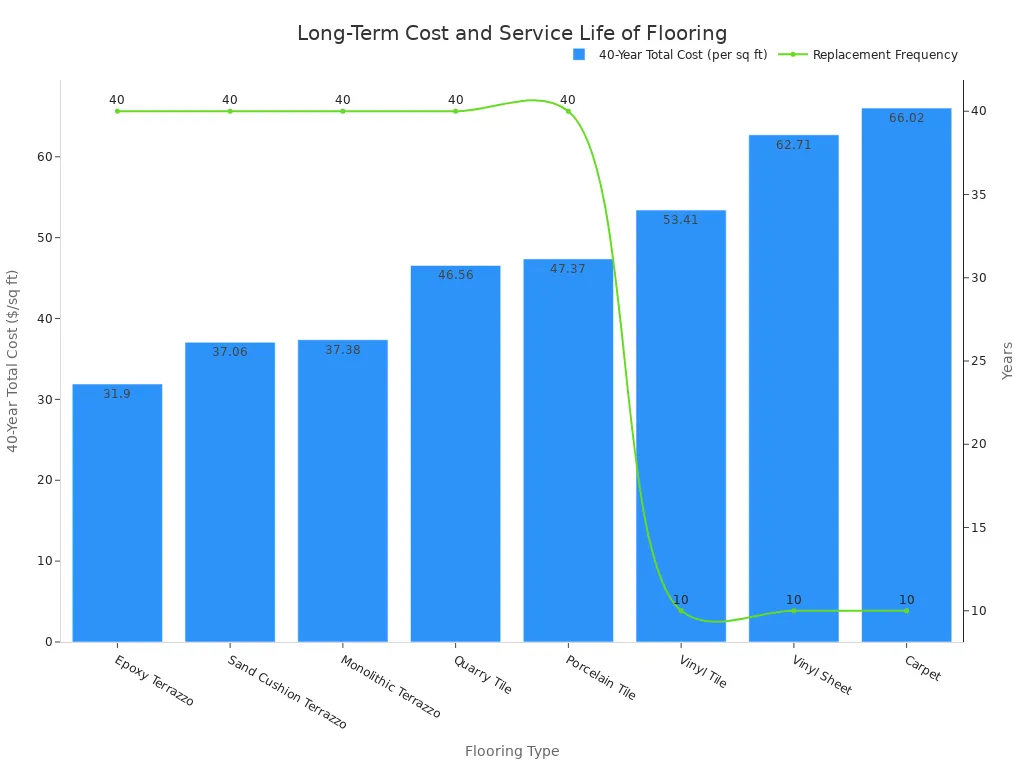
Sustainability credentials strengthen the lifecycle case. Terrazzo can contribute up to eight LEED points depending on design and material sourcing. A floor containing 100% recycled glass may hold as much as 75% recycled product by volume. G·ONE partners with you to balance upfront investment against long-term performance and environmental responsibility.
You now hold the full decision framework. Binder type, installation method, aggregate selection, design features, and performance requirements each shape the final result. Epoxy suits indoor work with fast cure times. Cement handles outdoor exposure. Poured terrazzo delivers seamless surfaces. Precast tiles simplify smaller scopes.
Use this checklist when you specify terrazzo floors:
| Decision | Ask Yourself |
|---|---|
| Binder | Indoor or outdoor? Epoxy or cement? |
| Installation | Poured or precast? |
| Aggregate | Which size, type, and source? |
| Finish | Polished, honed, or slip-resistant? |
| Performance | Does the floor meet ASTM limits? |
Architects who coordinate with suppliers early align design intent with technical performance. G·ONE supports that process with samples and engineering guidance. Epoxy terrazzo and stone remain durable, expressive, sustainable choices for contemporary architecture.
FAQ
Which binder serves your project best?
Epoxy binder works for indoor applications. Epoxy cures fast and resists chemicals. Cement binder suits outdoor exposure. Your decision between epoxy and cement depends on moisture levels and installation environment.
How long does terrazzo last?
Epoxy terrazzo floors last 75 to 100 years. The epoxy binder provides durability. Routine care involves sweeping and mopping. Your terrazzo investment pays off over decades.
What finish options work with epoxy terrazzo?
Polished epoxy delivers high reflectivity. Honed epoxy provides a matte surface. Slip-resistant epoxy suits wet zones. Your finish choice affects appearance and safety for terrazzo floors.
Can you use terrazzo outdoors?
Cement binder works outdoors. Epoxy stays indoors. Cement breathes and resists sunlight. Your outdoor project requires cement-based terrazzo for lasting performance.