
Selecting floor materials for commercial projects requires balancing structural loads and long-term durability. In the debate of terrazzo vs marble, thin-set epoxy terrazzo provides a lightweight profile at just 3/8-inch thickness, while dimensional marble slabs require a heavy full-bed installation. This structural difference impacts your building dead load calculations significantly. Non-porous resin systems deliver superior stain resistance and scratch protection, whereas quarried stone absorbs liquids and demands continuous crystallization treatments.
When you evaluate initial capital investment against 40-year lifecycle costs in a terrazzo vs marble comparison, engineered composite surfaces frequently outperform natural stone in high traffic environments. This technical guide helps architects, structural engineers, and project managers navigate critical material selection trade-offs. You will find objective performance metrics to specify the right surfacing system for your project requirements.
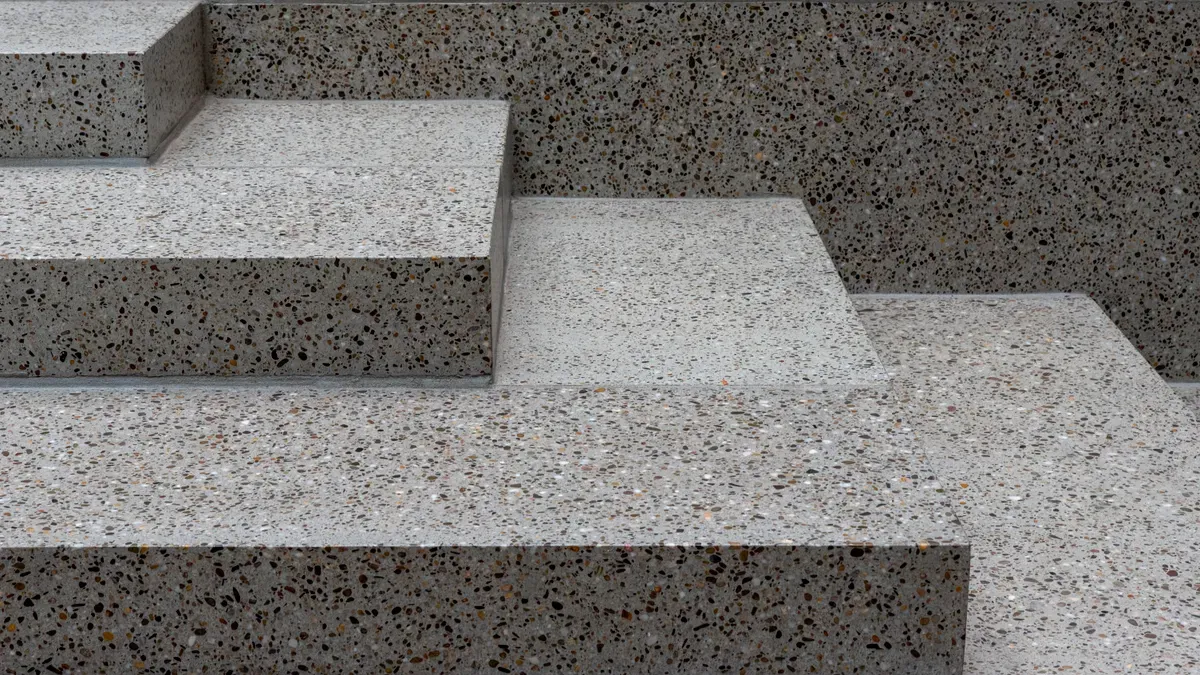
Key Takeaways
- Thin-set epoxy terrazzo reduces building structural loads by weighing far less than heavy marble slabs.
- Non-porous terrazzo matrices prevent chemical stains and acid etching much better than porous natural marble.
- Epoxy composite floors withstand heavy foot traffic without developing noticeable wear paths or lost polish.
- Simple neutral mopping cleans terrazzo floors, eliminating expensive marble re-crystallization routines and frequent sealers.
- Terrazzo offers lower total lifecycle costs over forty years compared to high-maintenance dimensional stone.
- Architects customize terrazzo designs easily through unlimited color choices and diverse recycled glass or aggregate options.
- Zero-VOC terrazzo matrices help projects earn valuable LEED credits for indoor air quality and sustainability.
Executive Summary of Terrazzo vs Marble
Specifiers evaluate high-traffic surface materials through structural load capacities, life-cycle costs, and long-term durability. In the choice between terrazzo vs marble, you must balance raw architectural beauty with realistic mechanical demands. Thin-set resinous terrazzo systems deliver an ultra-thin 3/8-inch footprint with minimal weight penalties. Conversely, natural dimensional marble slabs require deeper substrate recesses and heavier structural support.
Specifier Selection Criteria
You need clear material criteria when you design commercial corridors, transit hubs, and institutional facilities. Primary evaluation factors include structural dead load, surface porosity, maintenance frequency, and daily footfall resistance.
- Structural Load Management: Resin-based thin-set systems add minimal dead load to structural concrete decks. Slab marble requires thick mortar beds, which increase total weight significantly.
- Surface Porosity and Maintenance: Unsealed marble absorbs spills rapidly and requires frequent crystallization treatments. Engineered terrazzo provides an impenetrable matrix that resists chemical staining.
- Traffic Durability: Heavy pedestrian traffic wears down softer natural stone quickly. Engineered composite systems retain their polished finish under continuous foot traffic.
Commercial specifiers rely on ASTM E648 (Critical Radiant Flux) to measure a hard surface flooring material’s resistance to flame spread. Compliant commercial products earn a Class 1 or Class 2 rating based on their fire-retardant capabilities.
Technical Performance Matrix
You can compare critical laboratory testing standards to determine the best material for your floor assembly. The following performance matrix outlines essential ASTM testing methods for commercial hard surfaces:
| Performance Category | ASTM Standard Code | Evaluated Criteria | Specifier Relevance |
|---|---|---|---|
| Abrasion Resistance | ASTM D4060 | Top layer wear rate under rotary wheels | Evaluates surface life under foot traffic |
| Fire Safety & Flammability | ASTM E648 | Flame propagation and radiant flux | Ensures life-safety compliance in corridors |
| Surface Safety | ASTM D2047 | Static coefficient of friction | Verifies slip resistance on flat walking surfaces |
| Microbial Resistance | ASTM G21 | Fungal and bacterial growth resistance | Determines suitability for healthcare settings |
| Subfloor Moisture | ASTM F2170 | Relative humidity inside concrete slabs | Prevents adhesive bonding failure over time |
| Acoustic Performance | ASTM E492 / ASTM E90 | Impact noise insulation and sound transmission | Controls ambient sound in multi-story buildings |
Evaluating these standardized tests helps you select the right system for your building envelope. While marble offers classic beauty for quiet luxury areas, terrazzo provides superior resilience across busy commercial spaces.
Pros and Cons of Terrazzo vs Marble
Architects and facility managers must carefully weigh material performance before specifying hard surface systems. Understanding the pros and cons of terrazzo vs marble helps you select the right surface for specific building zones. Both materials deliver distinct operational tradeoffs regarding physical durability, ongoing maintenance, and total installed cost. While natural stone provides timeless elegance, modern engineered composites offer distinct advantages in high-demand environments.
Advantages of Engineered Terrazzo
Engineered resin systems deliver exceptional performance across demanding commercial interiors. You gain major technical pros when specifying thin-set epoxy or resinous composites over traditional quarried slabs.
The primary pros of selecting engineered systems center on surface strength and mechanical resilience:
- High structural flexibility reduces floor cracking over structural concrete slabs.
- Continuous seamless installations eliminate dirt-accumulating grout joints.
- Non-porous resin binder systems deliver maximum stain resistance against spilled chemicals, oils, and colored liquids.
- Custom color combinations allow exact corporate branding integration directly into your floor design.
These engineered composite systems offer exceptional durability and longevity under heavy commercial foot traffic. High pedestrian volume in airport terminals, educational hallways, and medical facilities will not wear down epoxy surfaces. Beyond horizontal flooring, designers frequently specify resinous composite panels for heavy-use countertops in commercial restrooms and reception desks. A resinous composite surface performs reliably in busy kitchen environments and high-moisture bathroom spaces without absorbing liquids.
Specifier Tip: Resinous composite systems allow seamless poured-in-place installations. You can integrate sanitary cove bases directly into the floor assembly to streamline facility cleaning routines.
Drawbacks of Natural Marble
Natural stone panels create sophisticated spaces, but you must evaluate specific performance cons before specifying them for heavy-use floors. Quarried calcitic stone remains chemically vulnerable to daily environmental exposure.
Major operational cons stem from natural stone composition:
- High surface porosity allows standing liquids to migrate deep into the slab.
- Calcitic minerals react quickly with mild acids, leading to surface etching and permanent dullness.
- Softer mineral structures show noticeable scratch patterns under heavy traffic conditions.
- High initial material costs and specialized slab installation elevate upfront capital budgets.
Professional maintenance guidelines suggest performing marble floor crystallization every 6 to 12 months, adjusting the exact frequency according to overall foot traffic and floor wear. High-traffic commercial lobbies, such as busy Manhattan hotels, require monthly re-crystallization due to heavy daily foot traffic. Standard office building entrances typically need treatment every two to three months. Most high-traffic facilities establish recurring maintenance schedules to address wear before visible dullness occurs.
These intensive maintenance cycles mean natural stone slab installations create ongoing operational demands. Installing calcitic stone countertops in a busy public kitchen or institutional bathroom frequently leads to severe staining and surface dullness without continuous sealer reapplications.
Material Composition: Composite vs Quarried Stone
The performance differences in a terrazzo vs marble comparison stem directly from material composition. Engineered composite surfaces combine stone or glass aggregates within an epoxy binder. Quarried stone consists of natural calcitic deposits formed under geological heat and pressure.
Natural calcitic stones contain mineral deposits that chemically dissolve upon contact with acidic substances. Common acidic liquids like coffee, cola, or citrus juices cause immediate chemical reactions on unsealed stone, leaving permanent rough marks. Although less porous than some soft sedimentary stones, unsealed calcitic aggregates and traditional cement binders will eventually absorb standing surface spills, leading to deep stains.
The following matrix comparison shows how resinous systems protect surfaces compared to calcitic stone options:
| System Type | Matrix Porosity | Protection Mechanism Against Stains |
|---|---|---|
| Resinous Systems (Epoxy/Polyester) | Non-porous surface | Naturally blocks penetration; requires no penetrating sealers, relying only on surface sealers. |
| Calcitic / Portland Cement Systems | Porous matrix containing calcium deposits | Vulnerable to fluid absorption and acid dissolving calcium; necessitates immediate penetrating sealers to inhibit spill absorption. |
The natural veining of quarried stone creates a unique appearance in every slab. This natural variation enhances luxury feature walls, executive suites, and low-traffic aesthetic accents where chemical exposure remains minimal. Natural stone creates an elevated overall appearance in quiet luxury spaces. However, when your project demands consistent color control across thousands of square feet, engineered aggregates give you total command over the visual appearance and long-term surface aesthetics.
Structural Dead Load and Floor Comparison
Structural engineers must calculate dead load weight carefully when designing multi-story floor assemblies. You need to understand how material thickness directly influences overall building engineering and structural support costs.
Thin-Set Epoxy vs Full-Bed Stone Profiles
Thin-set epoxy systems measure only 3/8-inch thick and weigh approximately 3 to 4 pounds per square foot. In contrast, dimensional marble slabs usually require a 3/4-inch to 1-1/4-inch stone thickness set over a full 1-1/2-inch mortar bed. This traditional full-bed assembly exerts a heavy load of 25 to 30 pounds per square foot onto your structural deck.
# Structural Load Comparison Per 10,000 Sq. Ft.
epoxy_terrazzo:
  system_thickness: "3/8 inch"
  weight_per_sqft: "3.5 lbs"
  total_dead_load: "35,000 lbs"
dimensional_marble:
  system_thickness: "2.5 inches (with bed)"
  weight_per_sqft: "27.5 lbs"
  total_dead_load: "275,000 lbs"
Selecting thin-set systems eliminates hundreds of thousands of pounds in dead weight across large multi-story projects. You save significant money on structural concrete and steel reinforcing members by reducing floor assembly thickness.
Compressive and Flexural Strength
The internal matrix composition directly determines how floor materials handle mechanical stresses. Resinous terrazzouses a high-strength epoxy resin binder that locks mineral aggregate tightly together. This formulation yields an exceptional flexural strength exceeding 4,500 psi and a compressive strength over 10,000 psi.
Natural dimensional stone exhibits natural geological veins and structural fissures. These internal weaknesses reduce average flexural strength down to 1,000 to 1,500 psi. High compressive forces can easily fracture unreinforced natural slabs under heavy rolling equipment.
The non-porous epoxy resin matrix provides superior stain resistance against harsh chemicals, oils, and continuous spills. Liquid contaminants cannot penetrate deep into the dense resin surface. Unsealed natural stone rapidly absorbs liquid spills, leading to severe deep-set discoloration. This core physical difference transforms your ongoing maintenance requirements for high traffic facilities.
Impact Resistance and Crack Suppression
Busy commercial spaces endure continuous impacts from heavy luggage, foot traffic, and rolling equipment carts. Epoxy composite matrix floors absorb kinetic impacts without chipping or spalling. Structural engineers routinely specify fluid-applied crack isolation membranes beneath thin-set poured applications. These flexible elastomeric membranes bridge subfloor movement up to 1/8 inch, protecting top surface finishes from concrete slab cracking.
Natural calcitic slabs lack inherent impact flexibility. Point-load forces from dropped objects quickly shatter rigid stone surfaces. Repairing cracked or chipped natural stone requires expensive, specialized slab replacement techniques.
Your choice of material defines your daily maintenance routine over decades of building operations. Thin-set surfaces require only neutral damp mopping and periodic buffing to keep their high gloss. Natural stone slabs demand constant re-polishing, stone crystallization treatments, and frequent chemical sealers to maintain basic visual appearance on high traffic floors. Executing an objective floor comparison helps you protect both structural integrity and long-term operating budgets.
Commercial High-Traffic Floor Comparison
Commercial building spaces require surfaces that maintain structural stability under extreme physical demands. Thin-set epoxy terrazzo systems excel on high traffic floors because their non-porous resin matrix binds aggregate materials tightly. This engineered composite surface withstands thousands of daily footsteps without showing path wear or traffic patterns. Conversely, dimensional marble slabs feature softer calcitic mineral structures. These natural stone tiles develop wear paths quickly in high traffic zones, which dulls the factory polish and creates uneven walking surfaces over time.
Facility managers must account for maintenance downtime during floor selection. Natural stone installations require continuous crystallization treatments to maintain their high-gloss finish under heavy footfall. This mechanical process uses specialized steel wool pads and acidic chemical compounds to re-crystallize the top layer of stone. Thin-set epoxy systems eliminate these recurring labor costs entirely. You maintain resin-based surfaces through simple neutral damp mopping and periodic high-speed burnishing.
The following table compares key technical performance metrics for high-use commercial applications:
| Performance Metric | Thin-Set Epoxy Terrazzo | Dimensional Marble Slabs |
|---|---|---|
| Surface Matrix | Non-porous epoxy resin | Porous calcitic stone |
| Maintenance Routine | Neutral cleaning and buffing | Continuous crystallization and sealing |
| Stain Penetration Risk | Extremely low | High |
| Structural Dead Load | 3.5 lbs/sq ft at 3/8-inch thickness | 27.5 lbs/sq ft at 2.5-inch bed assembly |
| Long-Term Wear Resistance | Superior surface durability | Susceptible to foot-path wear |
Subfloor movement presents another critical challenge in busy public buildings. Structural concrete decks expand and contract continuously due to thermal changes and structural vibrations. Epoxy systems include flexible crack isolation membranes that bridge substrate cracks up to 1/8 inch. These elastomeric layers absorb horizontal concrete shear forces before stress transfers to the decorative topping. Marble assemblies rely on rigid mortar beds that transfer subfloor movement directly into the stone slabs. This rigid connection often leads to cracked tiles, loose grout lines, and costly structural repairs.
By choosing thin-set epoxy systems over dimensional stone, you reduce building dead loads while maximizing surface longevity. Lightweight resinous floors deliver unmatched impact resistance, chemical protection, and aesthetic stability. These technical advantages ensure your commercial floor assembly remains beautiful and functional across decades of continuous operation.
Design Versatility and Aggregate Control
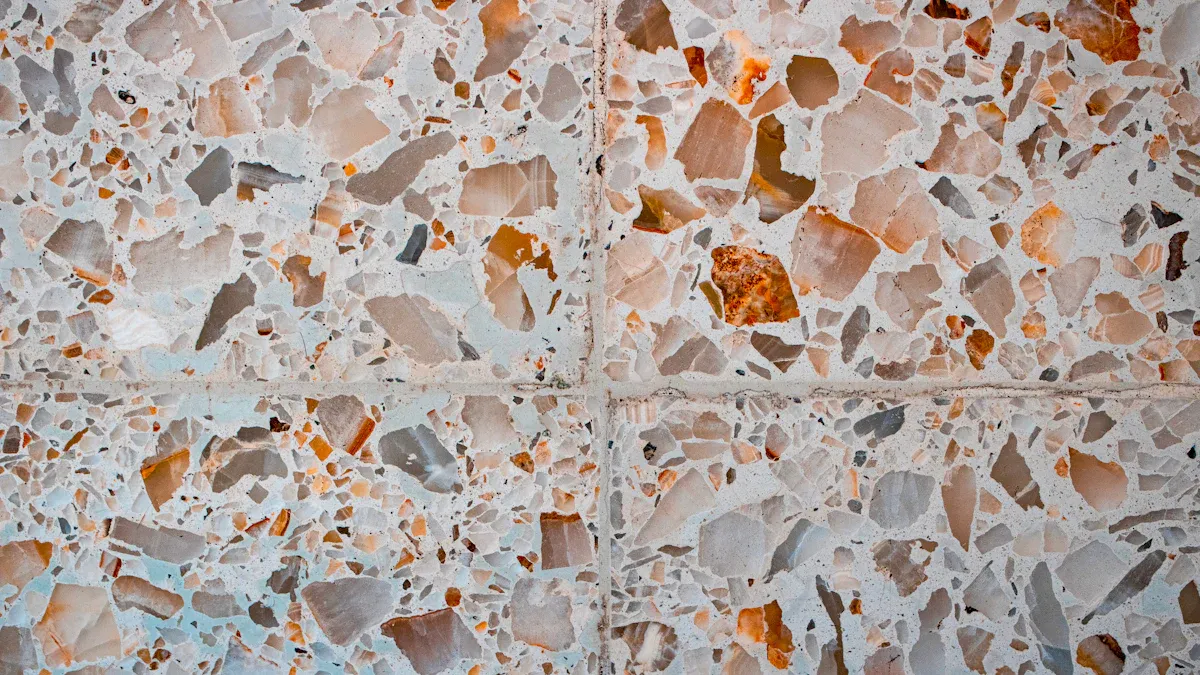
Designer-Controlled Matrix and Aggregates
Engineered composite surfaces give you complete control over your final design scheme. Quarry workers harvest dimensional stone in fixed natural colors, but you select aggregate ratios, chip sizes, and resin colors directly. You can specify recycled clear glass, mother-of-pearl, granite, or crushed calcitic chips. This flexibility lets you craft unified visual aesthetics across horizontal floors and vertical elements. You can easily extend your primary floor aesthetic onto custom countertops in a high-traffic public kitchen or executive office lounge. Specifiers also match these composite designs across vanity countertops inside a commercial bathroom interior. Choosing synthetic composite mixes over traditional natural marble panels eliminates mineral veining flaws while maintaining full design autonomy.
Seamless Layouts, Inlays, and Strips
Poured-in-place installations create expansive, continuous walking surfaces across large commercial spaces. You specify divider strips to form intricate geometric patterns, direct pedestrian movement, or establish crack-suppression joints. These strips anchor directly to the concrete subfloor before technicians pour the liquid matrix.
Industry standard materials for divider strips in seamless terrazzo floor patterns include:
- Zinc alloy (or white alloy of zinc)
- Aluminum
- Brass
- Plastic
Using custom terrazzo techniques allows you to execute precise brand logos, directional floor signage, and multi-color artistic patterns. Flexible metal strips bend effortlessly into complex curved shapes on site. Unlike rigid natural marble tiles that require porous grout lines, poured terrazzo cures into an unbroken monolithic floor assembly. This seamless layout improves sanitation and eliminates weak joint lines across heavy foot-traffic zones.
Custom Color Matching Standards
Matching precise architectural color schemes becomes effortless with modern resin formulations. Custom color matching systems from major paint brands like Pantone, Benjamin Moore, or Sherwin-Williams translate directly into epoxy matrix resin formulas through advanced optical technology. A spectrometer analyzes your targeted shade sample to precisely identify and replicate the necessary pigment proportions required for the matrix.
This scientific formulation process guarantees exact color uniformity across thousands of square feet. Natural quarried stone slabs display unpredictable visual shifts between quarry extraction blocks. Conversely, resinous composite systems ensure total color consistency across every section of your project. This precise control creates a uniform overall appearance across expansive airport terminals, medical corridors, and university facilities. Your finished floor surface retains its clean visual appearance for decades without fading or shifting.
Lifecycle Cost Comparison and Maintenance
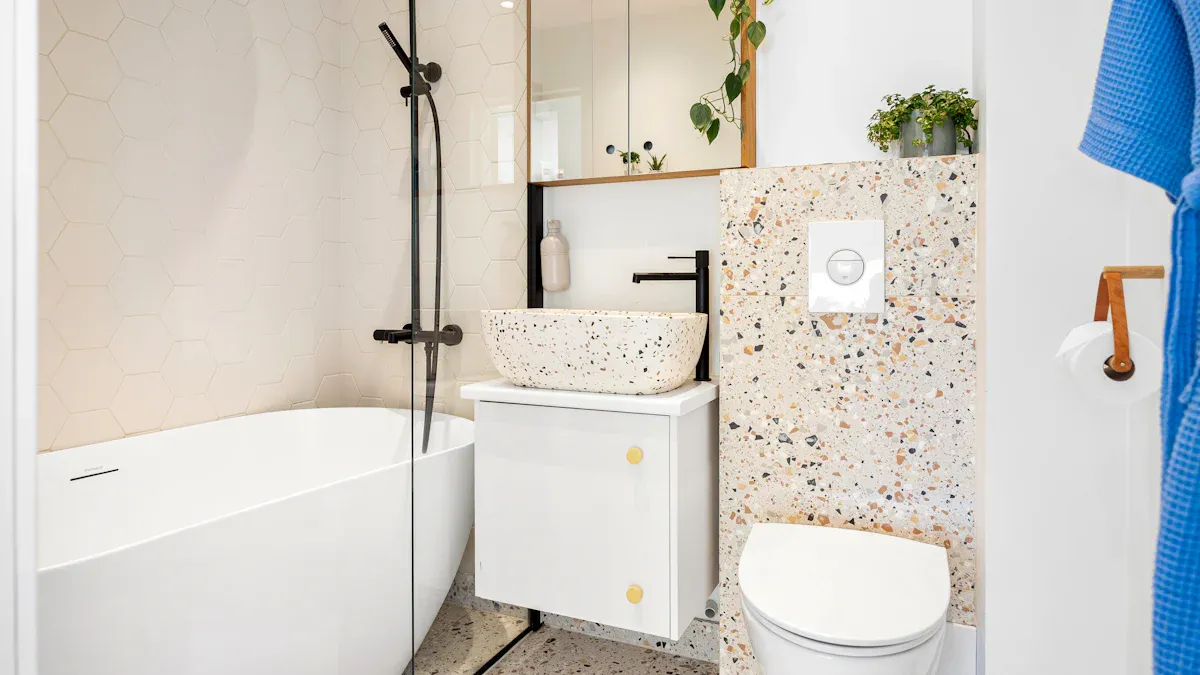
Specifiers must evaluate upfront construction expense alongside long-term facility operating budgets. Initial material price tags rarely reflect the actual financial commitment of a commercial floor assembly. A comprehensive cost comparison between synthetic resin systems and quarried stone slabs highlights vast differences in capital allocation over time.
Upfront Material and Labor Investment
When you calculate initial procurement expenses, natural stone slabs often command a higher price tag. The high raw cost of marble stems from expensive geological extraction, overseas shipping, and strict quarry yields. Rare aesthetic veining patterns drive raw material expenses even higher. Installing dimensional stone slabs also requires specialized stonemasons. These artisans must hand-trim individual tiles, mix thick mortar beds, and establish deep subfloor recesses. This labor-intensive installation process slows down construction timelines and increases immediate field labor costs.
{
  "project_scale_sqft": 10000,
  "initial_capex_estimates": {
    "thin_set_epoxy_terrazzo": {
      "material_per_sqft": 18.00,
      "labor_per_sqft": 14.00,
      "total_initial_investment": 320000
    },
    "dimensional_marble_slabs": {
      "material_per_sqft": 30.00,
      "labor_per_sqft": 22.00,
      "total_initial_investment": 520000
    }
  }
}
By contrast, fluid-applied thin-set composite installations streamline field operations. Trained crews pour liquid matrix quickly over expansive continuous floor zones. They lay divider strips rapidly, grind cured surfaces with heavy rotary machinery, and polish the top layer to your specified gloss level. While specialized equipment remains necessary, rapid coverage speeds reduce overall job site labor hours. You lower total initial construction costs while achieving superior dimensional consistency across your entire facility footprint.
Resealing and Maintenance Overhead
Daily facility operations reveal the true mechanical trade-offs between composite surfaces and quarried stone. Unsealed calcitic slabs feature high natural porosity. Acidic cleaners, food spills, and foot-borne grit dull factory polishes quickly. Facility managers must implement intensive surface restoration programs to preserve original visual appearance.
Typical natural stone restoration schedules demand extensive ongoing treatments:
- Continuous surface crystallization using acidic compounds and weighted steel wool buffers
- Periodic application of deep-penetrating fluorochemical sealers
- Mechanical re-honing to grind out deep traffic scratches and severe acid etching
- Routine grout joint repair, localized re-grouting, and stain removal
These repeating chemical and mechanical treatments raise annual maintenance requirements significantly. In contrast, non-porous resinous surfaces require only routine neutral damp mopping and periodic high-speed dry burnishing. The synthetic matrix blocks fluid penetration completely. You eliminate the need for harsh chemical strippers, toxic sealers, and expensive specialized restoration contracts.
Maintenance Efficiency Tip: Resinous composite floors eliminate mechanical crystallization routines entirely. You can clean high-traffic concourses using standard automatic scrubbers equipped with neutral pH cleaning solutions and soft microfiber pads.
Regarding overall durability and life, resinous floor choices provide unmatched operational security. Epoxy terrazzo flooring systems are designed to endure for the entire lifespan of the building structure in which they are installed. Due to their high resistance to cracking compared to cement-based alternatives, these floors do not require replacement after installation. This structural permanence frees your client from costly rip-out and replacement operations down the road.
30-to-40-Year Net Present Value Analysis
To evaluate real asset cost, building owners rely on Net Present Value (NPV) formulas. You calculate total life-cycle costs by combining initial capital expenditure with discounted annual maintenance expenses over decades of continuous operation.
Express the Net Present Value calculation through this straight formula: NPV = Initial Cost + Sum of [Annual Maintenance Cost / (1 + Discount Rate)^Year].
The following financial comparison demonstrates cumulative operating expenses per 10,000 square feet over a standard 40-year commercial lifespan, assuming a standard 4% annual discount rate:
| Operational Milestone | Thin-Set Epoxy Surface | Dimensional Quarried Stone Slabs |
|---|---|---|
| Initial Capital Investment | $320,000 | $520,000 |
| Year 10 Cumulative Cost | $345,000 | $610,000 |
| Year 20 Cumulative Cost | $370,000 | $780,000 |
| Year 30 Cumulative Cost | $395,000 | $950,000 |
| Year 40 Total Lifecycle Cost | $420,000 | $1,150,000 |
While thin-set composite systems require a solid initial investment, their low operational costs create high total long-term value. Heavy commercial foot traffic rapidly wears down softer natural calcitic tiles, pushing maintenance budgets upward every single year. Dimensional marble installations often force owners to complete full floor replacement cycles every 15 to 20 years due to severe cracking, deep staining, or unrecoverable surface wear.
Choosing resinous terrazzo delivers immediate structural efficiency and long-term financial stability. You avoid repeating capital expenditure cycles while providing your facility with a resilient, beautiful walking surface that retains its full aesthetic value across the full building lifespan.
Sustainability Credentials and LEED Contribution
Modern building standards prioritize low environmental impacts and healthy interior spaces. You must evaluate raw material extraction, indoor air emissions, and supply chain logistics when choosing floor assemblies. Thin-set composite systems offer major ecological benefits over heavily mined natural stones.
Recycled Aggregate Usage
Engineered composite floors utilize significant amounts of post-consumer and post-industrial waste. You can specify aggregate mixes containing recycled post-consumer glass, post-industrial porcelain, and reclaimed stone chips. Reusing these materials diverts tons of hard waste from local landfills.
leed_v41_credit_mapping:
  material_resources:
    building_product_disclosure: "Sourcing of Raw Materials (Option 1)"
    recycled_content_target: "Minimum 20% post-consumer aggregate"
  indoor_environmental_quality:
    low_emitting_materials: "Zero-VOC binder compliance"
In contrast, harvesting natural marble requires massive open-pit quarrying. Heavy diesel equipment cuts dimensional stone slabs out of natural geological formations. This extraction process disrupts habitats, consumes massive electrical power, and generates millions of tons of unrecoverable mineral sludge. Choosing composite systems protects natural landscapes while providing rich visual textures.
Indoor Air Quality and Zero-VOC Systems
Occupant health depends directly on clean indoor air. G·ONE terrazzo formulations use advanced liquid epoxy resin matrices engineered for zero-VOC compliance. These non-porous formulations release zero toxic chemical off-gassing into interior air streams during installation or daily operation.
Sustainability Note: Third-party testing validates that zero-VOC resin systems protect sensitive indoor facilities. Products earn GREENGUARD Certification and GREENGUARD Gold Certification after undergoing strict chemical emission testing. Furthermore, Declare Label Verification confirms that qualified resin formulations comply with International Living Future Institute standards to remain fully Red List Free.
These certifications allow you to earn critical points under LEED v4.1 Indoor Environmental Quality (EQ) credits for Low-Emitting Materials. You protect occupants in healthcare, education, and corporate settings from hazardous airborne chemicals.
Environmental Footprint and Local Sourcing
Shipping heavy building materials across long distances burns fossil fuels and increases project carbon footprints. Overseas quarries harvest raw dimensional stone and ship heavy slabs across oceans on fuel-intensive container ships. This long supply chain inflates your total embodied carbon calculations.
You can lower total supply chain emissions by sourcing aggregates regionally. Specifiers earn key LEED v4.1 Material and Resources (MR) credits by sourcing aggregate materials within a 500-mile radius of the job site.
| Sustainability Category | G·ONE Resinous Terrazzo | Quarried Dimensional Marble |
|---|---|---|
| Recycled Content | High (Up to 70% post-consumer glass/stone) | None (0% raw recycled content) |
| VOC Emissions | Zero VOCs (GREENGUARD Gold Certified) | Zero VOCs (Inherent to natural stone) |
| Embodied Carbon Footprint | Low (Lightweight profile reduces freight fuel) | High (Heavy slab freight increases carbon) |
| LEED v4.1 Contribution | Multiple MR and EQ credit paths | Limited sourcing credit paths |
By specifying lightweight composite surfaces, you streamline transportation emissions and lower building structural requirements. These sustainable material choices allow you to meet strict environmental standards without sacrificing aesthetic design or daily floor performance.
Specifier Decision Matrix by Application
Choosing between surfacing materials requires aligning physical properties with specific project demands. You must analyze foot traffic, chemical exposure, and structural support before finalizing building specifications. The following decision framework guides your selection process across diverse commercial and residential environments.
High-Traffic Commercial and Institutional Spaces
Continuous footfall and heavy equipment demand maximum surface durability. In any high-traffic commercial space, poured epoxy systems deliver the best long-term performance. Airport concourses, hospital corridors, and university halls benefit directly from seamless installations. Resin-bound aggregate surfaces withstand millions of footsteps annually without showing wear patterns.
{
  "matrix_selection_guide": {
    "high_traffic_zones": "Thin-set epoxy composite",
    "structural_load_preference": "3/8-inch lightweight assembly",
    "chemical_exposure_risk": "Zero penetration non-porous matrix"
  }
}
These non-porous installations block liquid penetration entirely. Facility staff clean busy concourses quickly using standard neutral cleansers. You avoid the high cost of continuous chemical stripping and re-crystallization treatments. When your project demands unbroken floor planes and extreme durability under heavy traffic, engineered composite floors provide the single best operational choice.
Low-Traffic Luxury and Architectural Features
Natural stone holds a distinct position in high-end architectural design. Quarried stone provides unmatched visual depth through natural veining and organic color variations. You achieve the best applications for natural stone slabs in controlled environments with low foot traffic.
Executive boardrooms, hotel reception backdrops, and luxury residential suites showcase natural stone effectively. However, you must adapt your material specifications based on installation placement and structural demands:
- Slab Thickness Selection: A 2 cm thickness works best for vertical wall cladding to minimize weight. Horizontal commercial floor slabs require a 3 cm thickness to sustain heavy physical loads.
- Finish Selection for Safety: High-gloss polished finishes elevate luxury vertical walls. Conversely, honed or matte finishes optimize slip resistance and reduce stain visibility on horizontal floors.
- Structural Reinforcement: High-strength fiber back mesh attached to stone panels reduces transit breakage by up to 80%. Metal backstring bars embedded into oversized slabs distribute stress to prevent cracking.
Design Tip: Calcitic slabs react quickly to acidic substances. Avoid unsealed natural stone in high-use service areas. Poured composite surfaces offer a stain-proof alternative for high-moisture vanity tops inside a public bathroom interior.
Vertical Wall Cladding (2 cm slab + back mesh) ---> Minimal dead load penalty
Horizontal Commercial Flooring (3 cm slab + honed finish) ---> Enhanced load capacity
The table below contrasts design criteria for high-use floors versus feature installations:
| Design Consideration | Low-Traffic Luxury Feature | High-Use Commercial Space |
|---|---|---|
| Aesthetic Focus | Intricate veining and high visual impact | Visual continuity across large areas |
| Material Choice | Quarried natural stone slabs | Engineered epoxy composite |
| Surface Finish | Polished for a high-end feel | Honed or matte for safety |
| Maintenance Profile | Periodic sealing and crystallization | Neutral mopping and dry buffing |
You can also specify engineered surfaces for specialized architectural elements beyond floors. Resinous composite formulations perform exceptionally well for heavy-use countertops across various commercial zones. An engineered composite surface resists harsh spills on a breakroom kitchen surface while providing seamless hygienic protection across every commercial bathroom vanity top. Specifiers balance aesthetics and technical needs by reserving dimensional stone for quiet feature zones while deploying durable terrazzo across demanding commercial floor environments.
In the technical evaluation of terrazzo vs marble, thin-set composite systems deliver superior structural efficiency, high impact durability, and maximum long-term ROI. Independent lifecycle cost analysis by the National Terrazzo & Mosaic Association confirms that poured epoxy terrazzo provides the lowest 40-year total cost of ownership while lasting over 75 years. Conversely, quarried marble retains a specialized niche for quiet luxury walls and low-traffic aesthetic accents.
Take immediate steps to enhance your building project specifications. Contact G·ONE to order physical aggregate samples for your material board. Download 09 66 00 MasterFormat specifications to simplify project documentation. You can also consult G·ONE technical reps to evaluate structural floor loads and subfloor conditions.
FAQ
How do you choose between terrazzo vs marble for high-traffic areas?
Select epoxy terrazzo for busy corridors and public spaces. It resists scratches, blocks liquid stains, and supports heavy footfall without showing wear paths. You should reserve marble for quiet feature walls or luxury suites with low traffic.
What are the main lifecycle costs associated with each material?
Epoxy terrazzo requires lower long-term maintenance costs. You avoid frequent crystallization and chemical sealers. Marble requires continuous polishing, sealing, and grout repairs, which increases your total building operating expenses significantly over 40 years.
Which flooring option adds less dead load to structural slabs?
Thin-set epoxy terrazzo adds only 3.5 pounds per square foot at 3/8-inch thickness. Dimensional marble slabs need a thick mortar bed, adding up to 27.5 pounds per square foot. You save structural concrete and steel weight by specifying thin-set systems.
Can you customize the matrix colors and aggregate patterns?
Yes. You can pick precise resin matrix colors matching Pantone or paint manufacturer standards. You also select aggregate materials like recycled glass, granite, or mother-of-pearl chips to create unique custom patterns.
How do stain resistance levels compare between resin and natural stone?
Resinous matrix systems create a non-porous surface that naturally blocks chemical spills and oils. Natural stone features a porous calcitic structure. Acidic liquids like coffee or orange juice rapidly etch and stain unsealed stone surfaces.
Does thin-set terrazzo contribute to LEED certification credits?
Yes. Zero-VOC epoxy formulations support Indoor Environmental Quality credits. You can also incorporate up to 70 percent recycled post-consumer glass or stone aggregates, earning key Material and Resources credits for sustainable design projects.