
You need a terrazzo kitchen floor that performs under heat, moisture, grease, impact, and constant foot traffic. Start with a five-step framework: define kitchen performance demands, shortlist terrazzo types by binder and aggregate, verify slip resistance and durability, evaluate maintenance and sustainability, and confirm budget and lead times. This sequence puts performance before appearance.
Kitchens punish weak surfaces. ANSI A326.3 sets a DCOF of at least 0.42 for wet traction, and OSHA 1910.22 requires you to minimize slip hazards. FDA and USDA rules demand smooth, non-absorbent, easily cleanable flooring. Architects and designers can apply this guide as a practical decision tool. You can evaluate G·ONE precast terrazzo systems and terrazzo tiles within the same framework.

Key Takeaways
- Choose terrazzo type by binder and format to match kitchen conditions and performance needs.
- Verify slip resistance with a wet DCOF of 0.42 or higher for safety.
- Plan a simple maintenance routine with pH-neutral cleaners to protect the floor.
- Specify recycled content and request transparency documents for sustainability.
- Evaluate life-cycle cost over initial price to see terrazzo’s long-term value.
Terrazzo Types for Kitchen Floors
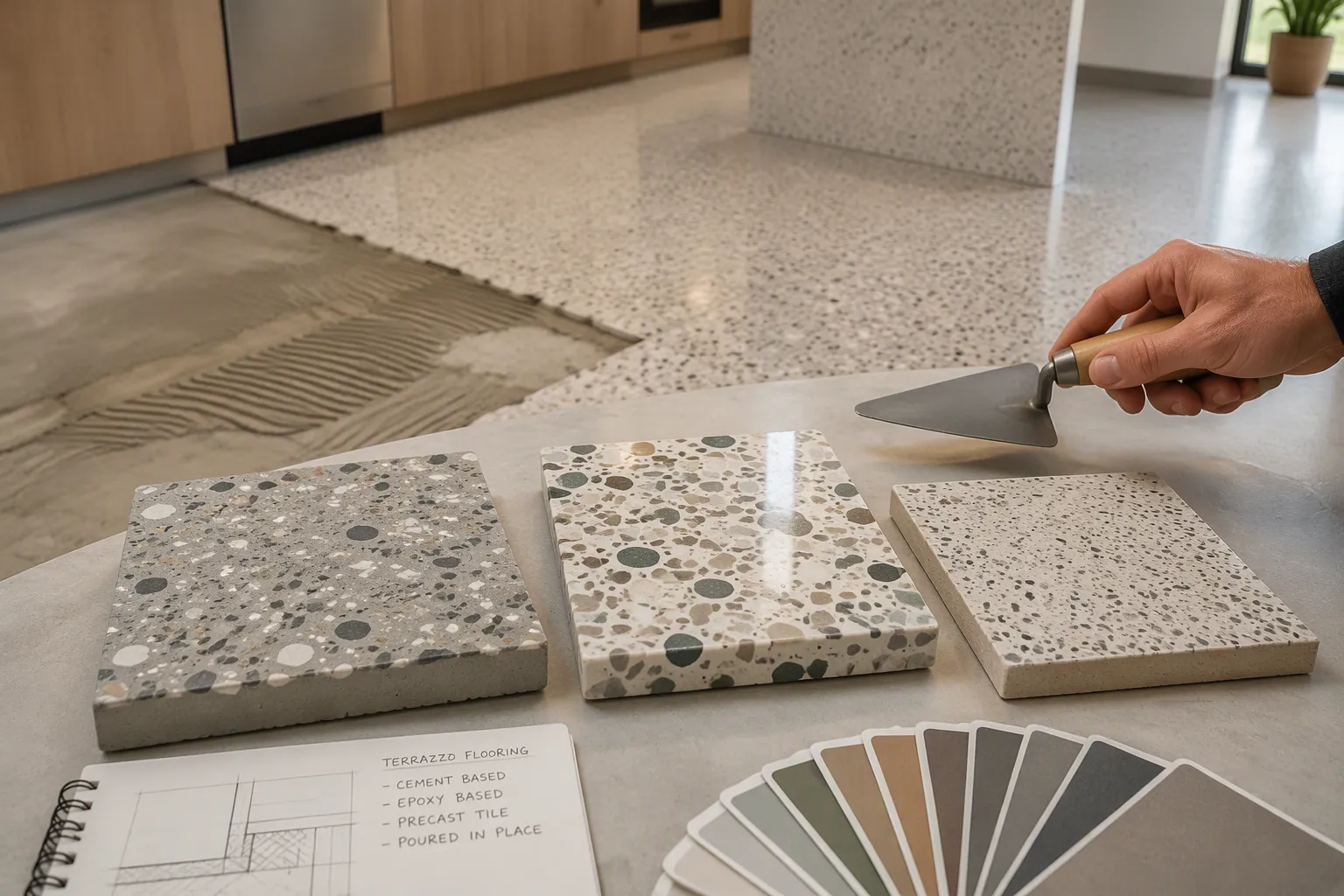
You will meet four basic terrazzo types in specification work: cement-based, epoxy-based, precast tile and slab, and poured-in-place systems. Each type carries distinct performance traits. Your choice shapes performance, maintenance profile, and the installation sequence of the finished floor.
Cement vs. Epoxy Matrix
The binder decides how the material behaves under heat, moisture, and grease. Compare the two matrices directly:
| Attribute | Cement-based Terrazzo | Epoxy-based Terrazzo |
|---|---|---|
| Durability | Durable with high strengths, but more prone to surface cracks; porous surface | Over 3x the compressive strength of cement terrazzo; superior tensile and flexural strength; reduced cracking and warping |
| Moisture resistance | Porous, allows moisture to breathe through; performs well in high-moisture and below-grade settings | Non-porous; requires a moisture mitigation system when relative humidity exceeds 75% |
| Kitchen suitability | Porous, so more susceptible to stains and bacteria; higher maintenance | Non-porous and resistant to stains and bacteria; low maintenance and easy to clean |
Match the matrix to the project conditions. Specify epoxy for indoor high-traffic commercial use. Specify cement for high-moisture or below-grade slabs, or pair epoxy with a moisture mitigation system. Choose epoxy for multi-story buildings and renovations. Reserve cement for outdoor or exterior exposure as rustic terrazzo. A porous cement surface absorbs grease and harbors bacteria, so it demands a stricter cleaning regime in food prep areas. A non-porous epoxy surface wipes clean and resists staining, which lowers long-term upkeep. Cement tolerates thermal movement well in exterior conditions, yet epoxy wins on hygiene inside the building envelope.
Precast Terrazzo Floor Tile and Slab Options
Traditional poured terrazzo flooring cures on site. That wet installation invites cracking as the slab moves and shrinks. Precast terrazzo floor tile and slabs cure under factory control. You gain stable dimensions, consistent color, and faster site work. Precast slabs suit food prep zones where schedule certainty and crack resistance matter. Poured systems still make sense for large uninterrupted areas, provided the substrate is stable and the schedule allows full cure time.
G·ONE supplies three precast lines for your projects. Regular terrazzo delivers a durable, polished surface for daily use. Recycled terrazzo incorporates recovered content for sustainability targets. Mosaic terrazzo creates intricate artistic patterns for feature zones. Custom aggregate blends let you specify marble, quartz, granite, or glass chips in your chosen gradation and color.
Architects often ask which format suits a busy cooking space. Precast terrazzo tiles give you modular layouts, easy replacement of damaged units, and predictable joints. Terrazzo tiles also let you phase work room by room without closing the whole floor. Large-format terrazzo tiles reduce joint count across open plans. Both formats accept the same aggregate palette, so you can carry one visual language from the cooking zone into adjacent rooms.
Weigh the binder and format together. A non-porous epoxy matrix in a precast tile gives you stain resistance plus crack control. A cement matrix in a precast slab suits a damp basement space. Document the matrix, the format, and the aggregate in the specification. That trio drives the durability and the maintenance regime of the finished terrazzo kitchen floor. Request samples of each candidate blend before you commit.
Key Terrazzo Kitchen Floor Criteria
Durability and Slip Resistance
A terrazzo kitchen floor must survive dropped pans, hot pots, and constant scraping. Precast terrazzo delivers strong resistance to impact and abrasion, and its dense matrix resists thermal shock better than many alternatives. Thermal performance also matters near ovens and dishwashers, where temperature swings test the binder. You should still verify the wear layer and aggregate hardness against your traffic load. For kitchens, where spills are common but standing water is limited, durable and easy-to-clean terrazzo tiles with a PEI rating of at least 3 are advised. Durability here means more than surface hardness. That durability depends on the binder and aggregate. Both qualities extend the longevity of the floor.
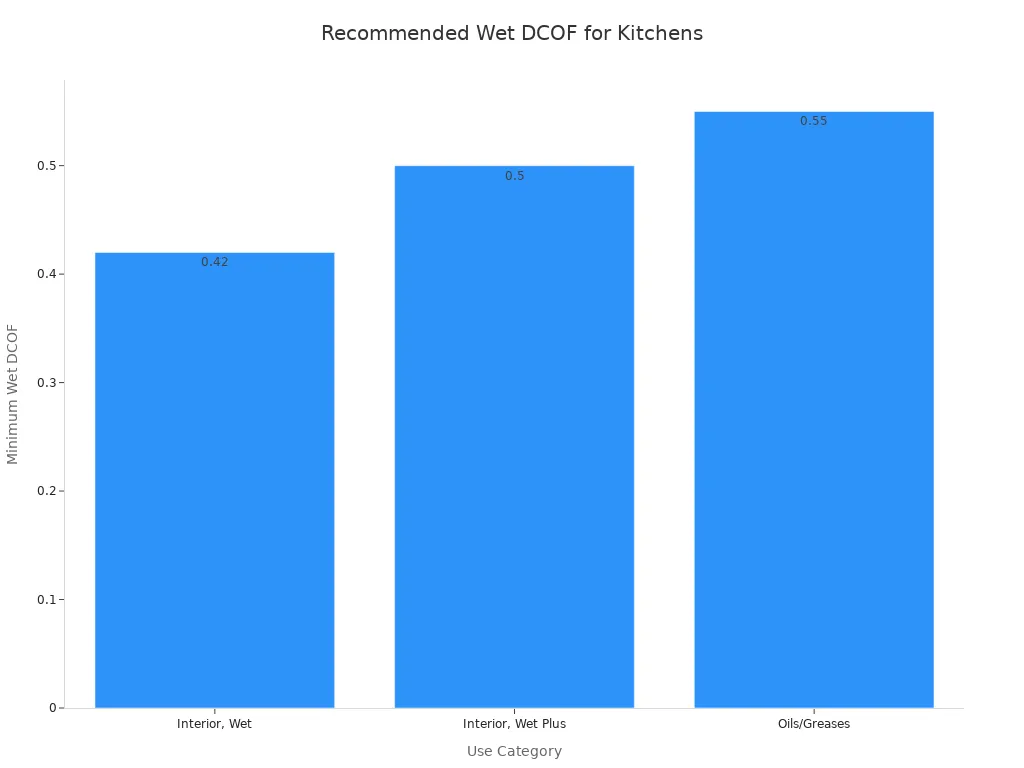
Slip resistance demands equal attention. ANSI A137.1 sets a wet DCOF of 0.42 or higher for flat indoor areas that can get wet. The IW category covers interior wet areas at 0.42, while the O/G category for commercial food service calls for 0.60 or greater when wet. Use this table to match the rating to your project:
| Use Category | Minimum Wet DCOF | Kitchen-Relevant Application |
|---|---|---|
| Interior, Wet | ≥ 0.42 | Residential kitchens |
| Interior, Wet Plus | ≥ 0.50 | Commercial kitchens |
| Oils/Greases | ≥ 0.55 | Commercial kitchen floors, food service |
Per ANSI A137.1, tile flooring intended for flat indoor areas that can get wet should have a DCOF of 0.42 or higher.
Texture matters as much as the number. Matte and textured finishes generally outperform polished surfaces in wet conditions. Textured terrazzo tiles near sinks and prep zones give you extra grip. Contaminants such as soap film, grease, and standing water reduce effective traction even on high-DCOF tile. Texture, cleanability, and long-term wear resistance matter as much as DCOF for sustained slip performance. Specify a matte finish and a documented DCOF above the baseline for high-liability zones.
Maintenance and Hygiene
The low-maintenance nature of terrazzo starts with sealing. A professional seal helps resist stains and water. Unsealed flooring stains more easily, so wipe spills fast. Sealing changes maintenance needs, so confirm the requirement with the building owner before you apply it.
Daily care is simple. Use a damp microfiber flat mop with a pH-neutral stone cleaner. Wring the mop until damp, not dripping, then rinse with clean water and dry to avoid streaks. Never use vinegar, lemon, ammonia, or acidic cleaners, because acid etches the calcium-based marble chips. A soft nylon brush cleans grout lines, edges, and baseboard strips where mops miss. Avoid abrasive pads and steel wool that scratch the polish. This routine supports durability and keeps the surface hygienic.
A steam mop is not recommended. Heat and forced moisture can penetrate hairline cracks, stress old seams, and cloud unsealed terrazzo. A wrung-out damp microfiber mop is the safer alternative. Good joint design and correct installation of terrazzo tiles support long-term serviceability. Plan movement joints at perimeters and large field changes, and keep joints narrow and filled. These habits protect the durability and longevity of the floor and preserve its low-maintenance requirements over time.
Design Flexibility with Kitchen Terrazzo Tile
Color, Aggregate, and Pattern Control
You control three variables on every terrazzo order: the aggregate, the pigment, and the pattern. Aggregate choice sets the visual scale. Marble chips give a classic look, quartz adds density, and glass chips catch light. Pigment choice sets the background tone. A light background with dark chips reads bold, while a tonal blend reads quiet. Pattern control sets the rhythm. You can specify uniform scatter, graded bands, or a custom-patterned kitchen floor that traces a zone boundary.
G·ONE custom blends give designers a wide range of colors, patterns, and finishes to work with. Start from a single color palette and build outward. Pull one chip color from the cabinetry and one from the countertop. That approach keeps the kitchen terrazzo tile tied to the room. Request physical samples of each blend, because screen renders shift tone. Review the samples under the actual lighting of the space. A variety of finishes, from matte to honed, changes how the same blend reads. Test your design ideas on a mock-up panel before you release the order.
Seamless Layouts Across Living Spaces
Terrazzo tiles can run continuously from the cooking zone into dining and living areas. A continuous field removes the threshold strips and visual breaks that fragment open plans. Specify one terrazzo floor tile across all three zones, and let the aggregate blend carry the transition. The same terrazzo kitchen floor then reads as one surface instead of three.
Plan the layout around the full run, not room by room. Set expansion joints at structural lines and door openings, and keep field joints aligned across zones. Confirm the substrate is continuous and level before installation. A single flooring field also simplifies maintenance, because one cleaning routine covers the whole space. Carry the same terrazzo into a hallway or entry, and the plan gains visual length. Document the joint plan early, and coordinate it with the structural engineer.
Sustainability and G·ONE Systems
Recycled Content and Indoor Air Quality
Terrazzo carries a strong sustainability story, and you can specify it with confidence. Recycled content enters the mix through several streams:
- Post-consumer glass from mirrors, bottles, and containers
- Post-industrial marble and granite chips from quarry operations
- Recycled porcelain and recycled concrete aggregates
- Plastic chips containing up to 20% recycled plastic
- Aluminum divider strips and steel underbed reinforcement with recycled metal content
A floor using 100% recycled glass aggregate can reach as much as 75% recycled raw material by volume. That figure gives you a defensible number for project sustainability targets.
Indoor air quality matters just as much in a kitchen. Thin-set epoxy terrazzo uses zero-VOC materials, and the cured floor shows little to no off-gassing over its life. The non-porous finish resists bacteria, mold, and mildew, and it does not let moisture accumulate. You gain a mold-free environment plus easier cleaning. Recycled aggregates sourced within 500 miles of the site contribute to LEED Materials and Resources credits. Low- or zero-VOC materials support occupant health and comfort.
Documentation and Material Transparency
Material transparency has become a baseline expectation in green building. You should request third-party documentation before you release a terrazzo specification. Environmental Product Declarations (EPDs) report life-cycle impact, Health Product Declarations (HPDs) disclose ingredients, and GREENGUARD Gold certification verifies low VOC emissions. A published EPD for a thin-set epoxy system illustrates the level of detail available:
The system is GREENGUARD Gold-certified for low VOC emissions, with the only component containing any VOCs being the sealer. The EPD documents a cradle-to-gate global warming potential of 39.03 kg CO2 equivalent per square meter. With a reference service life of 60 years, the annualized impact is 0.651 kg CO2 equivalent per square meter per year.
G·ONE supports this transparency push through digital catalogs, technical specifications, and material selection manuals. Ask for project samples and recycled content summaries alongside the EPD. Document the binder, the aggregate source, and the VOC profile in your specification. That package protects the longevity of your sustainability claims and simplifies LEED v4 Low-Emitting Materials submittals. Pair terrazzo tiles with a clear maintenance plan, and the floor keeps its environmental and hygienic performance for decades.
Budget, Lead Time, and Life-Cycle Cost
Material, Installation, and Maintenance Costs
Budget talks start with the installed cost. Terrazzo tile material runs $4–$12 per sq. ft., and tile labor adds $5–$10, for a tile total of $9–$22. Poured terrazzo material costs $5–$15 per sq. ft., and poured labor can reach $20. A typical residential whole-project total lands between $4,000 and $7,000, averaging $4,400. Small kitchens carry a higher per-square-foot price, because specialized materials cost more at low volumes. A simple 1,000 sq. ft. residential kitchen starts at $30+ per sq. ft., while a simple 30,000 sq. ft. installation drops to $18.
Maintenance stays modest. Clean terrazzo like marble, so avoid abrasive and acidic cleaners such as vinegar. Mop with plain water or a neutral cleaner, remove dirty water with a wet vac or squeegee, and buff with a soft cloth to keep the shine. These low-maintenance requirements protect the surface for decades.
Lead Times and Terrazzo-Look Alternatives
Authentic terrazzo tile orders can take three to four months. Plan that window into the schedule early. A small residential kitchen installation also takes at least three days on site, because poured product needs cure time. When the program cannot absorb that lead time, porcelain stoneware terrazzo offers a faster route. Terrazzo-look porcelain tile costs $8–$15 per sq. ft. and lasts 30+ years, though it brings moderate upkeep and grout maintenance.
Frame value engineering around life-cycle cost, not first cost. Terrazzo’s longevity of 75–100+ years offsets its higher upfront price with zero replacement cycles.
“When you factor in installation time, maintenance labor, and replacement frequency, terrazzo’s durability delivers measurable savings over a 30-year building life.”
Compare that longevity against luxury vinyl tile at 10–20 years and polished concrete at 30+ years. Terrazzo flooring wins on total cost of ownership across the building’s service life.
Terrazzo vs. Alternative Kitchen Flooring
Tile, Polished Concrete, and Resilient Flooring
Compare terrazzo against the three materials you will most often weigh in a kitchen. Ceramic and porcelain tile offer a wide price range and easy replacement of damaged units, yet grout lines collect grease and demand scrubbing. Polished concrete delivers a monolithic look and strong wear life, but it feels hard underfoot and shows stains without a sealer. Resilient flooring such as luxury vinyl tile installs fast and feels warm, though it wears out sooner and cannot be refinished.
Terrazzo holds a distinct position in that group. It ranks among the most durable flooring materials, resists chipping, and can be re-finished and polished to look new. Once sealed correctly, it becomes impenetrable to water and stain damage. That combination of durability and refinishability separates it from resilient products, which you replace rather than restore.
When to Specify Terrazzo Tiles
Specify terrazzo tiles when the project pairs heavy foot traffic with a long service horizon. Restaurants, cafes, bars, and public spaces have relied on terrazzo for decades, and homes now use it indoors and in outdoor zones such as gourmet areas and balconies. Large-format terrazzo tiles cut grout lines far below small mosaic work, so there is much less grime to scrub. A honed or matte finish is the smarter pick where water and oil regularly hit the floor.
Plan around two practical points. Marble chips react to acidic spills such as citrus, wine, and vinegar, so prompt wiping is required. The surface also feels cold in winter without a heat insulator, and installation is complex enough to leave to professionals. Weigh those trade-offs against the longevity you gain. For a terrazzo kitchen floor that must look new after years of service, the choice of flooring becomes clear. Terrazzo tiles reward that decision through low maintenance and a durable surface. Budget for the higher initial cost, then let the few repairs and long service life repay it. That logic makes terrazzo a strong answer for kitchens’ flooring in high-use homes and hospitality projects.
Installation and Specification Essentials
Substrate Preparation and Movement Joints
A sound substrate protects the durability of your terrazzo floor. Measure slab humidity before installation. If the reading exceeds the manufacturer’s maximum, extend curing time or apply a compatible moisture mitigation membrane. This step matters most for vapor-impermeable epoxy terrazzo, where trapped moisture causes delamination. Work back from the required finished floor elevation to set the concrete height. Grind or bush-hammer a high slab, and fill a low slab with compatible material. For thin-set terrazzo, hold the substrate flat within 1/4 inch in 10 feet from the required plane. Remediate cracks so they do not telegraph through bonded systems.
Divider strips carry both aesthetic and functional duties. They accommodate movement across large floor areas and may be zinc, brass, aluminum, or plastic, commonly 16 gauge or 1/8 in. wide. Each strip must adhere tightly to the substrate, because a strip is not a leveling device. Set the strip layout around existing concrete control joints, existing cracks, perimeter walls, and other fixed elements. A divider strip at or near the base acts as a perimeter movement joint.
Specifying G·ONE Terrazzo Systems
G·ONE gives architects and designers the documents a specification demands. Digital catalogs support comparison of aggregate blends and binder options. Design lookbooks let you review finish samples before you finalize the terrazzo floor package. Technical specifications document performance criteria and sustainability claims, and they support green specifications and LEED submittals. Pull these resources early in the installation process, so the specified system matches the substrate and joint plan.
The supporting services close the gap between document and site. Tailored consultations adapt terrazzo tiles to your exact palette, aggregate blends, and mold shapes. Request project samples to validate the specification before you release the order. Expert engineering support supplies performance data and guidance on meeting local codes, so the floor performs as specified over the building’s life. Combine the documents with a sample review, and your terrazzo tiles reach the site with fewer surprises.
Project Examples and Lessons Learned
Residential and Hospitality Kitchens
A residential open-plan project shows how far one material can carry a design. The design team ran a single terrazzo field from the cooking zone through the dining area and into the living room. One aggregate blend and one color palette held the whole plan together. The owners gained a floor that hides crumbs and resists daily spills. The specification also set a matte finish near the sink, which raised wet traction without breaking the visual line.
Hospitality kitchens test durability harder. A busy restaurant floor faces grease, dropped pans, and constant traffic. Teams that specify a non-porous epoxy matrix with a documented wet DCOF above the commercial baseline report fewer slip incidents and simpler cleaning routines. They also plan replacement of individual terrazzo tiles instead of closing the whole floor. The lesson is consistent: match the binder, the finish, and the joint plan to the real traffic load before you release the order.
Common Specification Pitfalls
The most frequent mistake is choosing a polished finish for a wet prep zone. A high DCOF number means little when grease sits on a glossy surface. Specify a matte or textured finish and confirm the rating in writing. A second pitfall is skipping the mock-up. Screen renders shift tone, and a blend that looks subtle on a monitor can read loud under kitchen lighting. Review a physical sample panel on site.
Schedule errors cost more than material errors. Authentic terrazzo tile orders can take three to four months, so late decisions push the whole program. Lock the lead time into the schedule at design development. Finally, protect longevity with the right maintenance plan. Acidic cleaners etch marble chips, and a steam mop can cloud the surface. Hand the owner a written cleaning routine at handover. That single step preserves the durability you specified and protects the installation for decades.
Apply the five-step framework: define kitchen performance demands, shortlist terrazzo types by binder and aggregate, verify slip resistance and durability, evaluate maintenance and sustainability, and confirm budget and lead times. Performance and safety come first. Maintenance and design follow. Sustainability and cost close the review.
Shortlist terrazzo systems early in design development. Request mock-ups and technical documentation before you commit. Engage suppliers such as G·ONE during specification, so performance data and aesthetics align. Architects and designers who raise these questions early avoid late substitutions.
Terrazzo tiles will keep earning their place in kitchens. The material pairs long service life with design control. That pairing suits durable, design-forward kitchen environments for decades.
FAQ
Does a terrazzo kitchen floor need sealing?
Yes. A professional seal helps the surface resist stains and water. Unsealed flooring stains more easily, so wipe spills quickly. Confirm the sealing requirement with the building owner before you apply it, then hand over a written cleaning routine.
What wet slip rating should you specify for a commercial kitchen?
Specify a documented wet DCOF of 0.55 or higher for zones exposed to oils and grease. ANSI A137.1 sets 0.42 as the baseline for flat indoor wet areas. Pair the rating with a matte or textured finish, because grease reduces traction on polished surfaces.
How long does an authentic terrazzo tile order take?
Plan three to four months for an authentic terrazzo tile order. Lock that window into the schedule at design development. When the program cannot absorb the lead time, terrazzo-look porcelain tile offers a faster route at a lower first cost.
Can you run one floor across the kitchen, dining, and living areas?
Yes. Specify one tile and one aggregate blend across all three zones. A continuous field removes threshold strips and visual breaks. Set expansion joints at structural lines and door openings, and align field joints across zones.
How long does the floor last compared with alternatives?
Terrazzo lasts 75–100+ years with proper care. Luxury vinyl tile lasts 10–20 years, and polished concrete lasts 30+ years. Frame value engineering around that service life, not the first cost, and the total cost of ownership favors terrazzo.