
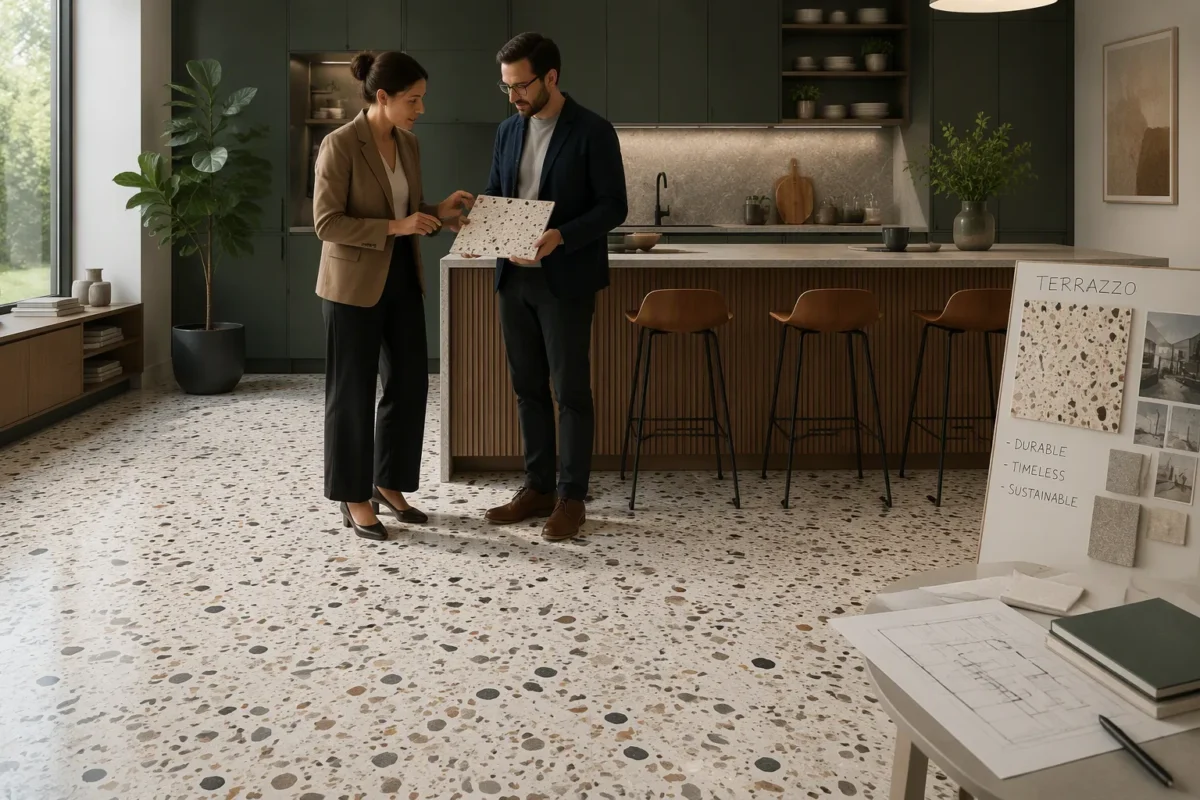
Kitchens combine heavy foot traffic with moisture, oil, wine, citrus, and heat. A terrazzo floor kitchen meets these conditions well: the surface is seamless, design options are broad, service life is long, and maintenance stays low. Terrazzo flooring costs roughly $12–$35 per square foot, yet the material is often described as a forever floor that withstands heavy wear. This guide gives architects and designers a decision framework for material type, performance, design, compliance, and cost. It compares options neutrally so each project can match a system to its own fit. Durability claims deserve scrutiny, and high-traffic areas reward careful specification.
Key Takeaways
- Choose epoxy terrazzo for stain resistance or cement terrazzo for moisture tolerance.
- Plan for a slip rating of at least 0.42 DCOF to keep kitchens safe.
- Select aggregates and patterns that match your cabinets and countertops for a cohesive look.
- Budget $12–$35 per square foot and consider lifecycle value over upfront cost.
- Schedule three to four months for true terrazzo orders and plan substrate work early.
Terrazzo Types for Kitchen Floors
Binders and Four Core Types
The binder matrix drives kitchen performance more than any other specification choice. Epoxy binders deliver more than three times the compressive strength of cement binders, and they resist tensile and flexural stress far better. That strength reduces crack and warp risk in busy kitchens. Epoxy terrazzo also offers a non-porous surface, so it resists stains and skips periodic sealing. Cement-based terrazzo tolerates residual moisture and vapor transmission, which suits damp or below-grade slabs. It also handles thermal shock and aggressive chemical spills with ease. A specifier should weigh these trade-offs against the kitchen’s actual conditions.
| Factor | Epoxy (resinous) | Cementitious |
|---|---|---|
| Moisture tolerance | Low; needs a dry, vapor-tight slab | High; suits damp or below-grade slabs |
| Chemical resistance | Good against solvents and mild alkalis | Superior against aggressive acids |
| Abrasion and impact | Moderate | Outstanding |
| Surface safety | Smooth; slippery when wet | Matte; naturally slip-resistant |
Four core types merit review. Standard terrazzo uses marble, quartz, or granite chips in a binder. Recycled terrazzo incorporates reclaimed aggregate and supports green building goals. Mosaic terrazzo creates intricate artistic patterns for feature zones. Precast terrazzo floor tiles arrive factory-finished for tight quality control. G·ONE supplies precast terrazzo, recycled terrazzo, and mosaic terrazzo lines, and each line supports custom color and aggregate blends.
Precast versus Poured-in-Place
Precast terrazzo tiles and poured terrazzo differ mainly in site conditions and schedule. Precast terrazzo tiles cure in a controlled plant, so color and finish stay consistent. Installation moves quickly with minimal wet work. Poured systems form a seamless field with no joints, which suits large commercial kitchens. Poured work demands careful substrate prep and longer site time. Both routes deliver durable terrazzo flooring. Project size, joint tolerance, and schedule decide the better fit.
Terrazzo Flooring Performance
Durability, Stains, and Maintenance
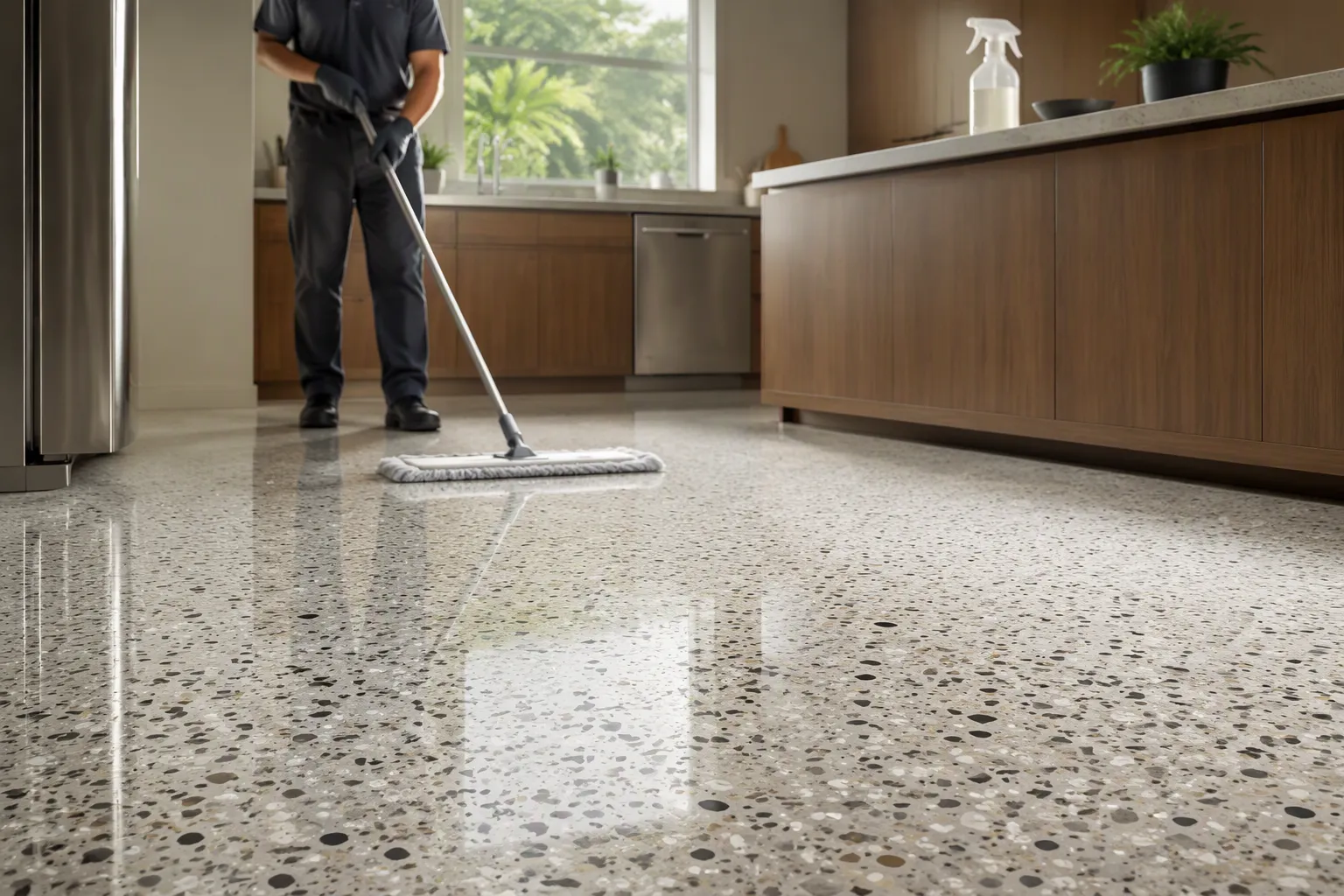
Kitchen conditions test every floor. Oil splashes, wine spills, citrus juice, and hot pans all attack the surface. Terrazzo handles this mix well. A hard-wearing surface resists abrasion from constant foot traffic and rolling carts. Epoxy matrices stay non-porous, so stain resistance holds against everyday kitchen spills. Cementitious terrazzo brings superior chemical resistance for aggressive acids. Both systems reward a simple care routine. Terrazzo flooring is extremely low maintenance when properly installed and sealed. Daily dust mopping and stone-safe cleaners keep the surface clear. Spills need prompt response, not harsh chemicals.
Professional service keeps terrazzo looking its best over decades. The table below summarizes recommended procedures and frequencies.
| Maintenance Aspect | Recommended Procedure / Frequency |
|---|---|
| Routine professional service | Deep cleaning of traffic lanes, refining clarity and sheen, minor spot repairs, and sealing support when appropriate |
| Frequency (residential) | Annual visit for many homes |
| Frequency (busy commercial/public spaces) | Quarterly or even monthly service depending on traffic |
| Daily care guidance | Straightforward daily cleaning guidance provided alongside professional service |
This maintenance plan adapts to moisture, spills, and daily wear. Busy commercial kitchens often need quarterly or monthly visits. Many homes do well with an annual service call. Sealer evaluation and fresh penetrating sealer improve stain resistance and ease cleaning between visits.
Installation, Weight, and Repair
Terrazzo installation demands disciplined substrate work. The slab must be clean, steel-troweled, and cured for at least 28 days with no curing agents in terrazzo areas. Leveling tolerance allows a maximum variation of 1/4 inch in 10 feet. A moisture barrier of at least 10 mils sits directly under the slab. Moisture testing follows ASTM F 1869-98 and ASTM F 2170-02. Cracks wider than 1/32 inch get routed, filled with rigid epoxy, and covered with a flexible epoxy membrane at least 24 inches wide. Divider strips go above control, cold, and expansion joints.
These specifications cover substrate preparation only. Structural weight review remains a separate step, and the design team should confirm slab capacity before specifying any topping.
Local repair preserves the floor instead of replacing it. Small batches of matching topping repair cracks, spalls, and delaminations. The repair team matches the matrix and the stone chips in size, gradation, and type. A typical crack fix follows these steps:
- Inspect the floor to assess the extent of damage.
- Clean the cracked area to remove debris and dust.
- Fill cracks with a color-matched epoxy filler compatible with the terrazzo binder.
- Grind the filled area level with the surrounding floor using diamond abrasives.
- Polish the repaired area to blend with the rest of the floor.
Regrinding, grouting, and polishing restore cementitious terrazzo with severe scratches. Strip and reseal restores protection when the finish dulls. These methods produce a seamless, durable fix at far lower cost than replacement. Good moisture resistance and sound installation practice protect the investment for decades.
Terrazzo Floor Kitchen Design
Color, Aggregate, and Pattern
Aggregate selection shapes both the look and the wear life of a terrazzo floor kitchen. Marble, quartz, granite, and glass chips each bring a distinct character. Natural stone provides earthy tones and organic texture. Glass adds brightness and dimensionality. Embedded particles are typically harder than the surrounding matrix, so the surface resists scratching, chipping, and abrasion. A higher aggregate-to-matrix ratio yields more dramatic visual engagement. Polished terrazzo finishes boost color vibrancy, while matte surfaces reduce glare and can enhance slip resistance.
| Aggregate | Effect on Color | Effect on Durability |
|---|---|---|
| Marble, quartz, granite | Earthy tones, organic texture | Harder than matrix; resists abrasion |
| Glass | Brightness and dimensionality | Contributes to hard embedded aggregate |
Pattern strategy follows the same logic. Macro-chip designs use large, prominent fragments for statement floors. Micro-chip patterns distribute smaller aggregates evenly for a subtle, minimalist look. Large-format tiles with fewer grout joints create visually continuous flooring in open-concept kitchens. The 2026 palette favors ivory, cream, beige, taupe, warm gray, and soft terracotta. Charcoal, gray, and black patterns add contrast to minimalist spaces. These color choices keep terrazzo relevant in both residential and commercial kitchens.
Pairing with Cabinets and Countertops
Successful pairings start with the matrix undertone. Designers should separate dominant chip colors from occasional accent chips, then classify the countertop’s visual scale. Warm wood cabinets connect through a warm matrix or cream chip. Green or blue cabinets can repeat an aggregate color. Warm white cabinets expose blue casts, and cool white cabinets make cream terrazzo look more yellow. Dark cabinets raise light-dark contrast and make pale chips pop.
Backsplash scale should answer chip scale. Small-chip terrazzo pairs well with larger field tile and restrained grout. Large-chip terrazzo suits large-format field tile or a simple slab. Coordinated surfaces extend consistent terrazzo flooring into adjacent living and dining areas. A terrazzo-inspired backsplash adds pattern without elaborate detailing. Testing the complete group in the actual room remains the final step.
Flooring Compliance and Safety
Slip Resistance and Hygiene
Slip resistance is a measurable specification, not a marketing claim. For indoor wet residential spaces such as kitchens, a minimum DCOF of 0.42 applies, with an ideal R-rating of R10 to R11. Tiles rated R10 suit areas with occasional moisture, including kitchens and bathrooms. R10 or P3 ratings are recommended for residential kitchens, dining rooms, laundry rooms with closed appliances, bathroom dry zones near the sink, and office lobbies and corridors. These spaces stay mostly dry but may occasionally get a little moisture. A textured matte surface outperforms a smooth honed surface near sinks and prep zones. ANSI A326.3 sets the DCOF ≥ 0.42 benchmark, and OSHA 1910.22 requires the floor to minimize slip hazards. ADA accessibility adds a stable, firm, and slip-resistant requirement for staff and visitors.
Hygiene depends on cleanability. The FDA Food Code requires smooth, durable, easily cleanable floors in food areas, and Section 6-201.13 requires coved and sealed floor-to-wall junctures in wet-flush zones. USDA sanitation standards call for non-absorbent, chemical-resistant surfaces. A seamless terrazzo floor removes grout joints where bacteria accumulate. Integral cove base, proper slope-to-drain installation, and a non-slip sealer in grease-prone zones complete the hygiene strategy. These details keep terrazzo compliant and easy to sanitize.
Indoor Air Quality Certifications
Specifiers should verify third-party certifications before approving any flooring product. Relevant programs include low-emission VOC testing, recycled-content validation for recycled terrazzo lines, and health-product declarations that disclose material ingredients. Manufacturers should supply current test reports rather than generic claims. G·ONE provides technical specifications and material selection manuals to support this review. Confirming these documents early protects the project from substitution risk at bid stage.
Terrazzo Floor Tiles Cost Guide
Installed Cost and Lifecycle Value
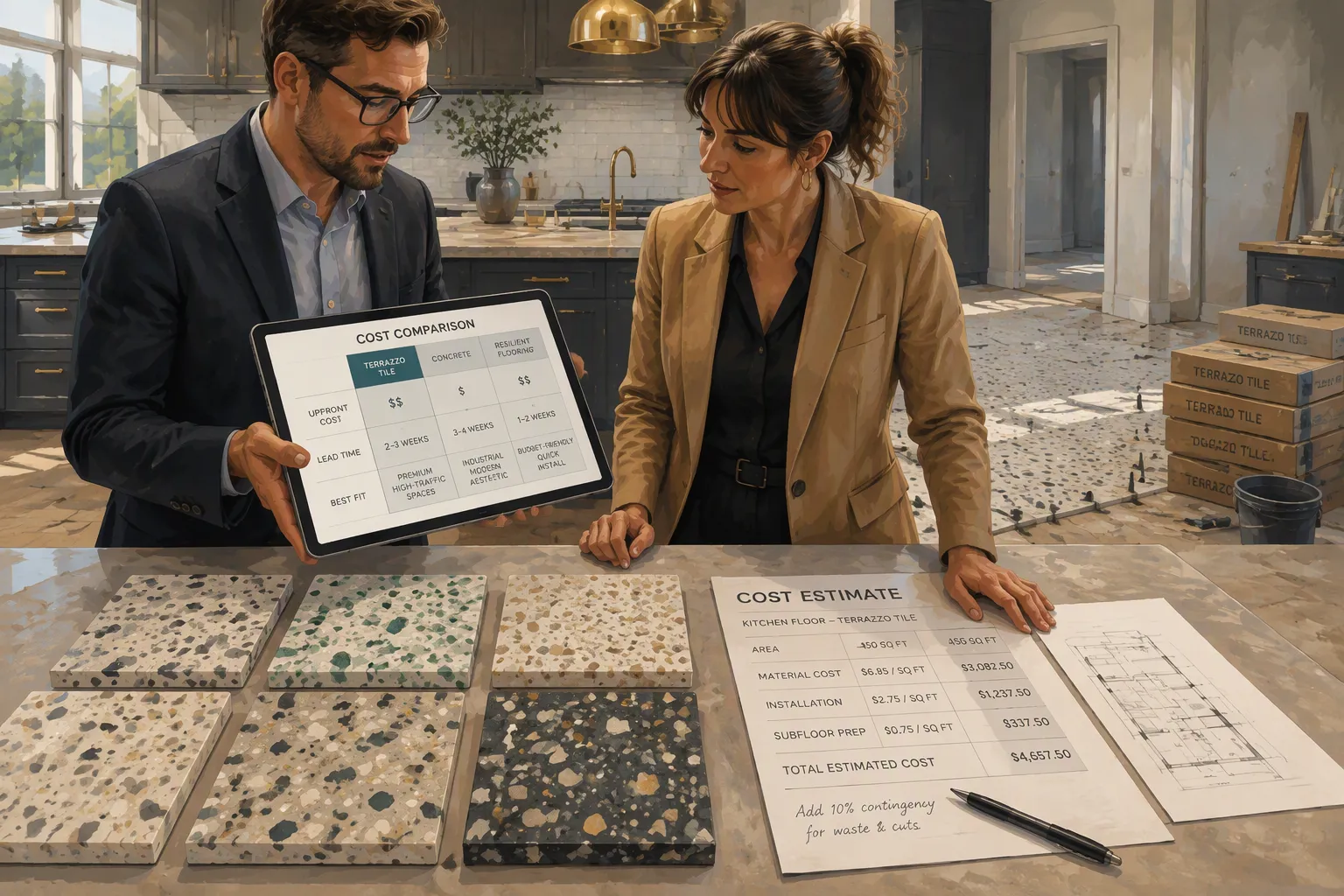
Budget conversations start with the installed cost, not the sticker price. Terrazzo flooring runs roughly $12–$35 per square foot, and several drivers push a project toward either end of that band. Aggregate type sets the material cost: glass and imported stone chips cost more than standard marble. Binder choice matters too, since epoxy systems and cement systems carry different material and labor profiles. Substrate preparation adds real money. Crack routing, moisture barriers, and leveling work all consume labor before any topping goes down. Pattern complexity raises the price again, because intricate mosaic work demands more layout time. Site access and floor area round out the list, and small rooms with tight corners cost more per square foot than open fields.
Lifecycle value tells the fuller story. A terrazzo floor resists abrasion, cleans easily, and accepts local repair instead of replacement. Owners avoid the recurring replacement cycle that thinner resilient products require. That long service life offsets the higher upfront number, and the practical side of terrazzo floor tiles becomes clear on a whole-life basis.
Comparing Tile, Concrete, and Resilient
Each option fits a different project profile. The table below compares the three routes on the factors that shape a kitchen decision.
| Option | Upfront Cost Profile | Lead Time | Best Fit |
|---|---|---|---|
| Terrazzo tiles | Higher; driven by aggregate, binder, and substrate work | Three to four months for true terrazzo orders | Projects that prioritize service life and design control |
| Concrete | Moderate; depends on finish and sealer | Shorter than terrazzo | Budget-led or industrial kitchens |
| Resilient | Lowest upfront | Fast | Fast-track or temporary spaces |
True terrazzo orders can take three to four months, so schedule planning starts early. Terrazzo-look porcelain tiles offer a faster installation path with a shorter lead time. Neither route is better in every case. A tight schedule favors porcelain, and a long-horizon project favors true terrazzo. Designers should match the choice to the program rather than defaulting to one system.
G·ONE supports budgeting and specification with custom color and aggregate blends, project samples, digital catalogs, and engineering support. Samples let the team confirm colors before committing to a full order. Digital catalogs give estimators the technical data they need for accurate pricing. Engineering support answers substrate and weight questions during design. Large-format terrazzo tiles reduce joint count and simplify installation on open kitchen plans. Early engagement with these resources keeps the budget realistic and the specification defensible.
A sound kitchen specification matches terrazzo type to the actual use case, verifies performance data, confirms compliance, and weighs installed cost against lifecycle value. Architects and designers can close the decision with a short checklist:
- Material type: precast, poured, recycled, or mosaic
- Slip rating: DCOF of at least 0.42
- Maintenance plan: daily care plus scheduled service
- Substrate and weight review: confirm slab capacity
- Lead time: plan for three to four months on true orders
- Budget benchmark: compare installed cost with whole-life value
G·ONE supplies project samples, custom blends, and engineering support to finalize flooring system selection. Early engagement keeps terrazzo flooring decisions practical and defensible.
FAQ
Which terrazzo system suits a wet, busy kitchen?
Epoxy systems resist stains and clean easily, so they fit most commercial kitchens. Cementitious systems tolerate residual moisture and aggressive acids, which suits damp or below-grade slabs. Specifiers should match the binder to the actual conditions. Both routes deliver a durable terrazzo surface.
How long does a terrazzo installation take?
True terrazzo orders can take three to four months. Substrate work adds time on site: the slab needs a 28-day cure, moisture testing, and crack repair before any topping goes down. Teams should plan the schedule early. Terrazzo tiles arrive factory-finished and reduce wet work.
What slip rating should a kitchen floor carry?
Indoor wet residential spaces need a minimum DCOF of 0.42 under ANSI A326.3. An R10 to R11 rating suits kitchens well. A textured matte surface outperforms a smooth honed finish near sinks and prep zones. OSHA 1910.22 also requires the floor to minimize slip hazards.
Do terrazzo floor tiles cost more than other kitchen options?
Terrazzo flooring runs roughly $12–$35 per square foot installed. Aggregate type, binder choice, substrate prep, and pattern complexity drive the final number. Concrete and resilient products cost less upfront. A long service life and local repair options offset the higher initial spend on terrazzo.
Can a damaged terrazzo floor be repaired locally?
Yes. Small batches of matching topping repair cracks, spalls, and delaminations. The repair team matches the matrix and stone chips in size, gradation, and type. Grinding and polishing blend the patch into the field. This approach costs far less than replacing the flooring.