
Modern terrazzo flooring is a high-performance, design-flexible system. It is not a nostalgic speckled surface. This material resolves the tension between durability, sustainability, and custom aesthetics in one specification. You get a unique blend of durability, aesthetics, and sustainability without compromise. If you are specifying flooring for a healthcare lobby, boutique hotel, or corporate HQ, terrazzo deserves a fresh look. A complete guide to terrazzo flooring helps you evaluate binder systems, aggregate blends, and installation methods with confidence. Terrazzo flooring outlasts vinyl, tile, and carpet. Terrazzo also supports recycled content and low-VOC binders. Specify terrazzo once, and it will serve your project for decades.
Key Takeaways
- Modern terrazzo flooring lasts over 40 years and saves money over time.
- You can choose from many colors, patterns, and recycled materials for a custom look.
- Terrazzo is easy to clean and resists bacteria, making it great for hospitals and schools.
- Plan ahead: terrazzo installation takes 3-4 months from start to finish.
- Work with a manufacturer like G·ONE to get samples and expert help for your project.
What Is Modern Terrazzo Flooring?
Modern terrazzo flooring is a composite system built from three essential components: aggregate chips, a binder matrix, and divider strips. This combination creates a seamless, durable surface that outperforms many traditional flooring options. The system differs sharply from historic Venetian terrazzo through advanced binder technology and greater installation flexibility.
Beyond Venetian Origins
Traditional Venetian terrazzo relied on lime or Portland cement binders mixed with marble chips. That method produced beautiful floors but required thick applications and long curing times. Modern systems replace those binders with advanced alternatives. Epoxy resin binders, developed in the 1970s, offer a much wider color range and superior structural properties. Epoxy terrazzo delivers more than three times the compressive strength of cement terrazzo. It also exhibits higher tensile and flexural strength, reducing crack risk under heavy loads. These improvements make this terrazzo flooring system suitable for demanding commercial environments.
The three components define every terrazzo flooring system. Consider the following breakdown:
| Component | Definition |
|---|---|
| Aggregate | Also called chips, this provides most of the visual impact. Designs call for 75–85% chip density. Common types include marble, granite, river rock, colored glass, crushed mirror, and mother-of-pearl. |
| Binder | Also called the matrix, this suspends the aggregate. Cementitious binders come from white or grey cement and can be pigmented. Epoxy binders can be colored to any custom shade and are 100% solid with zero VOCs. |
| Divider Strips | These serve aesthetic and structural roles. They divide floor areas into smaller panels, allow contrasting colors, and accommodate movement. Materials include zinc, brass, aluminum, and plastic. |
Epoxy binders also enable diverse aggregates not possible in Venetian terrazzo. You can specify glass, mirror, or mother-of-pearl chips without the compatibility issues cement binders presented. The resin matrix accepts any aggregate type or size. The binder cures in about 24 hours, significantly faster than cement terrazzo. This speed reduces overall project timelines.
Installation methods have evolved too. Site-poured terrazzo remains an option, but precast panels offer greater flexibility. Precast terrazzo panels arrive ready for installation, reducing on-site labor and disruption. However, you must plan for lead times. Site-poured terrazzo typically requires approximately 4–8 weeks, with most of that period spent on pouring and setting. Factor this into your project schedule from the start.
Why Specifiers Are Revisiting Terrazzo
The shift back to terrazzo flooring stems from several performance advantages. First, as a flooring material, terrazzo offers exceptional durability with a lifespan exceeding 40 years. For healthcare facilities, terrazzo provides an antimicrobial surface. The nonporous finish does not support bacteria, mold, or mildew growth. This keeps patient rooms, hallways, and restrooms hygienic without waxing or heavy chemical treatments.
Second, modern material options include zero-VOC epoxy resins. These produce little to no off-gassing, improving indoor air quality. Recycled content in aggregates and divider strips helps projects earn LEED credits. These sustainability features align with current building standards.
Third, design flexibility has expanded dramatically. You can specify unlimited colors, embedded logos, and custom patterns. Thin-set epoxy terrazzo allows detailed floor graphics for wayfinding. Terrazzo floor tiles from precast manufacturers offer consistent quality and faster installation than site-poured systems. These modern material options give you complete creative control.
The lifecycle cost advantage also drives decisions. A 100,000 sq ft hospital can save more than $3.2 million over 40 years by specifying terrazzo instead of vinyl composition tile. This makes terrazzo an economical choice despite its higher initial cost. Terrazzo materials require minimal maintenance and resist chemical stains common in healthcare settings.
As a modern terrazzo flooring option, this system resolves the tension between aesthetics, durability, and sustainability. Understanding the components, binder choices, and lead times helps you specify the right solution for your project. Precast terrazzo floor tiles from brands like G·ONE deliver consistent quality and design flexibility for demanding commercial applications.
Epoxy Terrazzo vs. Cementitious vs. Polyacrylate
Your binder selection determines the performance envelope of your floor. Each system serves distinct conditions. Knowing the differences helps you choose the correct material for your specific application.
Cementitious Systems
Cementitious terrazzo uses Portland cement as its primary binder. This system requires a thickness of 3/4 to 1 inch. You mix cement, aggregate, and water on site. You must allow a curing time of 7 to 14 days before grinding and polishing. This extended cure period affects project schedules significantly.
Cementitious terrazzo suits environments where moisture vapor transmission is a concern. The breathable nature of cement handles subfloor moisture better than resin-based systems. However, cementitious terrazzo offers limited color options. You can pigment the cement only to a certain degree before structural performance suffers. Chemical resistance falls below epoxy systems. Acidic cleaners can etch the surface. You should specify cementitious terrazzo for outdoor applications or spaces with high moisture exposure. The material withstands freeze-thaw cycles well. Initial material cost is lower than epoxy, but longer installation time can offset savings.
Epoxy and Polyacrylate Systems
Epoxy terrazzo uses an epoxy resin binder that cures in 24 to 48 hours. This fast-cure property allows grinding and polishing much sooner than cementitious systems. Epoxy terrazzo flooring materials achieve thicknesses as low as 1/8 to 1/4 inch. The thin profile reduces structural load.
The chemical resistance of epoxy terrazzo flooring systems is exceptional. These surfaces resist solvents, acids, and industrial chemicals. The epoxy resin binder accepts unlimited pigment options without compromising performance. This makes epoxy terrazzo ideal for healthcare facilities and laboratories. You can achieve logos and patterns impossible with cementitious systems.
Polyacrylate systems offer unique advantages for challenging conditions. This binder cures through a chemical reaction that continues in cold temperatures and high humidity. The material reaches full service strength in 2 to 4 hours. For projects requiring rapid return to service, polyacrylate is the superior choice.
Both epoxy and polyacrylate are types of terrazzo. They provide high-performance epoxy terrazzo surfaces. When specifying, consider whether you need cementitious, epoxy, or a combination of both for different facility zones.
For terrazzo, the binder choice determines aesthetics and durability. Terrazzo also impacts maintenance frequency. Specify terrazzo for high-traffic areas requiring longevity. Modern terrazzo systems outperform traditional options on every metric.
Benefits of Terrazzo Flooring for Design Projects
Durability and Lifecycle Cost
You specify flooring for decades of service, not for a single design cycle. A properly installed epoxy terrazzo floor in a high-traffic airport terminal can last 40+ to 100 years or more. Industry professionals widely regard it as a lifetime floor. Airports cannot afford to close for repairs every decade. Terrazzo ensures the facility keeps operating with a resilient, low-maintenance future. USDA Rural Development assigns terrazzo in multifamily common areas an expected useful life of 50 years or more for planning purposes. This planning category is not a warranty, and no universal terrazzo lifespan is honest to quote. Such long horizons matter because replacing flooring inside a facility that cannot close creates disruption costs on top of material costs.
Lifecycle cost data makes the financial case clear. Epoxy terrazzo costs $0.80 per square foot annually over 40 years. Carpet costs $1.65 per square foot annually over the same period. That is less than half the annual cost of carpet.
| Flooring Type | Forty Year Cost (Per Sq. Ft) | Annual Cost (Per Sq. Ft) |
|---|---|---|
| Epoxy Terrazzo | $31.90 | $0.80 |
| Sand Cushion Terrazzo | $37.06 | $0.93 |
| Monolithic Terrazzo | $37.38 | $0.93 |
| Carpet | $66.02 | $1.65 |
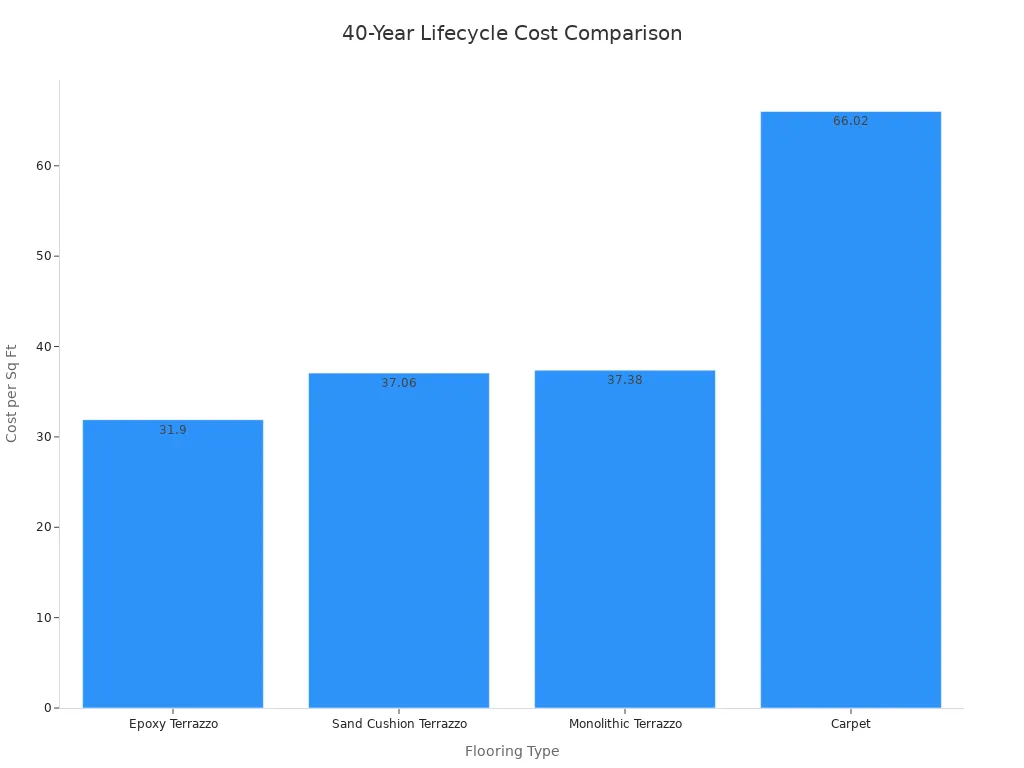
Epoxy terrazzo costs $0.80 per square foot annually over 40 years, less than half the $1.65 annual cost of carpet, according to NTMA lifecycle data.
This durable, long-lasting surface outperforms vinyl, tile, and carpet on total cost of ownership. A durable and decorative terrazzo flooring system delivers both performance and savings.
Sustainability and LEED Contributions
Modern terrazzo flooring supports your green building goals through recycled content and low-VOC binders. Epoxy terrazzo formulas contain a minimum of 20% and up to a maximum of 80% recycled materials. These percentages can contribute to U.S. Green Building Council credits under the LEED for New Construction Rating system.
| LEED Credit Point | Required Recycled Content |
|---|---|
| First point | 10% recycled content |
| Second point | Additional 10% (20% total) |
Terrazzo can contribute up to 6 points under the LEED v4 Materials and Resources category.
| LEED Credit Category (v4 MR) | Potential Points |
|---|---|
| MRcr1.3 Building Reuse | 1 |
| MRcr4.1 & 4.2 Recycled Content | 2 |
| MRcr5.1 & 5.2 Local/Regional Materials | 2 |
| MRcr2.1 & 2.2 Construction Waste Management | 1 |
| Total for Materials & Resources | 6 |
G·ONE embodies this sustainability mission. The brand’s slogan, “Small actions, big impact,” reflects its commitment to eco-friendly manufacturing. G·ONE produces recycled terrazzo and UHPC plates that meet modern green building standards. Specifying terrazzo flooring from a responsible manufacturer turns environmental goals into measurable results.
Design Possibilities with Terrazzo
Aggregates, Colors, and Divider Strips
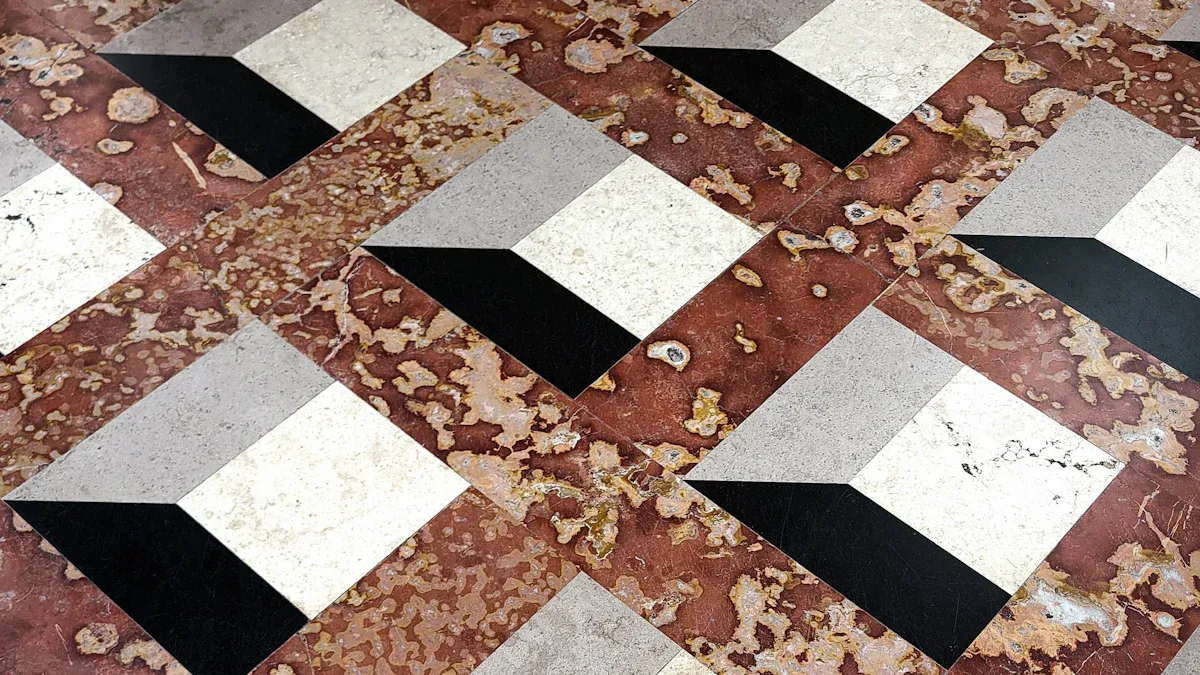
Aggregate choice drives the visual character of your terrazzo floor. Marble chips deliver earthy tones and organic texture. Glass chips add brilliant reflectivity and vibrance. Recycled glass and mother-of-pearl offer sustainable options with distinctive depth. Aggregate size shapes the design language as well.
| Terrazzo Style | Aggregate Size |
|---|---|
| Micro terrazzo | 1/16 inch diameter |
| Traditional terrazzo | 1/8 inch to 3/8 inch diameter |
| Venetian terrazzo | 5/8 inch to 7/8 inch diameter |
| Palladiana terrazzo | 2 to 12 inch fractured stone pieces |
Slip resistance depends on the surface finish, not the aggregate type. A polished surface feels smooth. A rustic finish, left unpolished, produces a rougher, slip-resistant texture. You can also specify slip-resistant sealers or carborundum strips on stairs. This separation matters for material selection. You gain full freedom over aesthetics without sacrificing traction.
Divider strips define every edge in a custom design. Most designers select aluminum, zinc, brass, or plastic. These strips serve a structural role over control joints and a decorative one. Your artwork and slab layout must coordinate from the start.
Custom Patterns, Logos, and Mosaics
Waterjet cutting turns intricate logos into permanent architectural elements. The process begins with a CAD drawing that converts artwork into buildable geometry. Each line becomes a physical metal strip. Fabricators cut zinc or aluminum strips into shape, then reassemble them on mesh backing with a keyed system. Installers transfer the layout through full-scale templates and pour each color separately to prevent bleed.
Color matching reaches remarkable precision. One medallion project produced 54 color samples before approval. Epoxy matrices accept custom colors with sharp control, and you can match brand palettes closely. Very fine lines, small text, and photographic gradients do not translate directly, so discuss detail limits at the design stage.
G·ONE’s mosaic terrazzo and custom-made solutions demonstrate this bespoke capability. The brand tailors custom colors, aggregate blends, and molds to specific project requirements. For custom terrazzo floors in hotel lobbies or retail flagships, this level of control transforms terrazzo flooring into a branded surface. Terrazzo materials from a capable partner give you infinite colorways and design combinations.
Applications for Terrazzo Floors and Surfaces
High-Traffic Environments
Healthcare facilities demand surfaces that resist bacteria and chemical cleaners. Terrazzo delivers a nonporous finish that prevents liquid penetration. Water absorption for untreated terrazzo ranges from 4.2 to 5.2 percent. After impregnation, that figure drops to 2 to 2.5 percent. The EN 13748-1 standard requires a maximum of 8 percent. This low absorption keeps pathogens from settling into the surface. Hospitals, clinics, and laboratories specify terrazzo for operating rooms, corridors, and waiting areas.
Educational buildings face constant foot traffic and heavy furniture movement. Abrasion resistance becomes the deciding factor. DIN EN 13748-1 classifies terrazzo into four classes using the Böhme method.
| Class | Maximum Abrasion Loss |
|---|---|
| Class I | No maximum specified |
| Class II | ≤26 cm³/50 cm² |
| Class III | ≤20 cm³/50 cm² |
| Class IV | ≤18 cm³/50 cm² |
Terrazzo materials for abrasive stresses must meet Class II or III. Class I may be required for extreme conditions. Hospitality and retail environments benefit from seamless application. Dirt and grime cannot accumulate in joints. Public landmarks choose terrazzo floors for slip resistance and chemical resistance. These properties maintain safety across decades of daily use.
Vertical and Custom Applications
Terrazzo extends beyond horizontal surfaces. You can specify terrazzo floor tiles for walls, stairs, and furniture. Designers use terrazzo cladding for reception desks, bathroom vanities, and tabletops. Stair treads gain traction from unpolished finishes. Vertical applications create visual continuity between floor and wall.
G·ONE manufactures UHPC plates for exterior and structural applications. These ultra-high-performance concrete panels provide exceptional strength and weather resistance. Architectural facades, column covers, and structural elements benefit from this material. The brand’s global project experience spans hotel lobbies, luxury retail boutiques, and public landmarks. G·ONE’s terrazzo flooring appears in commercial spaces worldwide. The company’s custom-made solutions allow tailored colors, aggregate blends, and molds. For any flooring project requiring both performance and design flexibility, terrazzo floor tiles from G·ONE deliver consistent quality.
Specifying and Sourcing Terrazzo
Manufacturers, Samples, and Regional Materials
Start your specification process with performance criteria. Define traffic loads, chemical exposure, and aesthetic requirements. Then move to sample approvals and mockups. This validation sequence prevents costly errors later.
The certification process follows a standard progression. First, perform small test patches at inconspicuous locations to determine the best repair or cleaning method and confirm products do not cause harm. Next, create mockup panels after testing, potentially incorporating successful test patches, with size and location set by your project team and oversight bodies. Require each worker to prepare a mockup panel for every activity they will perform; workers whose mockups are not approved cannot work on terrazzo repair and replacement. Follow manufacturer instructions and duplicate proposed restoration procedures. Include evaluation of materials and techniques for protecting surrounding areas in the mockups. For proprietary systems, require a materials manufacturer representative to be present during preparation and application of test areas. Treat approved mockups as part of the work and as the quality standard for all similar work. Remove rejected testing, demonstrations, or mockups entirely without damaging surrounding masonry, and perform a new demonstration or mockup for review. Prepare mockups for crack repair, patching, and cleaning including polishing, with sample areas demonstrating methods and workmanship.
Chosen aggregate shall be submitted to GSA Historic Preservation for approval prior to mockup.
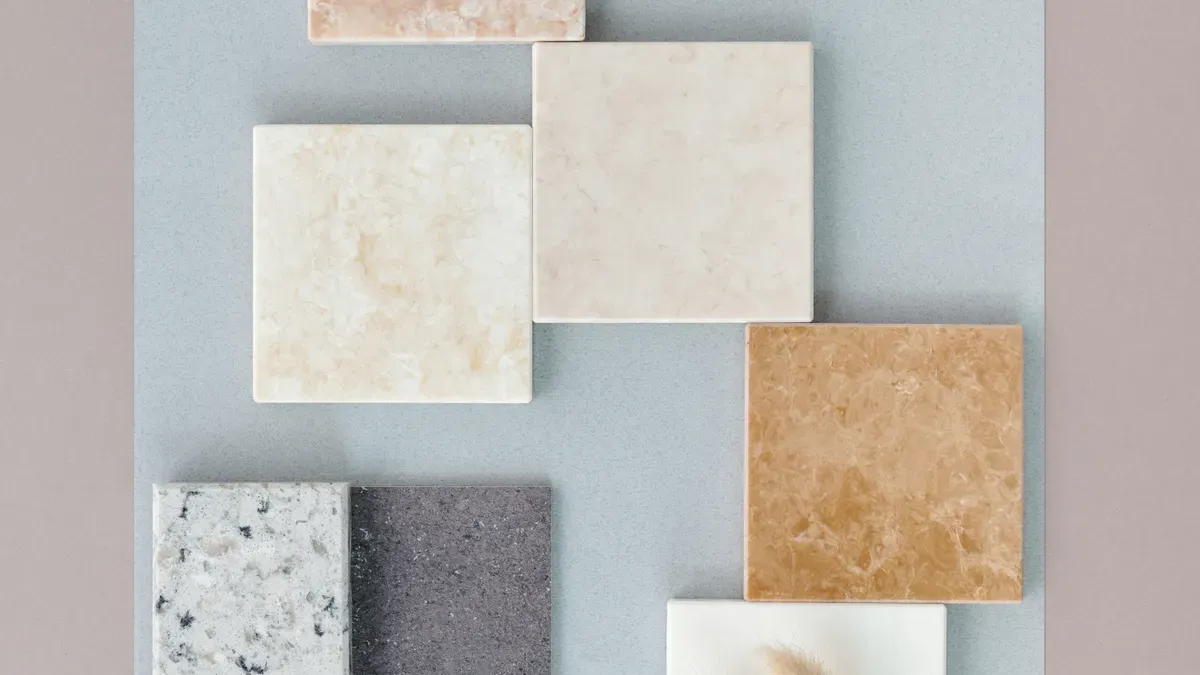
Sample approval is critical. Order actual material samples to verify texture and composition against your specification. The sample process should confirm color, aggregate density, and finish consistency. Lead times for true terrazzo materials typically require planning 3–4 months ahead. When you evaluate manufacturers, check for certifications that verify environmental compliance and product quality.
| Certification | Purpose | Contribution |
|---|---|---|
| LEED Rating System Credits | Direct contribution to environmental compliance through recycled content and regional sourcing | Supports green building goals |
| GREENGUARD Gold Certification | Ensures low chemical emissions, protecting indoor air quality | Critical for indoor environments |
| Environmental Product Declaration (EPD) | Lifecycle assessment data for environmental impact transparency | Informs material choices |
| Health Product Declarations (HPD) | Full ingredient disclosure for health and safety | Supports health-conscious projects |
| Declare Label (Red List Free) | Third-party verification that no red-list chemicals are present | Meets strict environmental standards |
Specify regional materials where possible. Local sourcing of aggregates and binders reduces transportation emissions and supports local economies. This also contributes to LEED credits for regional materials. A manufacturer with documented regional sourcing records simplifies your documentation process.
G·ONE Precast Terrazzo and Custom Solutions
G·ONE is a premium precast terrazzo and sustainable materials brand. The product line includes regular terrazzo, recycled terrazzo, and mosaic terrazzo plus UHPC plates for exterior applications. Each line meets specific project demands, from high-traffic interiors to architectural facades.
G·ONE offers tailored consultations, project samples, digital catalogs, and engineering support. The digital lookbook provides product brochures and technical specifications for early assessment of product fit. You can request samples to verify texture and composition before full production, helping avoid costly errors and ensuring the final installation meets expectations. Early sample evaluation during the design phase increases confidence in the outcome. The sample request process is straightforward, and the digital lookbook allows online review of material options before requesting specific samples. G·ONE also offers custom-made solutions with tailored colors, aggregate blends, and mold patterns, giving you the flexibility to create distinctive environments.
Specifying terrazzo flooring from a responsible manufacturer like G·ONE transforms sourcing into a collaborative partnership. The brand’s engineering support helps you navigate panel layouts, load calculations, and installation details. This level of support means you can specify terrazzo with confidence, knowing you have expert guidance from concept through installation. G·ONE’s terrazzo materials are engineered for durability and aesthetic consistency, while G·ONE’s terrazzo floor tiles provide a reliable alternative to site-poured systems. No matter the project scale, G·ONE delivers consistent quality and performance for every flooring application.
Installation Considerations for Terrazzo
Poured-in-Place vs. Precast
You face a fundamental choice between two installation methods. Poured-in-place terrazzo flooring requires mixing and placing material directly on site. This method suits complex geometries and seamless transitions across large areas. However, site conditions affect quality. Temperature, humidity, and substrate moisture all influence the cure. Poured-in-place epoxy terrazzo systems demand careful sequencing with other trades. You cannot pour until wet trades finish and the space remains clean and dry.
Precast terrazzo panels arrive at the job site ready for installation. The factory controls mixing, curing, and finishing. This approach reduces on-site labor and minimizes disruption to other trades. Precast panels also provide consistent color and aggregate distribution across every piece. You gain faster installation and predictable quality. For projects with tight schedules or limited site access, precast offers clear advantages. Both methods produce durable results when you follow proper procedures.
Timing, Labor, and Substrate Prep
Skilled labor determines the final quality of any terrazzo installation. Craft workers must understand mixing ratios, troweling techniques, and grinding sequences. Poor workmanship shows in every square foot. Plan for a 3–4 month lead time from specification to completion. This timeline includes sample approvals, material production, and installation. Rushing the process compromises results.
Substrate preparation and moisture testing protect your investment. Excess moisture causes delamination, cracking, and bond failure. You must test before you install. The following table summarizes the two accepted test methods.
| Test Method | Standard | Requirement |
|---|---|---|
| Relative Humidity Probe Test | ASTM-F-2170 | 75% to 80% relative humidity threshold |
| Anhydrous Calcium Chloride Test | ASTM-F-1960 | Alternative when probe test cannot be performed; maximum 3 pounds per 1,000 sq ft per 24 hours |
Coordinate with other trades to protect the substrate. Plumbing, electrical, and HVAC work must finish before you begin. Cementitious terrazzo requires longer cure windows than resin systems. Cementitious terrazzo also needs protection from water exposure during curing. Schedule inspections at each phase to verify readiness.
Maintenance and Longevity of Terrazzo Floors
Routine Care and Repair
A terrazzo floor requires simple daily care. Use a dust mop or soft-bristle broom for loose debris. For deeper cleaning, use a neutral pH cleaner. Avoid acidic or abrasive cleaners. These products etch the binder and dull the polish. Quick damp mopping proves sufficient for daily maintenance. The seamless surface prevents dirt accumulation in joints.
Periodic maintenance involves resealing. Apply a penetrating sealer every 1 to 3 years depending on traffic. This protects the surface from staining and maintains gloss. For terrazzo flooring in high-traffic zones, schedule annual sealer checks. The process requires minimal downtime and low cost.
Restorative maintenance addresses deeper wear. Scratches or dulling develop over decades. A professional contractor re-grinds and polishes the surface. This removes a thin layer and restores the original finish. Unlike carpet or vinyl, you avoid full replacement. It serves for generations with proper care.
Crack and chip repairs are straightforward. Small cracks fill with color-matched epoxy. Chips drill out and replace with new aggregate and binder. The repair blends with the surrounding surface. You cannot spot it after finishing. This repairability extends the lifespan significantly at low cost. These interventions make terrazzo a lifetime specification.
Radiant Heating and Slip Resistance
Terrazzo works well with radiant heating systems. The material’s thermal conductivity allows efficient heat transfer. The thin epoxy profile—as little as 1/8 inch—improves responsiveness. You install terrazzo directly over hydronic or electric radiant systems. The seamless surface distributes heat evenly across the space.
Slip resistance requires specification attention. Polished terrazzo has a smooth texture. The coefficient of friction typically falls between 0.4 and 0.5. For wet areas, specify a honed or matte finish. These finishes retain aggregate texture on the surface. You can also specify slip-resistant sealers or sharper aggregate blends. Local building codes may require minimum COF values for specific occupancies.
For commercial kitchens or pool decks, use a textured finish. The EN 13748-1 standard classifies slip resistance for different environments. G·ONE’s UHPC plates offer additional options for exterior wet areas. Terrazzo provides inherent slip resistance through surface texture. You maintain design freedom without sacrificing safety.
Modern terrazzo flooring delivers a timeless, sustainable, and design-forward solution for contemporary architecture. You control the outcome through four decisions: binder selection, design customization, sourcing, and installation. Each step becomes manageable with the right manufacturing partner.
G·ONE supports your project with precast terrazzo, recycled terrazzo, mosaic terrazzo, and custom solutions. Request samples early to verify texture and color before production. Consult a terrazzo specialist to confirm panel layouts and lead times.
Specify terrazzo once, and it will outlast trends, traffic, and turnover. Your floor becomes a permanent asset instead of a recurring expense.
FAQ
How far in advance should you plan a terrazzo installation?
You need 3–4 months from specification to completion. This window covers sample approvals, material production, and installation. Precast panels reduce on-site labor, but factory lead times still apply. Build this timeline into your project schedule from the start.
How long does a terrazzo floor last?
A properly installed epoxy terrazzo floor can serve 40 years or more. Industry professionals regard it as a lifetime floor. Lifecycle data shows epoxy terrazzo costs $0.80 per square foot annually over 40 years, less than half the annual cost of carpet.
What maintenance does terrazzo require?
Daily care is simple: dust mop or damp mop with a neutral pH cleaner. Avoid acidic or abrasive products. Apply a penetrating sealer every 1 to 3 years depending on traffic. Deep scratches and dulling respond to re-grinding and polishing, not replacement.
Is terrazzo slippery when wet?
Polished terrazzo has a coefficient of friction around 0.4 to 0.5. For wet areas, specify a honed or matte finish. These finishes retain aggregate texture at the surface. You can also add slip-resistant sealers. Local codes may set minimum values for specific occupancies.
Can you match a specific brand color in terrazzo?
Yes. Epoxy matrices accept custom pigments with sharp control. One medallion project produced 54 color samples before approval. Very fine lines, small text, and photographic gradients do not translate directly. Discuss detail limits with your fabricator at the design stage.