
You evaluate critical structural and environmental factors when selecting liquid terrazzo systems. Your slab requirements, environment, and design flexibility dictate whether you choose epoxy or cementitious chemistries.
| Evaluation Factor | Epoxy Matrix | Cement Terrazzo |
|---|---|---|
| Standard Application | Modern interior standard | Traditional outdoor use |
| Design Possibilities | Unlimited matrix colors | Limited color options |
| System Thickness | 3/8 inch thin-set | 1/2 inch to 1 inch |
| Moisture Tolerance | Requires vapor barrier | Handles active moisture |
Epoxy matrix expands architectural design possibilities for interior projects, while cement handles severe moisture. Engage G·ONE early to refine your terrazzo specification and secure custom design samples for architects and designers.
Key Takeaways
- Select epoxy matrices for colorful interior floors and choose cement matrices for sunlit outdoor spaces.
- Prepare concrete subfloors properly through shot-blasting and moisture testing to prevent future floor cracking.
- Thin-set epoxy terrazzo installs directly over existing concrete to reduce structural floor weight.
- Custom aggregates and metal divider strips help you create beautiful logos and custom floor patterns.
- Liquid terrazzo offers low maintenance costs and lasts for decades, making it a smart long-term investment.
Matrix Options for Liquid Terrazzo Floors
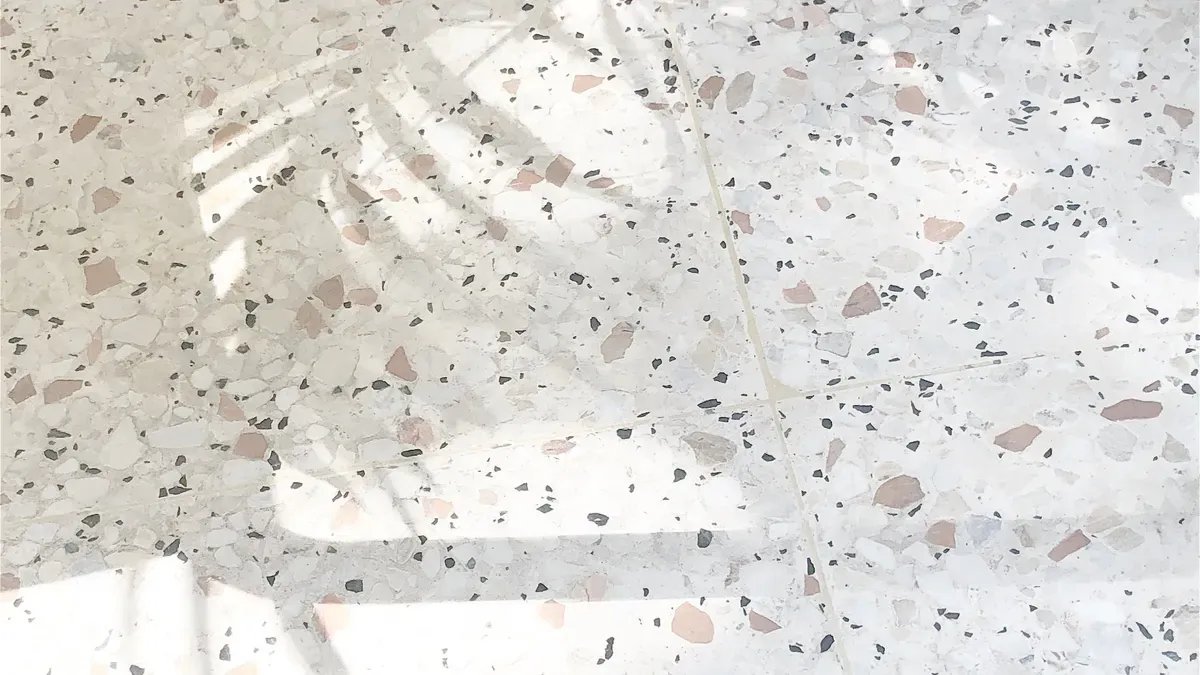
Select the correct binder chemistry to guarantee long-term performance for your project. You must balance foot traffic, chemical exposure, installation speed, and design flexibility when choosing between matrix systems.
Epoxy Matrix Performance
Epoxy liquid terrazzo serves as the industry standard for modern interior terrazzo installations. You achieve unmatched design flexibility because resinous matrices mix with any pigment color. Contractors pour these thin-set systems directly over concrete substrates, speeding up the installation schedule significantly.
| Property | Test Method | Typical Value (psi) | Metric Value (MPa) |
|---|---|---|---|
| Compressive Strength | ASTM D 695 | 10,000 psi | 68.9 MPa |
| Flexural Strength | ASTM D 790 | 4,500 psi | 31.0 MPa |
With a compressive strength of 10,000 psi under ASTM D 695 and flexural strength of 4,500 psi under ASTM D 790, epoxy terrazzo handles massive foot traffic and heavy rolling loads without cracking.
The impermeable surface forms a continuous barrier against harsh chemicals, grease, and aggressive cleaning solutions. Your epoxy terrazzo specification delivers superior stain resistance compared to cement matrices, making it ideal for high-traffic commercial spaces.
These resinous systems contain zero volatile organic compounds and hold GREENGUARD Gold certification. The material emits no off-gassing during installation or use, protecting indoor air quality. Incorporating these materials into your epoxy terrazzo specification supports sustainable building initiatives and strengthens your overall sustainability goals. G·ONE high-performance resinous matrices set the benchmark for vibrant, durable indoor floors.
Cementitious and Polyacrylate Systems
Cementitious liquid terrazzo systems offer distinct physical benefits despite chemical limitations. Cement matrices handle active moisture transmission through the concrete slab because the breathable surface allows water vapor to pass freely.
| Comparison Aspect | Epoxy Matrix | Cementitious Liquid Terrazzo Matrix |
|---|---|---|
| Primary Durability & Use Case | High-traffic commercial spaces with exceptional impact durability. | Decorative residential or interior retrofits with a softer feel. |
| Chemical Resistance Level | High resistance to acids, solvents, and fuels. | Moderate resistance to oils and household cleaners. |
| Surface Protection | Impermeable film that prevents chemical penetration. | Breathable surface that permits moisture vapor transmission. |
UV exposure creates strict boundaries between matrix choices. Sunlight breaks down epoxy resin binders, causing yellowing and surface chalking over time. You should specify cementitious or polyacrylate options for outdoor environments like plazas, walkways, and exterior building entrances. Polyacrylate systems combine cement with acrylic polymers, increasing bond strength and flexibility while maintaining UV stability.
Cement matrices suit exterior settings, but they provide moderate chemical resistance and require longer curing times. Epoxy matrices cure rapidly, allowing workers to polish the floor sooner. Choose cement binders for sunlit exterior plazas, and specify resinous liquid terrazzo for interior floors requiring high aesthetic quality, maximum impact resistance, and swift project turnover.
Specifying a Terrazzo Floor: Structural Prep
Substrate Conditioning and Crack Isolation
When specifying a terrazzo floor, your project requires thorough substrate preparation to establish permanent bond strength. Concrete surfaces demand mechanical shot-blasting or scarifying to remove surface contaminants, laitance, and curing compounds. Shot-blasting creates an open concrete profile for maximum mechanical bonding. You must verify subfloor levelness with a maximum deviation under 1/8 inch over a 10-foot span before starting surface prep work. Any cementitious patch or self-leveling underlayment must achieve a minimum tensile strength of 300 psi and contain zero gypsum. Gypsum disintegrates under intense mechanical grinding stresses, directly compromising long-term adhesion and causing substrate failure. Patch materials must cure completely to prevent structural shrinkage.
Perform relative humidity testing using ASTM F2170 on concrete slabs during early project planning stages. High slab moisture requires a dedicated epoxy vapor barrier to prevent moisture vapor transmission from loosening the surface layer. Furthermore, non-structural slab cracks demand liquid-applied crack-isolation membranes to stop stress reflection into your finished decorative flooring.
| Feature | Laticrete Blue 92 Anti-Fracture Membrane | SikaTile®-200 Fracture Guard Rapid |
|---|---|---|
| Form | Liquid (Two-part system) | Liquid |
| Primary Function | Crack isolation to reduce crack transmission | Rapid crack suppression |
| Compatible Substrates | Concrete, Cement-based surfaces, Resin matrices | Concrete, Cementitious surfaces |
Thickness Standards and Load Parameters
Structural parameters dictate matrix selection and subfloor engineering during initial planning. You must evaluate structural weight allowances, slab elevations, and expected foot traffic across the floor before writing your final architectural specification. Divider strip layout plays a key role in controlling thermal movement and design geometry. You should specify solid brass, zinc, or aluminum strips to establish crisp color transitions.
Thin-set epoxy terrazzo requires no slab depression and installs over existing concrete substrates, providing exceptional durability and high tensile strength. Sand-cushion cementitious terrazzo requires a depressed concrete slab to house a thick reinforced underbed, whereas monolithic cementitious terrazzo bonds directly to a level concrete slab without an underbed.
| System Type | Nominal System Thickness | System Weight (lbs PSF) | Compressive Strength (psi) | Tensile Strength (psi) |
|---|---|---|---|---|
| Thin-set Epoxy | 1/4″ to 3/8″ | 3–4 | 13,260 | 9,580 |
| Monolithic Cementitious | 0.5 inches | 5–7 | ~4,000 | ~400–600 |
| Sand-Cushion Cementitious | 3 inches | 25–30 | ~4,000 | ~400–600 |
Your architectural specification must outline three sequential core phases for every terrazzo installation:
- Substrate conditioning, moisture testing, crack isolation membrane placement, and divider strip layout secured directly to the concrete floor.
- Resinous epoxy or cementitious liquid mixture pouring, aggregate spreading, and hand troweling to nominal system thickness.
- Multi-stage mechanical grinding using diamond abrasives, resinous pinhole grouting, honing, and polishing across finished floors.
Thin-set epoxy systems maintain a thin profile that minimizes dead load weight on multi-story elevated concrete floors. You must align structural expansion joints and control joints directly from the concrete substrate through the topping surface. Proper joint alignment prevents stress cracking across commercial terrazzo installations. Quality resinous flooring materials deliver exceptional resilience under heavy rolling loads. Contractors complete the surface with protective penetrative sealers to maximize long-term stain resistance. Proper execution guarantees a seamless terrazzo installation that enhances the entire building space. Specifiers rely on thorough surface preparation to achieve long-lasting terrazzo installations across all interior floors. Careful planning streamlines every terrazzo installation.
Customizing Terrazzo Aesthetics and Artwork
Aggregates, Matrix Colors, and Custom Logos
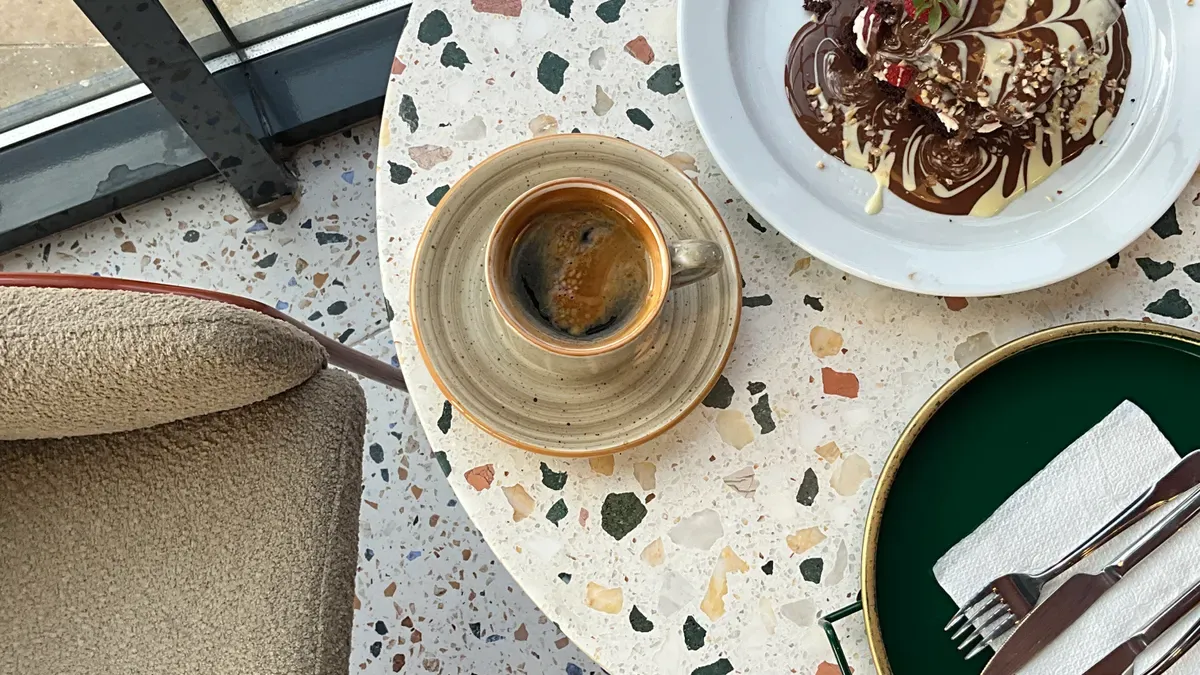
You achieve complete design flexibility when selecting aggregates for your liquid terrazzo floor. Resinous matrices hold diverse aggregate choices that change the final visual style.
- Marble Chips
- Glass Chips
- Shell Chips
You can embed granite, quartz, or mirror chips into the binder alongside traditional marble. These varied components create near-limitless design possibilities for modern commercial spaces. The dense aggregate distribution ensures exceptional structural durability across high-traffic floors.
| Material Type | Standard Size Range | Additional Customization Capability |
|---|---|---|
| Recycled Glass Aggregates | #0-2 on the gradation scale | Crushes to any size, including finer or larger Venetian aggregates. |
| Marble Chips | #0-2 on the gradation scale | Crushes to custom dimensions for tailored matrix thickness. |
You can specify high-quality hand-cast terrazzo to showcase intricate artwork directly on the floor. Installers cast corporate logos, school mascots, or complex geometric patterns into the seamless pour. Waterjet technology cuts precise divider strip channels that hold distinct matrix colors. You create stunning architectural visuals that maintain sharp color boundaries over decades of heavy use.
Divider Strip Metallurgy and Layouts
Divider strips define color transitions and manage physical floor stresses. You must choose strip metals based on the aesthetic style and chemical environment of your project. Heavy-duty zinc strips offer a crisp silver appearance for modern interior schemes. Brass strips deliver warm golden tones for traditional spaces, while aluminum strips provide lightweight cost savings for basic geometric layouts.
Terrazzo divider strips must precisely follow the concrete joint – even if crooked, to mitigate cracking in the terrazzo system.
You position divider strips strategically across the concrete subfloor to control thermal expansion and contraction. Strips absorb movement when the slab expands under temperature variations, preventing stress cracks across decorative sections. Proper strip layout preserves original design lines and secures the long-term beauty of your floor.
Surface Finishing and Slip Resistance
Polishing and Honing Specifications
You refine the visual character of your terrazzo floor during the mechanical grinding phase of installation. Installers use coarse diamond metal pads from 24 to 120 grit to expose aggregate and eliminate scratches. You can stop grinding between 200 and 400 grit to achieve a honed finish. This honed appearance provides a muffled shine with a distinctness of image rating between 10 and 39. Architects often specify this satin texture for outdoor floors to preserve slip resistance on polished terrazzo surfaces.
You proceed into higher grit sequences to create a high-gloss polished finish. Installers use resin pads from 800 up to 3000 grit to generate strong image clarity across interior floors. Highly polished surfaces achieve an image rating above 70, reflecting light effectively through building interiors. You refine the liquid terrazzo matrix step by step to control surface sheen. This process guarantees a high quality finish across all terrazzo installations.
Sealer Selection and Safety Compliance
Your final sealer selection dictates the slip resistance of finished terrazzo installations. Unsealed smooth surfaces create safety hazards, but proper sealers maintain traction on liquid terrazzo. A properly sealed epoxy terrazzo floor achieves a static coefficient of friction of 0.6 or higher. This rating satisfies DIN 51130 R10-R13 compliance levels. You must instruct owners to avoid wax, because wax creates a slick layer over decorative flooring.
| Sealer Type | Key Property | Safety Feature |
|---|---|---|
| Topical | Forms surface barrier | Requires anti-slip additives |
| Two-Component Epoxy | Resists harsh acids | Demands anti-slip formulation |
| Penetrating | Protects matrix interior | Preserves natural traction |
You match the sealer chemistry to your specific building environment. Polyurethane sealers deliver excellent ultraviolet stability, while polyaspartic sealers offer fast cure times during installation. Penetrating sealers preserve surface texture without forming a film. Meanwhile, two-component epoxy terrazzo sealers deliver maximum durability and chemical protection across high-traffic commercial spaces. Proper sealer application completes every terrazzo installation cleanly, securing long-term safety across commercial floors.
How to Guide for Architects: Specification
CSI MasterFormat Division 09 Integration
You can streamline your project documentation by following a clear how to guide for architects. Incorporating exact language into CSI MasterFormat Section 09 66 00 ensures precise contractor bidding and long-term floor performance. You must define strict physical criteria within your terrazzo specification to protect structural integrity.
| Performance Criteria | Test Standard | Requirement / Limit |
|---|---|---|
| Compressive Strength | ASTM D 695 | 20 to 34.5 MPa |
| Abrasion Resistance | ASTM F 510 | Maximum 0.0196 cm³ volume loss |
| Static Load Limit | ASTM F 970 | Maximum 0.0007-inch indentation |
| Resin Matrix Hardness | ASTM D 2240 | Shore D minimum 78 |
You establish clear standards for contractors when you write a complete epoxy terrazzo specification. Detailed planning during initial document creation prevents costly field changes. Your final project documents must mandate strict substrate preparation standards alongside these performance limits.
Lifecycle ROI and G·ONE Technical Support
A complete epoxy terrazzo specification balances initial installation investment against long-term operational savings. You achieve superior cost and planning benefits because liquid terrazzo requires minimal maintenance over decades of commercial use.
| Commercial Flooring Type | Initial Cost (Per Sq. Ft) | Annual Maintenance Cost (Per Sq. Ft) | Replacement Frequency | Forty-Year Cost (Per Sq. Ft) | Annual Cost Over 40 Years (Per Sq. Ft) |
|---|---|---|---|---|---|
| Epoxy Terrazzo | $14.50 | $0.43 | 40 Years | $31.90 | $0.80 |
| Vinyl Sheet | $3.58 | $1.12 | 10 Years | $62.71 | $1.57 |
| Carpet | $3.34 | $1.23 | 10 Years | $66.02 | $1.65 |
| Vinyl Tile | $1.21 | $1.18 | 10 Years | $53.41 | $1.34 |
You optimize overall building sustainability by selecting durable materials that eliminate frequent material disposal. Liquid terrazzo flooring boosts your building environmental ratings through recycled content and zero-VOC formulations. These physical properties strengthen indoor air quality while reducing environmental impact over time.
You can contact G·ONE technical representatives early during project planning to create physical control samples. These specialists help architects refine custom aesthetic layouts, test aggregate blends, and specify terrazzo floors with precision. Working directly with experienced technical representatives ensures high build quality across all decorative floors. Reviewing exact terrazzo specifications together guarantees seamless execution on site.
You deliver high-performing floors by mastering every key specification checkpoint. First, select your binder chemistry based on slab moisture and UV exposure. Next, verify substrate readiness with relative humidity testing and crack isolation membranes. You then define your custom aesthetic layout using aggregate blends and metal divider strips. Finally, confirm slip resistance and safety compliance for your liquid terrazzo surface.
A complete terrazzo specification eliminates installation risks across commercial project sites. You can request physical matrix samples directly from G·ONE to refine your material textures. Contact G·ONE technical representatives today to finalize your CSI Division 09 terrazzo specifications and complete your terrazzo design.
FAQ
How do you choose between epoxy and cementitious matrices?
You evaluate environmental factors and moisture levels for your project. Specify epoxy matrix for vibrant interior floors requiring stain resistance. Choose cementitious options for outdoor terrazzo installations requiring UV stability.
What structural preparation ensures a successful terrazzo installation?
You must shot-blast concrete subfloors. Perform ASTM F2170 moisture testing during early project stages. Apply crack-isolation membranes before starting the terrazzo installation. This process guarantees high visual quality and prevents structural surface cracks across the building floor.
How thick is a standard thin-set system?
A standard thin-set epoxy terrazzo floor measures 1/4 inch to 3/8 inch thick. This thin profile minimizes dead load weight on concrete slabs. You avoid slab depressions, streamlining installation speed and total project cost and planning during structural design.
Why should you prepare a precise terrazzo specification?
You ensure accurate contractor bidding when writing a detailed terrazzo specification. Specify ASTM D 695 compressive strength limits to secure long-term durability. Thorough technical review prevents field changes and delivers lasting value across commercial floors.