
Selecting a pink terrazzo tile comes down to four linked decisions. You match color and finish to design intent, verify technical performance for the application, confirm regulatory compliance, and validate lifecycle cost. Treat these as a sequence. Concept comes first, specification comes last.
Precast terrazzo rewards early planning. Producers need time to match aggregate blends and cure panels, so bring the material into the conversation before drawings freeze. Faster alternatives exist when schedules compress, and each has a place.
G·ONE supplies panels and specification support for teams that want both. Document each choice as you go. A written record protects the specification later.
Key Takeaways
- Choose pink terrazzo color and finish first to match your design idea.
- Check durability, slip resistance, and maintenance needs for your specific use.
- Confirm fire ratings, VOC emissions, and slip test reports for the exact product.
- Plan for 3–4 months lead time on custom blends to keep your schedule on track.
- Document each decision to protect your specification and avoid surprises.
Pink Terrazzo Tile: Color and Aggregate Options
Pink Color Variations and Aggregate Mixes
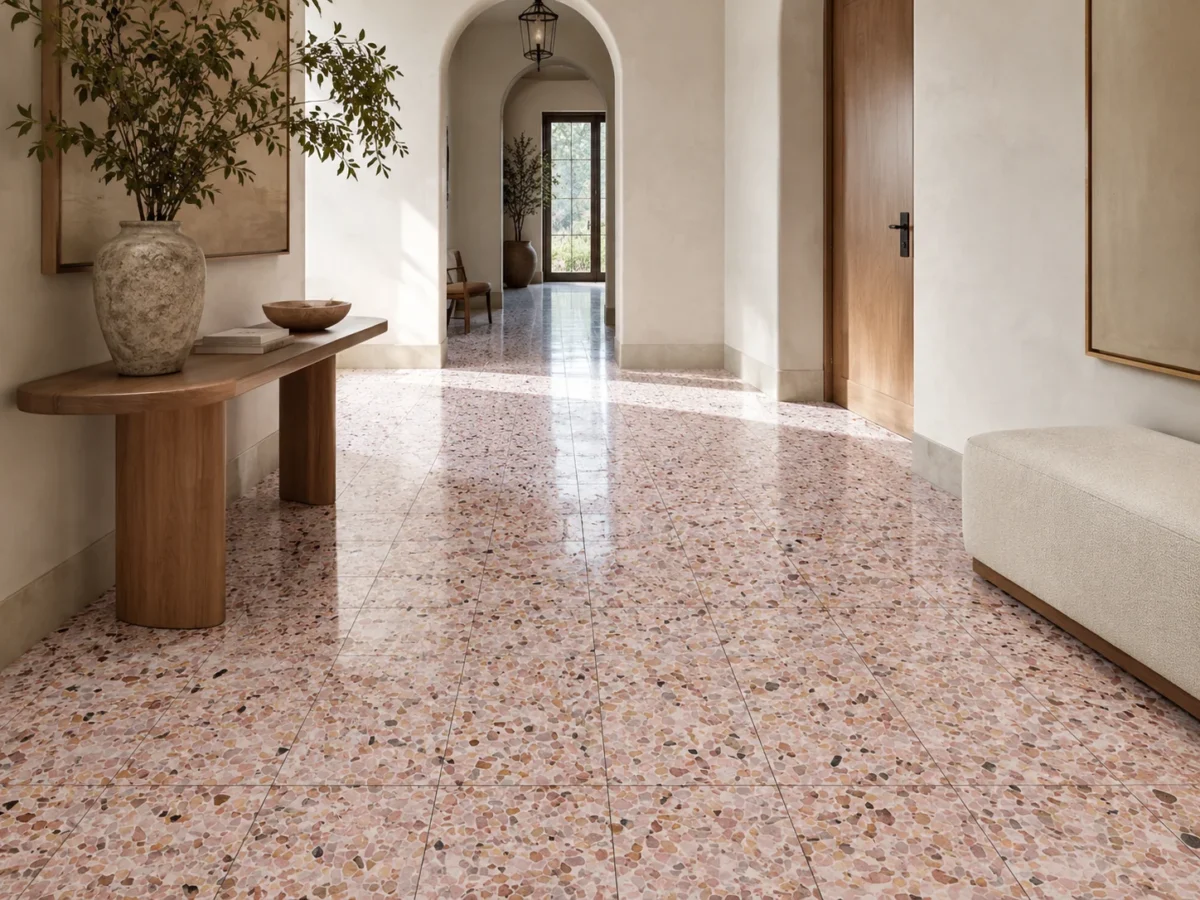
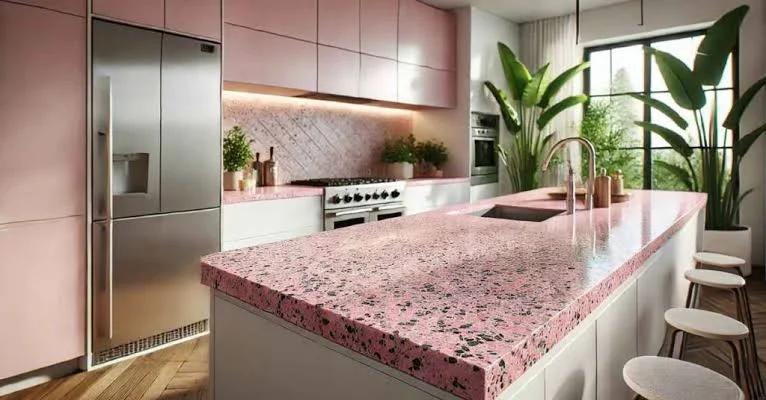
Pink covers a wide emotional range. Soft blush reads quiet and residential. Warm salmon brings energy to a hotel lobby or a retail floor. You control that range through pigment selection and through the aggregate itself.
Aggregate size, color, and density drive the visual texture. Large chips create movement and draw the eye across a floor. Fine chips produce an even, calm field. A mix of rose, cream, and gray stone fragments gives depth without shouting. This is where terrazzo’s natural chips earn their reputation. Each panel carries slight variation, and that variation is the point.
Pink terrazzo tile brings an organic texture and warm tone to contemporary architecture. The material softens hard-edged interiors and pairs well with concrete, timber, and brushed metal. Specify a pink terrazzo tile when you want warmth that still reads as stone.
Finishes and the Modern Terrazzo Tile Collection
Finish changes how deep the color appears. A polished surface amplifies color depth and reflectivity. Honed terrazzo, per Terrazzco, grinds the surface to a uniform level and yields a matte sheen that feels serene to the eye and touch. Matte finishes, Terrazzco notes, suit minimalist or industrial schemes and add understated warmth.
Maintenance follows the finish. Marble Systems recommends regular sweeping and weekly mopping with a pH-neutral cleaner, plus prompt spill cleanup. Avoid vinegar, bleach, and ammonia, especially on cement-based terrazzo with calcareous chips. Polished surfaces can be slippery when wet, so Marble Systems suggests them for walls or dry floors. Honed and matte surfaces offer better grip for wet areas.
A modern terrazzo tile collection gives you room to match finish to function. G·ONE’s regular, recycled, and mosaic lines each carry a distinct signature texture, color, and depth. Custom aggregate blends let you tune chip size and palette to the project. MEC Artworks shows how mosaic formats deliver a playful retro look in modern spaces. Sample programs such as Terrazzco’s Designer, Venetian, and Recycled series illustrate how a full terrazzo collection spans standard and custom development. Bedrosians’ Mystère line, for instance, offers seven colorways plus a stacked mosaic in a structured, high-wear finish. Use these precedents to brief your own blend.
Technical Performance Essentials
Durability, Slip Resistance, and Maintenance
Ask for four things before you approve a sample: wear resistance, compressive strength, slip ratings by application, and a maintenance regime. Wear resistance follows ASTM C241, the Böhme abrasion test, which runs a rotating grinding wheel at 30 RPM under a 300 N load with white corundum sand abrasive. The lab reports volume loss in cm³, abrasion depth in mm, or mass loss in g. For pink terrazzo tile, request a wear resistance value of 0.03 g/cm² or lower, compressive strength of at least 60 MPa, and flexural strength of at least 8 MPa. Water absorption should sit at 5% or below, and 3% or below for exterior wall panels.
Slip ratings depend on finish. Polished surfaces lack texture and can be slippery when wet, so reserve them for walls or dry floors. Honed and matte finishes give better traction and suit wet floors, bathrooms, and showers. ANSI A326.3 governs wet and dry coefficient of friction for hard surface flooring, and ASTM C1028 measures static friction on tile. Confirm which standard your jurisdiction accepts, then request the test report for the exact finish and sealer combination in your specification.
Maintenance protects the investment. SECOIN advises pH-neutral detergents only, since acidic or alkaline chemicals attack terrazzo. Keep brooms, mops, and buckets clean, because ingrained dirt acts as an abrasive. Build up sealer coats until you reach the desired gloss, then monitor foot traffic to judge how often top coats need renewal.
Acoustics and Underfoot Comfort
Hard stone feels cold and transmits sound. Amtico notes that traditional terrazzo, poured in situ or installed as stone tiles, can feel cold underfoot and proves complex to install on large projects. Plan for that in comfort-sensitive spaces. Rubber and resilient alternatives such as Johnsonite soften acoustics and add underfoot cushioning, per FCNews. Specify an acoustic underlayment or transition detailing when a pink terrazzo floor sits above occupied space.
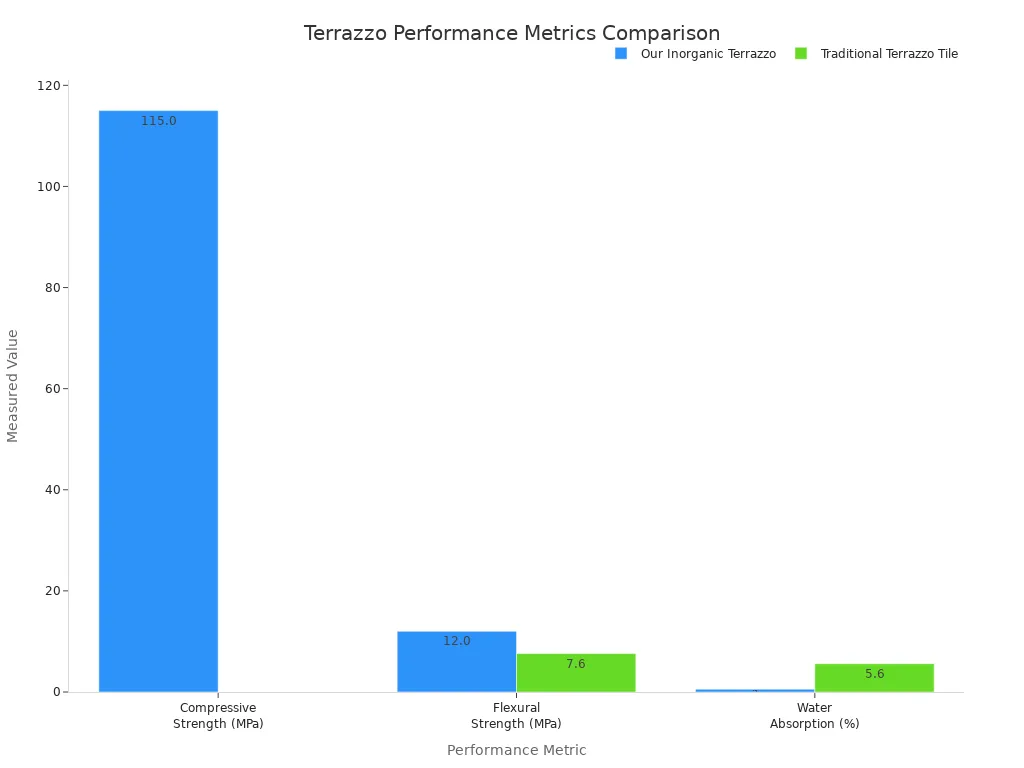
G·ONE engineers precast terrazzo for structural strength, high wear resistance, and long-term weatherability. The material is stain- and frost-resistant, which makes it a durable commercial flooring tile for high-traffic projects and exterior applications. Yflcstone reports 115 MPa compressive strength and 0.56% water absorption for inorganic engineered terrazzo, against unstable, workmanship-dependent results for traditional tile.
Application Fit for Terrazzo
Floors, Walls, and Wet Areas
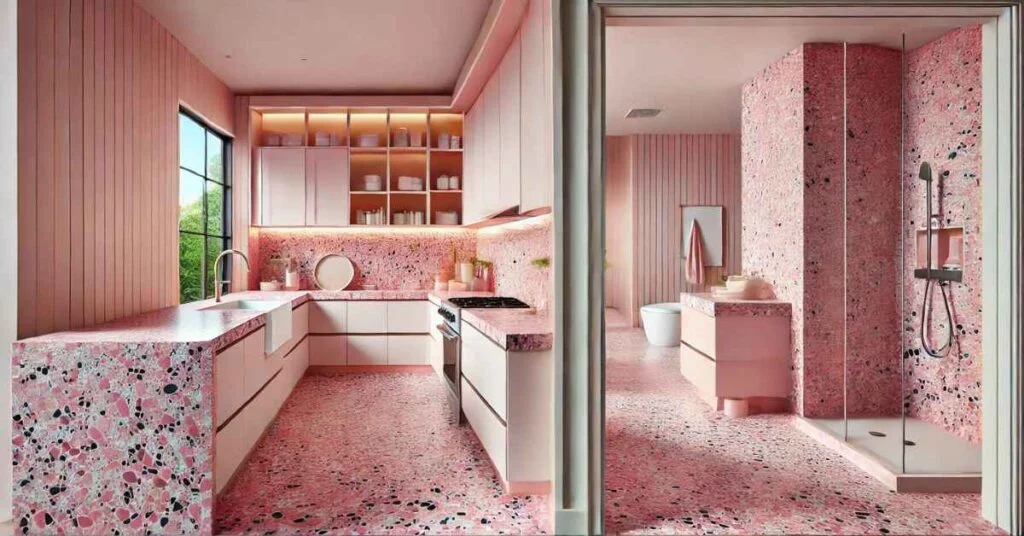
Pink terrazzo tile performs best where warmth and durability must coexist. Specify it for hotel lobbies, retail floors, and residential entries. A terrazzo floor handles heavy foot traffic and still reads as a design statement.
Wet areas need the right finish. Choose honed or matte surfaces for bathrooms and shower walls, and confirm an R11 slip rating under DIN 51130 with a wet friction coefficient of at least 0.6. Terrazzo on the wall works well in kitchens and kitchen backsplashes, where a non-combustible A1 rating adds reassurance. You can carry the same pink tone across floors and walls for a continuous envelope.
The 6×6 Size and Layout Options
The 6×6 size is a manageable, designer-favorite format. Small enough for one installer to handle, it still shows expressive stone fragments across each face. A 6×6 tile suits both residential bathrooms and commercial corridors. The 6×6 format also pairs easily with larger field tile formats when you want a border or accent band.
Most terrazzo floors look great in straight-set installation. Rubi describes straight lay as a clean grid that feels intuitive and timeless, ideal for a modern, minimalist aesthetic. Creative layouts add detail. American Olean lists herringbone, diagonal, checkerboard, and basketweave as options that shift the visual rhythm. A staggered layout brings more movement than a straight grid, per Tile Mart. Stocked patterns cover common 6×6 size needs, and custom designs let you tune the blend to the project.
Regulatory Compliance and Standards
Fire Ratings, VOC Emissions, and Slip Standards
Compliance review starts with three documents: a fire test report, a VOC emissions report, and a slip test report for the exact finish you plan to specify. Request them by product name and finish, not by generic material category.
Fire performance is straightforward for cement-based terrazzo. Inorganic terrazzo achieves A1 classification under EN 13501-1, which means non-combustible and suitable for escape routes and wall linings. Confirm the report covers the panel thickness and backing in your specification.
VOC emissions matter most in enclosed interiors. Ask for testing under the CDPH Standard Method v1.2, the basis for FloorScore, and check that the result meets your project’s threshold. Cement-based terrazzo with inorganic binders typically reports very low emissions.
Slip resistance depends on finish and application. The table below summarizes the control values to confirm.
| Parameter | Target | Basis |
|---|---|---|
| Slip rating | R11 | DIN 51130 ramp test, critical angle 19°–27° |
| Wet friction coefficient | ≥0.6 | DIN 51130 |
| Water absorption | ≤5% (exterior panel ≤3%) | Conventional control value |
| Wear resistance | ≤0.03 g/cm² | Abrasion performance control |
| Compressive strength | ≥60 MPa | Load-bearing performance |
| Flexural strength | ≥8 MPa | Bending performance |
| Radionuclides | Class A | Unlimited indoor use |
| Combustion | A1 | Non-combustible |
Sustainability Certifications to Verify
Green building credits reward documented material transparency. Ask your supplier for a health product declaration, an environmental product declaration, and recycled content verification. These documents support credit submissions under LEED and BREEAM without guesswork.
G·ONE manufactures terrazzo from inorganic materials with eco-friendly processes aligned with modern green building standards. The recycled terrazzo line converts post-industrial content into finished panels, and the Class A radionuclide result clears the material for unrestricted indoor use. Request the certificates alongside your samples, then file them with the specification.
Cost and Lead-Time Considerations
Material, Installation, and Lifecycle Costs
Budget the pink tile as three separate lines. Material cost covers the panels, the aggregate blend, and any custom mold work. Installation cost covers substrate prep, setting materials, labor, and sealing. Lifecycle cost covers cleaning products, sealer renewal, and repair over the service life.
Value engineering works best when you protect the design intent. Keep the pink tone and the chip size, then reduce cost elsewhere. Narrow the palette to a stocked blend instead of a fully custom mix. Simplify the layout from a herringbone to a straight set. Reduce the tile area to a feature zone and pair it with a neutral field. Each lever lowers cost without changing the visual story.
Lifecycle math often favors the durable option. A surface that resists abrasion and staining needs fewer replacements across a long service life. Price the sealer renewal cycle into the budget from day one.
Lead Times and Value Engineering
True terrazzo tiles can take 3–4 months to order. Custom blends need pigment matching, sample approval, and curing time before panels ship. Plan that window into the construction schedule, not around it.
Lead times vary by manufacturer, per TERRAZZCO. Stocked tile products can ship next day in some cases. Customized tile products take longer, and production may run several weeks depending on order size. Poured-in-place terrazzo can move faster than precast tile, and TERRAZZCO reports roughly 2 to 4 weeks for poured-in-place materials during peak seasons, provided a qualified installer is available.
When the schedule will not stretch, designers sometimes choose a terrazzo look porcelain tile as a faster alternative. Porcelain ships from stock, installs with standard tile methods, and suits fast-track retail and residential work. Authentic terrazzo fits projects where the schedule allows custom blends and where the specification calls for genuine stone chips. Match the option to the deadline, and document the choice.
Comparing Terrazzo with Alternatives
Against Other Terrazzo Colors and Materials
Pink is one palette choice among many, and each color serves a different brief. Neutral grays and creams recede and suit large commercial fields. Deep greens and charcoals anchor hospitality interiors. Pink terrazzo tile carries warmth that neutral fields cannot, so reserve it for spaces where you want the floor to lead. Judge every option on the same four criteria: performance, application, compliance, and cost.
Terrazzo look porcelain tile competes on schedule and budget. Stain- and wear-resistant porcelain ships from stock, installs with standard tile methods, and handles fast-track retail and residential work well. Authentic terrazzo wins where genuine stone chips, custom blends, and repairable surfaces matter. Original Mission Tile notes that terrazzo tiles offer more installation flexibility and easier repair than poured terrazzo, while poured work delivers seamless, joint-free surfaces. Match the material to the project, not the reverse.
Venetian Terrazzo Design Inspiration
Venetian craftspeople in the 15th century pressed leftover marble and stone fragments into clay and sealed them with goat’s milk, according to Crossville Studios. That origin still shapes venetian terrazzo design inspiration today. Draw on it when you brief a custom blend.
Original Mission Tile reports that 2026 design-forward work pushes toward larger chips, higher contrast, and bolder color combinations, especially in hospitality and high-end residential projects. Warm, earthy palettes are replacing the cool grays of the 2010s. Terrazzo-effect surfaces are also moving onto walls, backsplashes, and outdoor terraces. Weigh the practicality of porcelain against authentic terrazzo when you plan layouts for these spaces. Crossville Studios notes that properly maintained terrazzo floors last well over a century, and that Pinterest searches for terrazzo jumped 316 percent in 2017.
Selection Checklist with G·ONE Support
Step-by-Step Decision Framework
Work through four gates in order. Each gate closes before the next one opens, and each produces a document you file with the specification.
- Define the aesthetic direction. Choose the pink tone, the aggregate size, and the finish. Pull physical samples and view them under the project’s lighting. Confirm the 6×6 tile reads the way you intended at full scale. Lock the terrazzo collection and the blend before you move on.
- Verify performance and compliance. Request the wear resistance, compressive strength, and slip test reports for the exact finish. Confirm the fire rating and the VOC emissions report. Check that the 6×6 format meets your slip threshold for the intended room.
- Confirm application fit. Match the finish to the space. Polished surfaces suit walls and dry floors. Honed and matte surfaces suit wet areas. Test the layout on a mock-up panel. A straight set works for most floors, and a herringbone or staggered pattern adds movement where the design calls for it.
- Validate cost and lead time. Price material, installation, and lifecycle cost as separate lines. Confirm the production window against the construction schedule. Custom blends need sample approval and curing time, so build that into the timeline.
Final Verification Before Specification
Run a last check before you issue the documents. Confirm the product name, the finish, and the sealer combination match across every report. Verify the slip rating against the room type. Check that the fire report covers your panel thickness and backing. File the health product declaration and the recycled content verification with the specification.
G·ONE supports this work with tailored consultations, project samples, digital catalogs, design lookbooks, and expert engineering support. The table below shows what each offering delivers.
| Offering | What G·ONE Provides | Purpose |
|---|---|---|
| Project samples | Physical samples to verify texture and composition | Confirms color early and reduces costly errors |
| Digital catalogs | Brochures and technical specifications for online review | Supports early product assessment |
| Engineering support | Answers on substrate and weight questions | Keeps the specification accurate |
| Custom solutions | Tailored colors, blends, and molds | Creates distinctive environments |
Request project-specific samples before you finalize. Verify color and chip distribution against the approved blend. The G·ONE team answers substrate and weight questions and coordinates technical details with your contractors. This collaboration keeps the specification accurate from shortlist to final issue.
A written checklist protects the project. Each gate leaves a record, and each record supports the next decision. Teams that document every step issue specifications with fewer surprises and fewer late changes.
You now have a repeatable path. Define the aesthetic direction first. Verify performance and compliance next. Confirm application fit, then validate cost and lead time across the full lifecycle. Pink terrazzo rewards that discipline. Match the tone, finish, and format to the brief, and the material delivers warmth and durability together. Plan early around production windows, and the schedule stays intact.
Treat the checklist as a process you can run on every project. G·ONE supports the final steps with samples, catalogs, and technical coordination. Document each decision as you close it. Well-recorded specifications give you and your team the confidence to issue drawings and move forward.
FAQ
Which finish should you choose for a bathroom floor?
Choose honed or matte. Both surfaces give better traction than polished stone. Confirm an R11 slip rating under DIN 51130 and a wet friction coefficient of at least 0.6. Reserve polished finishes for walls and dry floors, where color depth matters more than grip.
Does the 6×6 format limit your layout options?
No. The 6×6 size handles straight-set, herringbone, diagonal, and staggered patterns with equal ease. Most floors read well in a straight set. Use a herringbone or staggered layout when you want more visual movement across the field.
How far ahead should you order pink terrazzo tile?
Plan for 3–4 months on custom blends. Pigment matching, sample approval, and curing all take time. Stocked patterns move faster. Bring the terrazzo selection into the schedule before drawings freeze, and the production window stays realistic.
Which documents should you file with the specification?
Collect four reports: fire classification (A1 under EN 13501-1), VOC emissions under CDPH v1.2, slip results for your exact finish, and recycled content verification. Match the product name and finish across every document before you issue drawings.