
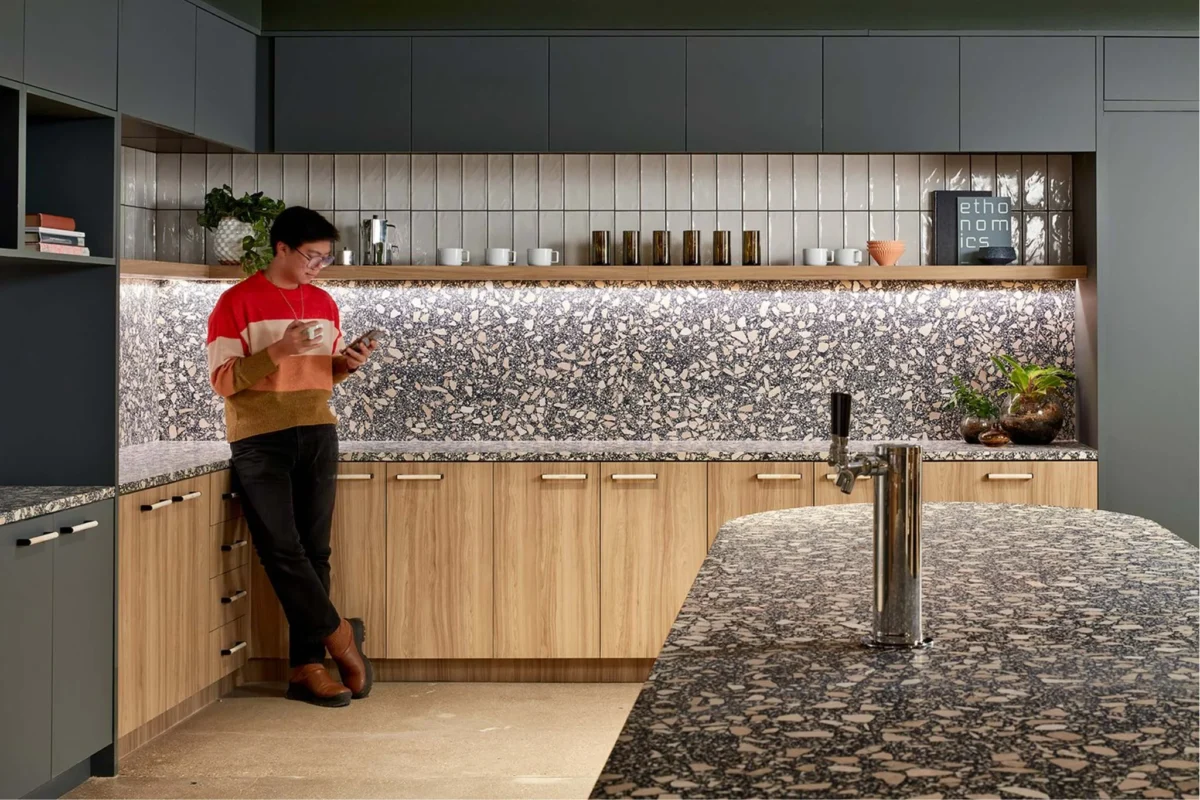
A designer sits at the specification table with three countertop samples in hand. Durability, visual identity, and service life all carry equal weight in that comparison. A terrazzo kitchen counter earns attention here because its matrix-plus-chip composition allows precise customization at the color and aggregate level, and this guide supplies a professional evaluation framework. Readers will find criteria for performance, design fit, fabrication quality, maintenance, and supplier vetting. Those criteria turn terrazzo selection and choosing kitchen countertops into a disciplined specification decision rather than a passing trend, and they apply to every project scale.
Key Takeaways
- Terrazzo counters combine colored chips with a binder, offering endless color and pattern choices.
- Epoxy binders are strong and non-porous, while cement binders need sealing but suit damp areas.
- Terrazzo lasts for decades and can be polished to look new again.
- Choose chip size and finish to match your kitchen style and daily use.
- Work with skilled fabricators and check supplier documentation for a successful installation.
What Sets Terrazzo Kitchen Countertops Apart
Composition and Binder Systems
Terrazzo is a composite material. A binder holds colored chips of marble, granite, glass, quartz, or other fragments in a continuous matrix. The binder choice shapes performance more than most buyers expect. Epoxy binders reach roughly 13,260 psi in compressive strength, while cement binders reach about 4,000 psi. Epoxy also brings non-porous surfaces, vibrant and consistent color, and compatibility with any chip type or size. Cement breathes, suits damp settings, and works indoors and outdoors. Both systems serve indoor kitchens well, and each one supports a different project profile.
| Attribute | Epoxy Binder | Cement Binder |
|---|---|---|
| Compressive strength | ~13,260 psi | ~4,000 psi |
| Porosity | Non-porous | Porous; breathes |
| Color customization | Limitless, consistent | Limited palette |
| Aggregate compatibility | Any type or size | Smaller aggregates |
| Maintenance | Easy, no sealing | May need sealing |
Designers pair any matrix color with a chip formula from a wide array of terrazzo options. That pairing separates the terrazzo kitchen counter from quartz, granite, marble, and solid surface. Quartz offers tight, consistent patterns and broad availability. Granite brings natural movement and depth. Marble delivers classic veining and a soft visual field. Solid surface supports seamless fabrication and integrated sinks. Each material fits a different brief, and terrazzo fits projects that need a custom visual identity.
Customization at the Chip Level
Chip size drives visual character. The NTMA grades chips from No. 0 at 1/16 inch to No. 5 at 3/4 inch. Small chips create a dense, finely speckled field that reads as a blended tone from a distance. Medium chips need careful pairing with tile formats to avoid visual competition. Large chips act as graphic punctuation across broad fields. Aggregate options include marble, quartz, granite, mother-of-pearl, glass, porcelain, and mirror.
The matrix color, chip frequency, fragment scale, and light-dark contrast together define what the countertop communicates from near and far. Quality aggregates and binders keep that composition stable over years of use. Durability follows from the same foundation, and the surface holds its intended look through daily kitchen activity.
Why Designers Specify Terrazzo Kitchen Counter
Design Freedom and Visual Character
Terrazzo once belonged to grand floors and institutional architecture. Designers now specify it for contemporary kitchen countertops, and the material carries that heritage into residential work. Professionals include terrazzo among the best kitchen counter materials recommended for projects, alongside butcher’s block, marble, quartz, and quartzite. Each option fits a different brief. Butcher’s block brings warmth and knife-friendly softness. Marble delivers classic veining. Quartz and quartzite offer tight patterns and strong wear resistance. The material fits projects that need a custom visual identity with a composed, intentional look.
It suits several kitchen styles. Fine-chip, neutral mixes add subtle texture to minimalist kitchens without cluttering clean lines. Light bases with gentle aggregates complement Scandinavian-inspired spaces and their warmth and natural materials. Marble-aggregate mixes with soft veining deliver refined depth in luxury interiors. Hospitality-inspired kitchens use the material as a centerpiece that performs under heavy use. Designers control aggregate size, color selection, and edge profiles to shape the final effect. Fine chips read as an understated smooth surface, medium chips balance visible character, and large chips create a bold focal point. Neutral tones offer flexibility and longevity, while bold colors make the countertop a feature.
Durability and Long-Term Performance
A terrazzo kitchen counter lasts for decades. The surface resists wear under heavy use and does not chip away like other materials. Once properly sealed, the material becomes impervious to water and stain damage. Non-porous epoxy resists stains, bacteria, and moisture. Cement-based versions are porous and absorb stains, so they require periodic sealing. Routine care stays simple: sweeping, mopping, and occasional resealing.
Refinishability strengthens the case for terrazzo kitchen countertops. Worn surfaces can be ground and polished back to a like-new condition. This durability for everyday use supports a long service life and lowers lifecycle cost over time. The upfront cost runs higher than tile, carpet, and vinyl, and budget-limited projects may find that premium unfavorable at first. Low maintenance and decade-long performance make the material cost-effective across the life of the kitchen. Skilled contractors handle installation, and the work is not a DIY task. A durable working surface rewards that investment with reliable performance year after year.
Design Elements That Influence Terrazzo Countertops
Aggregate Size, Color, and Pattern
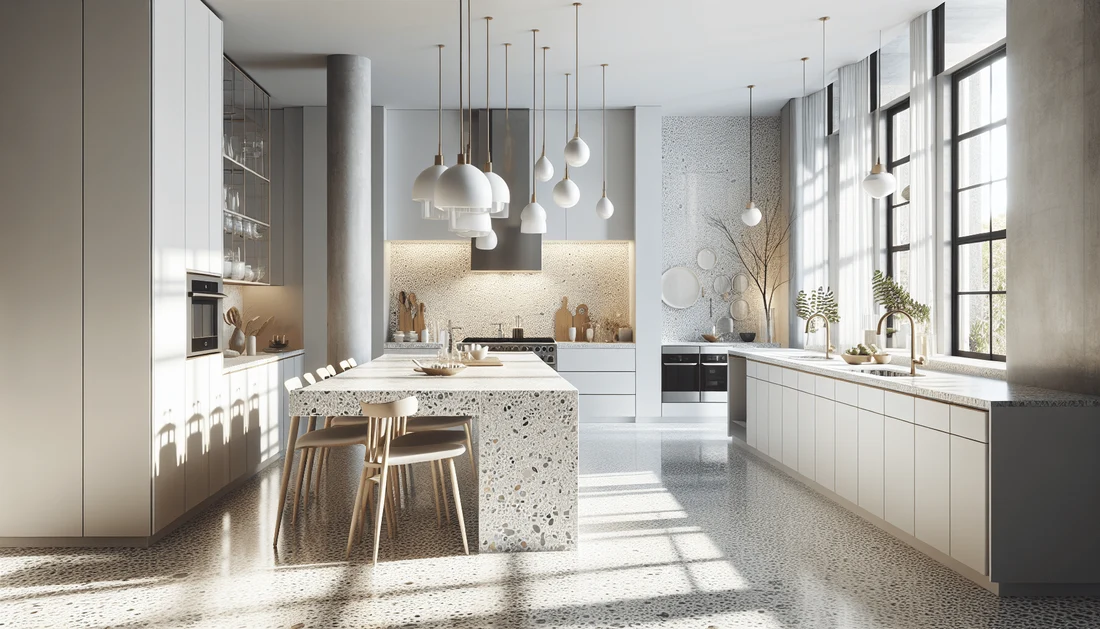
Chip size sets the visual scale of a terrazzo kitchen counter. Macro-chip mixes with large, prominent fragments create dramatic visual movement and suit statement islands or bold, eclectic kitchens. Micro-chip mixes distribute small fragments evenly and read as fine textures rather than contrast, which suits minimalist interiors and calm modern kitchens. The matrix occupies the space between chips, and its undertone can make a multicolor top still read as warm white, cool gray, beige, or charcoal. Designers separate dominant chip colors, which repeat and define the palette, from accent chips, which add surprise. A whole scheme should never rest on a rare bright fragment.
Color selection follows the same logic. Warm neutrals such as ivory, cream, beige, taupe, warm gray, and soft terracotta feel natural and inviting, and they pair well with wood cabinetry, limestone, and travertine. Deep tones such as forest green, charcoal, and black deliver a strong architectural accent for high-contrast schemes. A bright precast terrazzo countertop and backsplash with mixed aggregate sizes gives a minimalist kitchen with beige cabinets, glass-front uppers, and a wood floor a distinct, customized look. A fun multicolor mix on an off-white base turns a subtle modern kitchen with pink walls into a standout focal element. A white mix with red and blue tones plays against sleek dark blue cabinets and white wall tiles. These pairings show how far kitchen countertop styles can stretch when the chip formula drives the design.
Pattern strategy shapes how the surface reads. Patterned tile works when it plays a supporting role and repeats one or two countertop colors. Designers separate pattern from the surface through scale, contrast, layout direction, or finish. A slab treatment removes the grout grid and supports a focal terrazzo with a quiet solid field. Low-contrast grout softens a tile pattern, while high-contrast grout outlines every unit for a bolder, more graphic character. Straight stack layouts create order, running bond adds horizontal rhythm, and herringbone brings stronger movement. When a terrazzo island pairs with terrazzo flooring, quartz is often considered the easiest countertop option because of its tight, consistent pattern and wide availability of tones. That pairing is one coordination option among several, and it keeps the floor as the lead surface. Designers who gather countertop ideas and inspiration from showrooms should test the full group of surfaces in the actual room before committing.
Finish Selection: Honed, Polished, and Matte
Finish changes sheen, slip resistance, and maintenance. A polished surface carries bright highlights and emphasizes chip variation, and it can compete with reflective chips or polished floors. Honed and matte finishes soften transitions and provide relief beside reflective aggregate. Matte textures also hide smudges and fingerprints better in busy kitchens. Honed surfaces offer moderate slip resistance for wet zones. Polished surfaces demand more frequent attention to visible marks. The right finish depends on the room’s light, the surrounding textures, and the expected traffic. Durability holds across all three finishes when the binder and aggregate are sound, so the choice comes down to visual intent and care routine. A honed top in a family kitchen balances sheen with grip. These decisions keep terrazzo kitchen countertops coherent from the work zone to the seating edge.
Practical Considerations Before Choosing Terrazzo Countertops
Thickness, Edge Profiles, and Seams
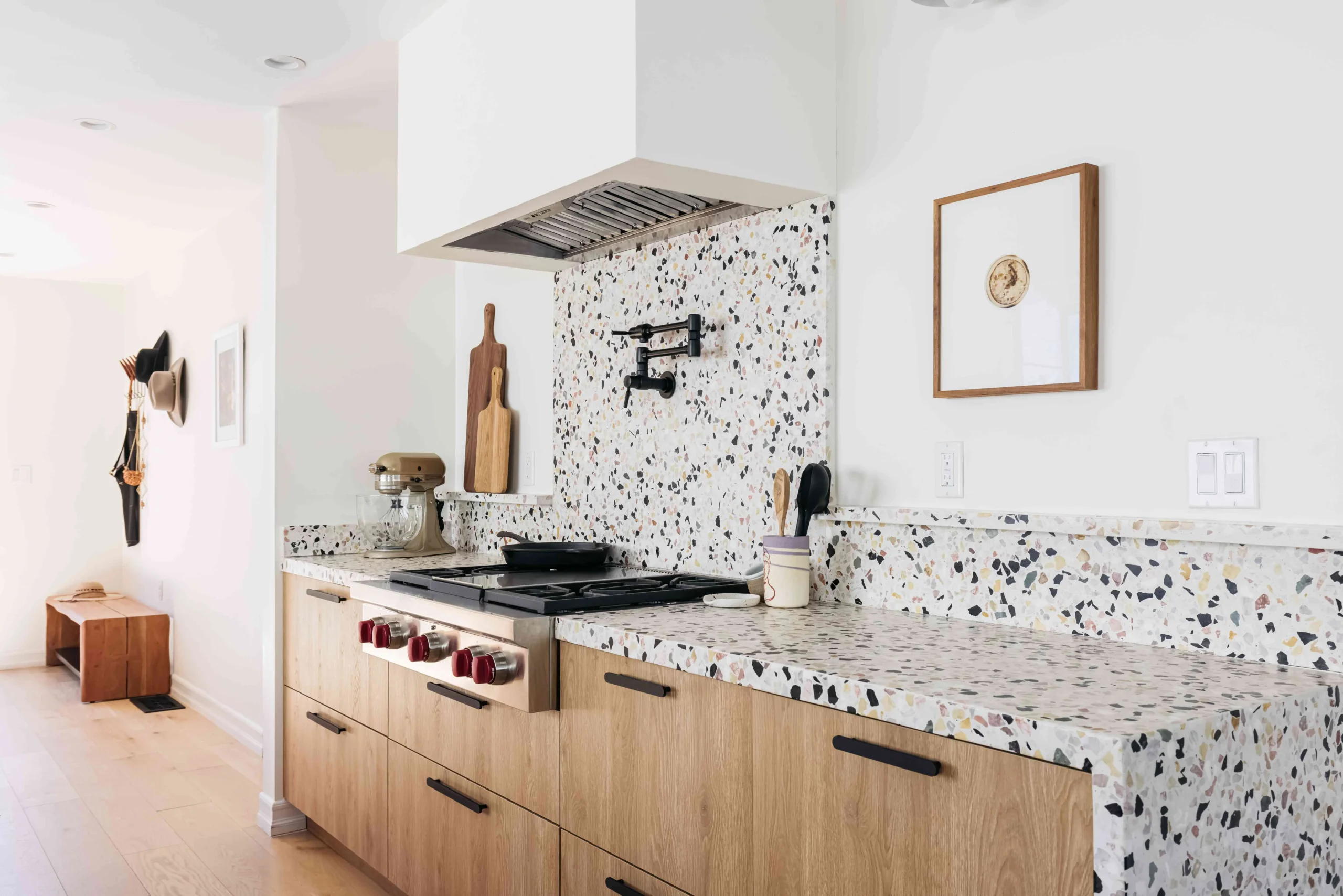
Precast and cast-in-place approaches shape the specification in different ways. Precast terrazzo arrives as finished slabs or panels, so the fabricator controls thickness, edge detailing, and seam layout in the shop before the material reaches the kitchen. Cast-in-place work builds the surface on site, which gives design teams more freedom in size and shape but ties the final outcome to site conditions and crew skill. Both routes demand early decisions on thickness and support. A thin panel needs a substrate that carries it evenly, and a thicker slab changes the visual weight of the island. Designers should settle these points with the fabricator before the shop drawing stage.
Thickness, support, seams, edges, outlets, movement accommodation, and wall conditions for terrazzo work are product- and project-specific and should be confirmed through actual fabrication and installation specifications rather than assumed.
Edge profiles carry both style and function. A clean-lined contemporary kitchen suits a straight or eased edge, while a detailed or whimsical scheme can carry a decorative profile. Material and thickness guide the choice: heavily veined stone may favor a straight or mitered edge for continuity, while solid stone can carry decorative profiles like ogee or Dupont. Bullnose edges are more child-friendly, and sharp bevels add definition. Seam planning deserves the same attention. Designers should set seam locations before fabrication, align them with cabinet divisions, and confirm cut edges, outlets, terminations, and seams have an approved treatment. A seam that lands in a sink cutout or a high-visibility run will read differently than one tucked behind a cabinet line.
Fabricator Qualification and Site Conditions
Fabrication quality decides how a terrazzo kitchen counter performs over time. Skilled fabricators control mix consistency, cure, grinding, and polishing, and those steps protect the surface and its visual character. Site conditions matter just as much. Dust, temperature, and cure time all affect the final surface, and a rushed installation can undo careful shop work. A qualified team verifies the substrate, the setting material, and the exposure before installation begins, and it confirms who holds responsibility for site measurements and final templating. The following checks keep a project on track:
- Confirm the terrazzo tile or panel is approved for the intended wall and exposure.
- Verify the substrate meets the selected system’s requirements.
- Ensure the setting material is compatible with the tile, substrate, and location.
- Use specified movement details at changes of plane and dissimilar-material intersections.
- Confirm cut edges, outlets, terminations, and seams have an approved treatment.
- Match grout, sealer, and cleaner instructions to the installed materials.
- Do not infer countertop maintenance or performance from terrazzo flooring guidance, since surface formulations, fabrication methods, sealers, and manufacturer instructions may differ.
G·ONE supports design teams through this stage with tailored consultations, project samples, and expert engineering support. That help lets architects plan fabrication and installation before work begins, which protects durability, longevity, and the intended color and aggregate effect. A disciplined review of these practical considerations before choosing terrazzo countertops keeps the finished surface aligned with the design brief.
Maintenance and Common Specification Mistakes
Routine Care and Sealing Schedules
A terrazzo surface rewards a simple routine. Design teams should hand owners a maintenance & care guide at handover, because care differs by binder and finish. Epoxy binders are non-porous, so sealers mainly protect the aggregates and enhance appearance. Cement binders benefit most from primary sealer protection. Honed and lightly textured finishes typically feel less slippery than highly polished ones, and suppliers can confirm slip ratings. A water-based acrylic sealer applied per manufacturer instructions usually needs two or more coats on new work, with good sheen lasting roughly 45–60 days before recoating. Sealer should carry a UL slip-resistant classification of at least 0.5 COF.
Daily care stays basic. Wipe acidic spills such as lemon, vinegar, wine, or tomato sauce promptly on worktops and islands. Use only pH-neutral, non-abrasive cleaners, and avoid bleach, strong degreasers, and abrasive pads. Let cleaner dwell for several minutes, but never let it dry on the surface. Splashbacks need less demanding resealing than hard-working countertops. Resealing intervals vary by product, finish, and traffic, so the manufacturer’s documentation sets the schedule.
Pitfalls That Compromise Outcomes
Most failures trace back to specification, not the material. A polished countertop beside a highly reflective backsplash creates competing highlight fields. A backsplash color pulled from a rare accent chip reads as disconnected. Strong grout contrast can make a wall resemble graph paper. Designers avoid these outcomes by comparing physical samples in the actual room, limiting accent colors, and reducing at least one backsplash variable against the counter.
Seam planning causes similar trouble. Unclear seam layouts, unresolved edge treatments, and finish expectations that never matched the sample all surface late. Fabrication quality depends on shop drawings that fix seams, edges, and support before cutting begins.
Grout acts as a joint filler, not the element that holds tile in place, and grout joints are not waterproof. Movement must be addressed where planes or dissimilar materials meet.
Clear documentation of textures, color, and finish protects the final result.
What to Look for in a Terrazzo Supplier
G·ONE is a premium brand specializing in precast terrazzo and sustainable building materials. Its range covers regular, recycled, and mosaic terrazzo, plus custom-made colors, aggregate blends, and molds. The brand also publishes digital catalogs and design lookbooks with product brochures, technical specifications, and material selection manuals. G·ONE serves global designers, architects, and builders, so a specification team can source a full palette from one partner.
Technical Support and Sample Programs
Strong technical support begins before the specification is fixed. A capable partner discusses scope, budget, and material possibilities at every project stage, then supplies the technical data and product data sheets that bid documents require. Custom, project-specific samples confirm that a design is buildable. A complimentary sample program lets a design team evaluate chip blends, matrix colors, and finishes firsthand before committing.
The National Terrazzo and Mosaic Association establishes national standards for terrazzo floor and wall systems and provides complete specifications, color plates, and general information to architects and designers at no cost, with technical specifications and details downloadable as a single source of information.
Support / Program What the Supplier Offers Consult and design Partners with firms at all project stages on scope, budget, and material options Sample design Custom, project-specific samples that confirm buildability Specification support Technical data and material specs for bid documents Complimentary samples Free samples of chip blends, matrix colors, and finishes
Documentation, Compliance, and Lead Times
Documentation deserves the same scrutiny as the sample. Teams should request product information, the specific specification, the applicable standard, and any relevant certification or test results. TCVN 7744:2013 is a key reference for cement-bound terrazzo tiles for interior and exterior paving. A compliance certificate applies only to the specific product and specification published, not automatically to every product from the same manufacturer. A 400×400 mm figure is a dimensional specification alone and does not prove compliance.
Lead time shapes the schedule. Qualification lead times, production capacity, distributor coverage, and technical after-sales service all affect delivery. A pre-purchase checklist keeps the comparison fair:
- Product name and type, dimensions, and thickness
- Intended use and applicable standard
- Quality documentation and required quantity
- Delivery terms, quotation based on the actual order, and lead time
Sourcing teams should weigh total delivered value rather than the quoted unit price alone. Pilot assessments and clear acceptance tests reveal problems before broad rollout.
A terrazzo specification pays back over decades when composition, finish, fabrication, and supplier all align with the project. The material’s longevity shows in the numbers: over a 40-year life cycle, terrazzo costs about $30 per square foot and never needs replacement, while VCT runs about $50 per square foot and does.
| Flooring System | 40-Year Life-Cycle Cost (per sq ft) | Replacement Needs |
|---|---|---|
| Terrazzo | $30 | Never needs replacement |
| VCT | $50 | Requires replacement |
The decision sequence stays simple. Define performance needs, match design intent and color, then vet fabrication and supply partners. G·ONE walks architects and designers from sample selection through project delivery, and every step echoes the brand’s guiding idea: Small actions, big impact.
FAQ
How long does a terrazzo kitchen counter last?
A well-built counter serves for decades. The surface resists wear under heavy use, and a fabricator can grind and polish a worn top back to a like-new condition. Proper sealing and routine care protect that service life.
Does a terrazzo countertop need sealing?
It depends on the binder. Epoxy systems are non-porous, so sealers mainly protect the aggregates and enhance appearance. Cement systems are porous and benefit most from primary sealer protection. The manufacturer’s documentation sets the resealing schedule for each product and finish.
Can designers match a counter to an existing terrazzo floor?
Yes. Designers can specify matrix colors and chip blends to coordinate with an existing floor. Some teams instead choose a quiet, tight-patterned counter so the floor leads the scheme. Physical samples tested in the actual room confirm the pairing before fabrication.
Which finish suits a busy family kitchen?
Honed and matte finishes hide smudges and fingerprints better than polished surfaces, and they offer moderate slip resistance in wet zones. Polished tops show marks more readily. Light levels, surrounding textures, and expected traffic guide the final choice.
What should a design team request from a supplier?
Teams should ask for product data, the specific specification, applicable standards, and test results. Custom project samples confirm buildability. Lead time, production capacity, and after-sales support belong in the same comparison, weighed against total delivered value rather than unit price alone.