
Seamless terrazzo flooring is a poured-in-place, monolithic system that minimizes joints and grout lines. Architects and designers specify terrazzo flooring for its durability, hygiene, design continuity, and lifecycle value in high-traffic spaces. This guide helps specifiers compare epoxy terrazzo and cementitious systems, execute proper terrazzo specification, and evaluate sustainability and cost. G·ONE provides precast terrazzo, recycled terrazzo, and custom solutions with samples and specification support. Designers can request digital catalogs and design lookbooks to align material choices with project requirements. Early decisions on system type, substrate readiness, and joint detailing determine long-term performance.

Key Takeaways
- Seamless terrazzo flooring creates a continuous surface with minimal joints, eliminating grout lines and improving hygiene.
- Epoxy terrazzo cures overnight and offers high strength, making it ideal for fast-track projects.
- Cementitious terrazzo resists moisture and heavy loads, but requires up to seven days to cure.
- Terrazzo offers unlimited design options with various aggregates, colors, and divider strips for logos and patterns.
- Proper substrate preparation and moisture testing are critical to prevent delamination and ensure long-term performance.
- Terrazzo contributes to LEED credits and indoor air quality due to low VOC emissions and recycled content.
- Lifecycle cost analysis shows terrazzo saves money over 40 years compared to porcelain tile.
- Early coordination with suppliers and contractors ensures successful terrazzo installation and design intent.
What Is Seamless Terrazzo Flooring?
Definition and System Basics
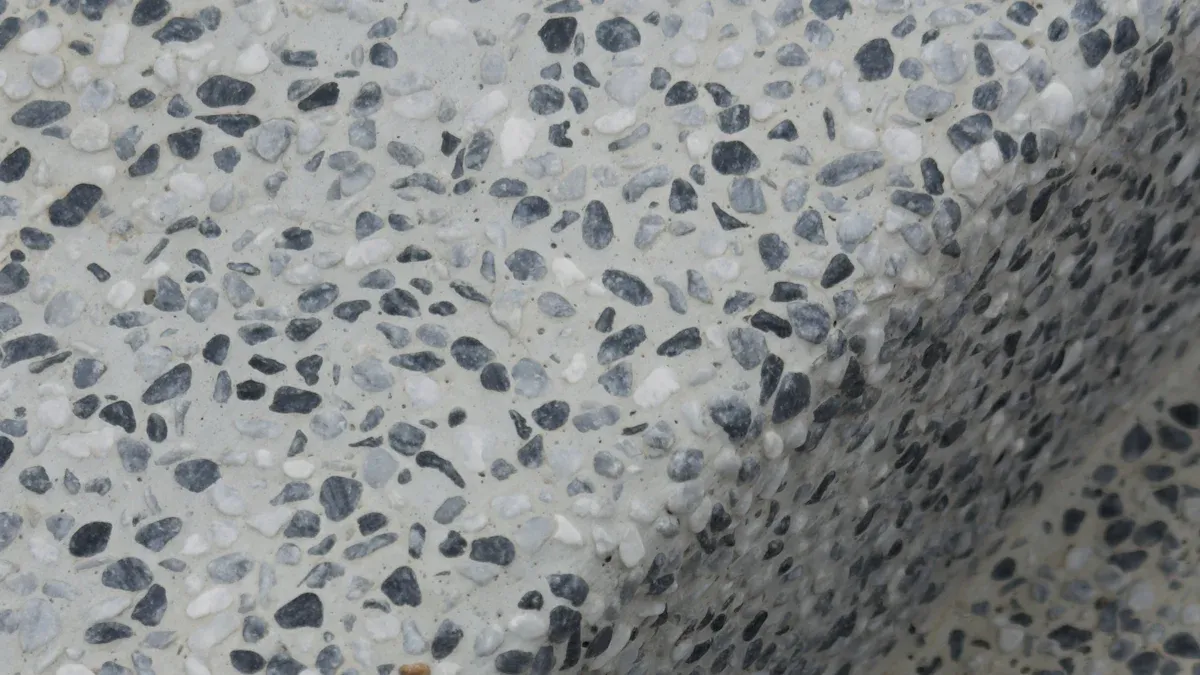
Seamless terrazzo flooring is a poured-in-place system that cures into a monolithic surface with minimal joints. Installers mix marble, granite, glass, or other aggregates with a binder, pour the mixture on site, and grind and polish the cured surface to a uniform finish. This process eliminates the grout lines and seams that fragment tile installations. The result is a continuous plane that reads as a single material across an entire floor plate.
A poured-in-place epoxy terrazzo system uses a resin binder instead of a cementitious matrix. Epoxy terrazzo offers a thin-set profile, rapid cure, and broad color flexibility. Cementitious terrazzo uses a Portland cement binder and delivers a thicker, heavier-duty surface. Both systems rely on divider strips to control cracking and define design zones. The National Terrazzo and Mosaic Association (NTMA) publishes installation and performance guidance that specifiers reference throughout the project.
Performance and Design Advantages
Terrazzo delivers an impermeable surface that resists moisture, stains, and chemical exposure. Maintenance crews need only neutral cleaners and routine polishing to sustain appearance. Designers gain wide latitude in aggregate selection, matrix pigmentation, and divider strip layout. These variables allow terrazzo floors to match brand palettes, wayfinding schemes, and architectural motifs without sacrificing performance.
The material suits high-traffic commercial spaces such as airports, museums, and luxury hotels. These environments demand surfaces that withstand millions of footfalls without visible wear. Terrazzo meets that demand through abrasion resistance and colorfastness. The durability of terrazzo also reduces replacement frequency, which supports lower long-term ownership costs.
Where It Outperforms Tile and Resin
Tile and resin floors present limitations that seamless terrazzo overcomes. Grout lines in tile collect soil and require aggressive cleaning. Resin coatings scratch, yellow, and delaminate under heavy loads. Terrazzo eliminates these failure modes through its monolithic construction and abrasion-resistant aggregate matrix.
Lifecycle data reinforces the case for terrazzo. A NTMA lifecycle cost study for the Southern U.S. region reports the following comparison:
| Flooring Type | 40-Year Cost (per sq ft) | Annual Cost (per sq ft) |
|---|---|---|
| Epoxy Terrazzo | $31.90 | $0.80 |
| Porcelain Tile | $47.37 | $1.18 |
The 40-year lifecycle saving reaches $15.47 per sq ft. Annual savings total $0.38 per sq ft. Authentic terrazzo also outlasts porcelain tile without replacement cycles, which reinforces lower long-term lifecycle costs. Specifiers who weigh first cost alone miss this advantage. Seamless terrazzo flooring repays its investment through decades of service.
Epoxy vs. Cementitious Systems
Specifiers face a fundamental choice between two binder systems. Each option carries distinct implications for thickness, strength, schedule, and budget. The decision shapes the entire terrazzo specification and influences everything from substrate preparation to project timeline.
Thin-Set Epoxy Terrazzo
Thin-set epoxy terrazzo uses a resin binder that cures into a dense, strong surface. Installers apply the mixture at a nominal 1/4-inch topping when using #0 and #1 aggregate. A nominal 3/8-inch topping accommodates #2 aggregate. The system weight is approximately 3 to 4 pounds per square foot. Thickness is determined by aggregate size, as larger chips require a deeper topping to be properly seated.
The compressive strength of epoxy terrazzo exceeds 10,000 psi (68.9 MPa). This strength allows thin-set epoxy systems to perform under heavy loads without cracking or delaminating. The thin profile also reduces dead load on the structure, which benefits multi-story buildings and renovation projects with limited floor height.
Epoxy terrazzo cures overnight under proper ambient conditions. Crews can grind and polish the surface the next day. This rapid turnaround enables other trades to work in parallel and allows large-area installation in days rather than weeks. Projects where time is of the essence benefit from choosing epoxy over cement terrazzo. The materials for cement terrazzo are often cheaper than epoxy, but the latter has a remarkable curing time of around 24 hours, allowing for quicker progress toward the grinding and polishing stages.
Custom epoxy colors can be manufactured to an architect’s exact requirements. This speed supports fast-track schedules and late-stage design changes. G·ONE offers precast terrazzo and custom color capabilities as a reference point for specifiers who need precise color matching and rapid sample turnaround.
Cementitious Terrazzo
Cementitious terrazzo systems use a Portland cement binder. These systems fall into several categories based on installation method. Sand cushion cementitious terrazzo reaches a total depth of 2.5 to 3 inches with a 1/2-inch topping. Monolithic cementitious terrazzo uses a 1/2-inch topping. Polyacrylate cementitious terrazzo measures 3/8 to 1/2 inch. Each variation suits different substrate conditions and structural requirements.
The compressive strength of sand cushion cementitious terrazzo is approximately 4,800 psi. This value is lower than epoxy terrazzo, but cementitious systems offer advantages in certain applications. They resist moisture vapor transmission from concrete slabs better than resin-based systems. They also tolerate substrate movement and temperature fluctuations without the same risk of delamination.
Cementitious terrazzo takes up to seven days to cure before polishing can begin. Some documentation cites a cure period of approximately 28 days for full strength development. The application area must remain traffic-free during curing. This extended timeline may cause business disruption and revenue loss due to closure. Facilities that cannot afford downtime often prefer epoxy terrazzo for this reason.
Thickness, Strength, Cure Time, and Cost
The following table summarizes the key technical differences between the two systems:
| System Type | Nominal Thickness | Compressive Strength |
|---|---|---|
| Thin-Set Epoxy Terrazzo | 3/8″ (9.5 mm); 1/4″ for #0/#1 aggregate | Over 10,000 psi (68.9 MPa) |
| Sand Cushion (Cementitious) | 2.5″ to 3″ total depth (1/2″ topping) | ~4,800 psi |
| Monolithic (Cementitious) | 1/2″ topping | Not specified |
| Polyacrylate (Cementitious) | 3/8″ to 1/2″ | Not specified |
Cure time differences drive scheduling decisions. Epoxy terrazzo cures overnight and is ready to polish the next day. Cementitious terrazzo requires up to seven days before grinding can begin. For a 10,000 sq ft commercial project, this gap translates into significant schedule compression with epoxy.
Cost comparisons favor epoxy terrazzo for most modern interior applications. Although epoxy’s material cost can be higher, it installs faster, is lighter weight, and is less prone to cracking. For a 10,000 sq ft commercial project, significant fixed mobilization costs mean the price per square foot drops dramatically as project scope increases. Large commercial projects of 10,000 sq ft or more benefit from economies of scale and achieve a much lower unit cost.
The choice between thin-set epoxy terrazzo and cementitious terrazzo systems ultimately depends on project priorities. Schedule-driven projects favor epoxy terrazzo floor installation for its rapid cure. Projects with moisture concerns or heavy static loads may favor cementitious options. Specifiers who understand these trade-offs can make informed decisions that balance performance, timeline, and budget.
Design Flexibility and Customization

Aggregates and Matrix Colors
Aggregate selection drives the visual character of any terrazzo floor. Designers choose from marble, granite, glass, quartz, and recycled materials in various sizes and gradations. Chip size includes #0, #1, and #2 gradations, and each gradation changes the floor’s texture and reflectivity. A #0 aggregate creates a subtle, uniform field. A #2 aggregate produces a bold, expressive surface with visible stone depth.
Matrix pigmentation controls the background color that surrounds each chip. Manufacturers can match custom colors to brand standards, paint swatches, or Pantone references. The combination of aggregate blend and matrix color gives terrazzo its nearly unlimited design range. Designers can specify a monochromatic scheme for quiet elegance or a high-contrast palette for visual drama.
Divider Strips and Logos
Divider strips serve both structural and aesthetic functions in terrazzo flooring. These narrow metal or plastic strips separate different colors, define geometric patterns, and control crack propagation. Zinc, brass, and white alloy strips offer different levels of corrosion resistance and visual weight. Strip width varies according to design requirements, and layout determines the scale of the design.
Logos, wayfinding graphics, and mosaic terrazzo patterns integrate directly into the poured surface. Installers place divider strips to outline letters, symbols, or complex imagery. The aggregate and matrix fill each enclosed zone with the specified color. This technique produces permanent graphics that will not peel, fade, or wear away. Airports, museums, and corporate headquarters use this approach for branding and navigation.
G·ONE Custom Terrazzo Solutions
G·ONE offers regular terrazzo, recycled terrazzo, mosaic terrazzo, and custom-made solutions for demanding projects. The recycled line incorporates post-industrial and post-consumer content without compromising surface quality. Mosaic terrazzo enables intricate artistic patterns for feature floors and signature installations. Custom-made solutions cover tailored colors, aggregate blends, and mold designs.
Specifiers can request digital catalogs and design lookbooks from G·ONE to guide material selection. These resources include product brochures, technical specifications, and material selection manuals. Early engagement with the supplier streamlines the terrazzo specification process. Designers who review samples and mockups before finalizing drawings reduce the risk of costly changes during installation. A well-coordinated terrazzo specification aligns design intent with substrate conditions and project schedule.
Terrazzo Specification Essentials
Substrate Prep and Moisture Testing
Substrate preparation determines whether a terrazzo floor performs for decades or fails within months. The concrete slab must be clean, sound, and free of curing compounds, sealers, and contaminants. Contractors should mechanically profile the surface to achieve the proper bond profile. Acid etching does not replace mechanical surface preparation because it leaves residue that weakens adhesion.
Moisture testing protects the terrazzo installation from vapor-driven delamination. Technicians perform calcium chloride tests or in-situ relative humidity probes to quantify moisture vapor emission from the slab. A moisture vapor barrier may be required when readings exceed the manufacturer’s threshold. The barrier isolates the terrazzo from upward vapor migration and prevents blistering or bond failure.
pH checks complete the pre-installation assessment. High alkalinity in the concrete can attack the binder and degrade the terrazzo matrix over time. Contractors neutralize the surface or apply a suitable primer when pH readings fall outside the acceptable range. A thorough technical terrazzo specification documents these test results and defines the remedial actions required before installation begins.
Crack Isolation and Joint Detailing
Crack isolation membranes manage the movement that concrete slabs experience throughout their service life. These membranes bridge dormant cracks and prevent them from reflecting through the terrazzo surface. Specifiers should require a membrane in areas where the slab exhibits existing cracks or where structural movement is anticipated.
Control joints and movement joints require careful detailing in every terrazzo specification. The terrazzo system must accommodate the same movement that the concrete joint allows. Installers align terrazzo joints directly over the concrete joints and maintain the joint width through the topping. This alignment prevents random cracking and keeps the surface intact.
Epoxy terrazzo demands particular attention at concrete joints. Tooled edges at concrete joints must not be used where epoxy terrazzo will be installed. This restriction prevents improper joint treatment that could lead to cracking. Early coordination between the terrazzo contractor and the concrete subcontractor prevents callbacks and delamination. The NTMA publishes guidelines that specifiers reference to confirm proper joint treatment.
Divider Strip Layout and Movement Joints
Divider strips control cracking and define design zones in terrazzo flooring. Their layout must align precisely with structural movement joints. The NTMA provides clear requirements for this alignment.
| NTMA Requirement | Purpose / Rationale |
|---|---|
| Divider strips must exactly track the concrete joint, regardless of whether the joint is straight or crooked. | Prevents cracking in the terrazzo system. |
| Divider strips must not be used to flatten or level the substrate. | They must bond tightly to the concrete. |
| Tile or stone divider strips are prohibited in both cement and epoxy terrazzo. | Avoids incompatible or unsuitable joint detailing. |
| Tooled edges at concrete joints must not be used where epoxy terrazzo will be installed. | Prevents improper joint treatment that could lead to cracking. |
These rules reflect decades of field experience. A divider strip that deviates from the concrete joint creates a stress concentration. The terrazzo cracks along that line because the strip cannot accommodate the movement. Specifiers who enforce these requirements in the standard epoxy terrazzo specification reduce the risk of callbacks.
Movement joints must remain functional after the terrazzo cures. The joint filler and sealant must accommodate the same movement that the structural joint allows. Contractors should verify that the joint width and sealant depth match the terrazzo specification. A moisture vapor barrier beneath the terrazzo does not replace proper joint detailing. Both elements work together to protect the floor.
Coordination among the design team, the terrazzo contractor, and the concrete subcontractor determines success. The terrazzo specification must state that divider strips track concrete joints exactly. It must prohibit tile or stone strips and tooled edges where epoxy terrazzo will be installed. These requirements prevent the most common causes of terrazzo failure. Early review of joint layouts during the submittal phase catches conflicts before installation begins. A well-coordinated terrazzo specification saves the project from expensive repairs and schedule delays.
Performance, Sustainability, and Lifecycle
Durability, DCOF, and Indoor Air Quality
Seamless terrazzo flooring delivers exceptional wear resistance through its dense aggregate-and-binder matrix. This durability maintains appearance under decades of foot traffic. The surface resists abrasion, impact, and chemical exposure without visible degradation. Hard aggregate particles form the wearing surface, and the dense matrix prevents staining or moisture intrusion.
Epoxy terrazzo carries certification under the ANSI/NFSI B101.1 standard as high traction. The system achieves a Dynamic Coefficient of Friction value of 0.42. Industry guidance references a wet DCOF benchmark of 0.42 for level interior areas expected to be walked on while wet. This value positions terrazzo favorably among flooring options for wet, high-traffic spaces. Terrazzo rates as Moderate-High slip safety. These metrics confirm that terrazzo floors satisfy safety requirements without sacrificing the polished finish designers demand.
Indoor air quality benefits from the material composition. The system emits little to no volatile organic compounds before, during, or after installation. No formaldehyde exists in formulations. The cured surface requires no paints, coatings, adhesives, or harmful sealants. This low-VOC profile simplifies compliance with indoor environmental standards.
LEED v4.1 and VOC Compliance
Terrazzo contributes directly to multiple LEED v4.1 credit categories. For the terrazzo specification, the Materials and Resources credits recognize that the basic makeup of epoxy terrazzo uses 100 percent solid materials without portland cement. This composition avoids the embodied energy of lime-rich cements. Aggregates can include natural stone or recycled glass. Sourcing materials locally reduces transportation impacts. The longevity of highly durable terrazzo flooring means it likely will not need replacement during the building’s life, unlike other materials that require periodic replacement.
Terrazzo exhibits little to no off-gassing over the life of the cured material. The nonporous surface does not support microbial growth and prevents moisture accumulation. These characteristics contribute to a mold-free environment and support wellness credits. The zero-VOC composition of the binder system confirms compliance with low-emitting material requirements.
G·ONE offers recycled terrazzo with post-industrial and post-consumer content. Eco-friendly manufacturing processes align with sustainability goals without sacrificing surface quality or performance.
Lifecycle Cost and Maintenance
Life-cycle cost analysis favors this system over replacement-based options. Tile, vinyl, and resin floors require periodic replacement as wear patterns develop or adhesion fails. The floor eliminates replacement cycles through its monolithic construction. The initial investment repays itself through decades of service without refinishing or replacement.
Maintenance requirements remain minimal. Crews use neutral cleaners and routine polishing to sustain appearance. No waxes, sealers, or coatings need reapplication. This low-maintenance profile reduces operating budgets over the building’s life.
When specifiers compare the life-cycle cost against porcelain tile, the savings become clear. The 40-year cost comparison from an NTMA study shows the epoxy system at $31.90 per square foot versus porcelain tile at $47.37 per square foot. The $15.47 difference compounds through reduced maintenance, lower replacement frequency, and uninterrupted facility operations. Specifiers who evaluate this system on life-cycle cost rather than first cost make the economically rational choice for long-term building performance.
Terrazzo Flooring by Building Type
Education and Healthcare
Schools and hospitals demand flooring that withstands constant traffic and supports strict hygiene standards. Epoxy terrazzo suits these environments because it cures overnight and allows crews to return spaces to service quickly. A hospital corridor renovation cannot wait a week for the floor to cure. Thin-set epoxy terrazzo solves that problem through rapid turnaround and seamless construction.
Classrooms and patient rooms benefit from the nonporous surface of terrazzo. This surface resists stains from spills, chemicals, and bodily fluids. Maintenance teams clean these high-traffic floors with neutral cleaners and routine polishing. The absence of grout lines removes places where bacteria can accumulate. Designers specify epoxy terrazzo in education and healthcare projects for these practical advantages.
Transportation and Public Facilities
Airports, train stations, and museums require flooring that endures millions of footfalls without replacement. Cementitious terrazzo systems deliver the heavy-duty performance these facilities need. The thicker profile and Portland cement binder tolerate static loads and substrate movement better than resin-based options. Specifiers choose cementitious terrazzo when durability outweighs schedule speed.
Airport terminals and museum galleries represent proven applications for terrazzo flooring. These spaces combine extreme traffic volumes with architectural significance. Terrazzo floors maintain their appearance through decades of public use. The material also supports wayfinding graphics and branding elements that airports and museums require. Public facilities gain a surface that resists wear, moisture, and chemical exposure.
Commercial and Hospitality
Luxury hotel lobbies and retail boutiques represent the most design-driven applications for terrazzo. Designers use large-chip, high-contrast compositions as focal surfaces that reward extended viewing. Warm earthy palettes appear in boutique hotel lobbies, spa bathrooms, and retail interiors to convey craft and quality. Vertical terrazzo applications extend the material onto feature walls and bathroom surfaces.
Seamless poured terrazzo outperforms tiled alternatives in these settings. Hotel lobbies, restaurant floors, spa reception areas, and boutique retail spaces all benefit from joint-free surfaces. Commercial and hospitality spaces rely on terrazzo’s combination of visual richness and extraordinary durability. This combination makes terrazzo one of the most specified materials in contemporary commercial interior design.
G·ONE supplies terrazzo for commercial spaces, luxury retail, and public landmarks worldwide. The brand’s materials appear in high-traffic interior floors across diverse building types. Architects and designers specify G·ONE terrazzo for commercial flooring installations that demand both performance and aesthetic distinction. The company’s global applications demonstrate the versatility of terrazzo across education, transportation, and hospitality sectors.
Selection Guide for Architects and Designers
Sample Review and Mockups
The decision sequence for a successful floor begins with system choice, design intent, substrate readiness, and lifecycle value. Designers select between epoxy terrazzo and cementitious binders based on project priorities. Aggregate blends and matrix colors follow from architectural motifs. Substrate conditions determine system compatibility. Lifecycle economics confirm the investment case for terrazzo material selection.
Mockups serve as the primary tool for verifying design intent. Approved mockups establish acceptable shade variation and aggregate density. Installer-produced samples align resin color with the actual stone blend during final approval. Aggregate must match the approved sample in color and gradation of sizes. Projects with historic preservation requirements need aggregate approval before mockup construction. Early sample review prevents costly corrections during installation.
Digital catalogs from suppliers such as G·ONE support informed material selection. These resources provide product brochures, technical specifications, and selection manuals. Designers who review physical samples against project lighting conditions reduce mismatch risk.
Specification Support and Submittals
A complete terrazzo specification documents every system detail. It states binder type, topping thickness, aggregate size and gradation, matrix color, and divider strip layout. It references NTMA guidelines for the terrazzo installation and performance. It defines substrate preparation including moisture testing and crack isolation.
Suppliers like G·ONE offer specification support to ensure accuracy. Technical documentation and custom solutions align with project requirements. Submittal review identifies conflicts between the specification and structural drawings. Joint layouts must match concrete joint locations. Divider strip types must comply with NTMA requirements. Early coordination between the design team and the contractor prevents callbacks.
Movement joint detailing deserves particular attention. Tooled edges at concrete joints require careful treatment in epoxy terrazzo installations. The specification must prohibit tooled edges where epoxy terrazzo will be installed. Projects using a moisture vapor barrier must still follow proper epoxy terrazzo joint detailing. A thorough submittal review confirms these requirements before installation begins.
Installation Coordination and Quality Control
On-site quality control determines long-term performance. Moisture testing follows manufacturer requirements to measure the moisture vapor emission rate in pounds of water per day per 1,000 square feet. Higher readings indicate a need for moisture mitigation.
Before applying moisture mitigation, contractors confirm the concrete slab is strong, clean, dry, and contaminant-free. This bond check supports adhesion between slab and mitigation system. After the material cures, a visual inspection identifies defects such as air bubbles or pinholes. These discrepancies signal problems that affect long-term performance.
Epoxy terrazzo requires particular attention to moisture testing due to its impermeable surface. Moisture testing before installation and correct adhesive selection prevent delamination. Delamination occurs when the surface layer separates from the substrate due to moisture issues, weak bonding, or improper techniques. A coordinated quality control plan reduces this risk for any terrazzo installation.
This selection guide for architects and designers helps specifiers navigate the material selection process. Early coordination with installers, thorough submittal review, and on-site quality control determine project success.
Architects and designers should weigh four decision points before specifying terrazzo flooring: system choice, design intent, substrate readiness, and lifecycle value. Successful terrazzo depends on early specification and coordination, not material selection alone. Specifiers should request samples, verify moisture and substrate conditions, and align divider strip layouts with joint details. Epoxy terrazzo cures overnight, so it suits fast-track schedules. Cementitious terrazzo serves heavy-duty applications.
Terrazzo represents a long-term, sustainable flooring investment. G·ONE provides recycled terrazzo, custom solutions, and specification support for global projects. Early collaboration with suppliers and installers protects both design intent and performance.
FAQ
What maintenance does seamless terrazzo require?
Maintenance requires neutral cleaners and routine polishing. No waxes, sealers, or coatings need reapplication. The nonporous surface resists stains and moisture. This low-maintenance profile reduces operating budgets over the building’s life.
How quickly does epoxy terrazzo installation finish?
Epoxy terrazzo cures overnight under proper conditions. Crews grind and polish the surface the next day. This rapid turnaround allows large-area installation in days. Custom epoxy colors are available for fast-track schedules.
Does terrazzo require sealing or waxing?
Seamless terrazzo does not require sealing or waxing. The dense aggregate-and-binder matrix creates an impermeable surface. Routine polishing sustains appearance. No paints, coatings, or harmful sealants exist in the system.
Does resin-based terrazzo retain heat from underfloor heating systems?
The thermal capacity of terrazzo flooring absorbs and releases heat efficiently. Its impermeable surface and hard aggregate composition do not trap or insulate heat. This makes it well-suited for radiant heating applications.
Can terrazzo contribute to LEED certification?
Terrazzo contributes to multiple LEED v4.1 credits. Epoxy terrazzo uses 100 percent solid materials without portland cement. Aggregates include recycled content. The durability eliminates replacement cycles. The zero-VOC composition supports indoor air quality credits.
What is the expected lifespan of a terrazzo floor?
Terrazzo flooring lasts for the building’s life without replacement. A NTMA lifecycle study reports a 40-year cost of $31.90 per square foot for epoxy terrazzo. This compares to porcelain tile at $47.37 per square foot over the same period.