
Brown terrazzo flooring deserves a place on your specification shortlist. Architects and designers value this timeless and versatile material for its unique blend of durability, aesthetics, and sustainability. Brown tones bring warmth and depth to interiors. Terrazzo flooring also delivers a long service life with minimal upkeep.
You need certainty before you commit. This guide gives you the practical detail to select a flooring material with confidence: color and aggregate options, binder performance, compliance, life-cycle cost, and commercial application advice. Each decision shapes how the finished floor performs and how confidently you can defend it to clients. Terrazzo rewards that early rigor with a surface that holds up for decades.
Key Takeaways
- Brown terrazzo offers many color and aggregate choices. You can create a unique floor that matches your design vision.
- Terrazzo lasts for decades with minimal upkeep. It resists wear, moisture, and chemicals, making it ideal for busy spaces.
- Choose epoxy binder for indoor high-traffic areas. Choose cement binder for outdoor or moisture-prone locations.
- Terrazzo meets strict environmental standards. It has low VOC emissions and can be Red List Free, supporting green building certifications.
- Terrazzo costs more upfront but saves money over time. Its long life and low maintenance make it a smart investment.
Brown Terrazzo Flooring Design Options
Color and Aggregate Selection
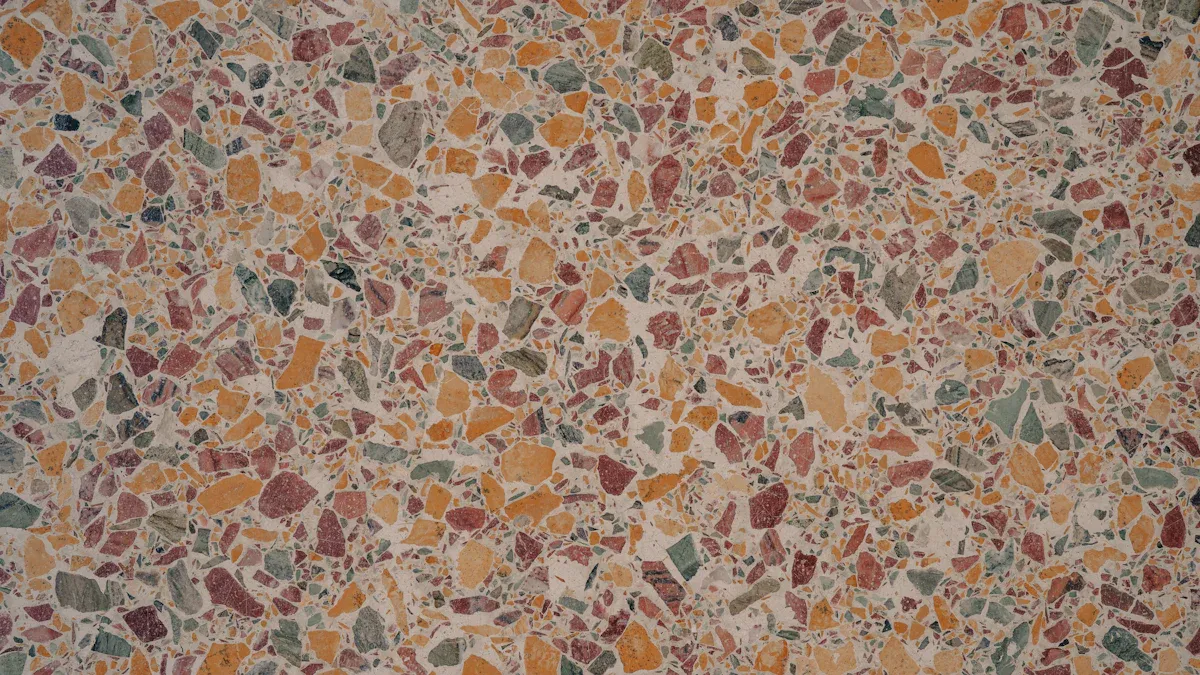
Color selection is your first specification step. Each terrazzo floor is one of a kind, so the palette you approve becomes the finished surface. Brown terrazzo flooring offers a wide range of color options, from warm ivory and taupe through soft terracotta to deep espresso. You can also pair brown with forest green, charcoal, or black for stronger architectural contrast.
Aggregate choice shapes the character of the floor. Chips of marble, quartz, granite, glass give you a wide variety of aggregates and pigments to work with. Brown marble chips and brown glass add depth and visual interest. Macro-chip blends create dramatic movement for entryways and feature zones. Micro-chip blends read quieter and suit minimalist interiors. Most installations blend two or three chip sizes for visual depth.
| Element | Available Options | Effect on Final Appearance |
|---|---|---|
| Brown tone range | Tinted to virtually any shade of brown | Matches your desired depth and richness |
| Aggregate types | Brown marble chips, pebbles, brown glass | Adds color and visual interest |
| Warm neutrals | Ivory, cream, beige, taupe, warm gray, soft terracotta | Natural look; pairs with wood, limestone, travertine |
| Deeper accents | Forest green, charcoal, black | Strong contrast and focal points |
G·ONE supports this stage with custom color and aggregate blends, mosaic terrazzo, and digital lookbooks. These resources help architects and designers review a wide range of aggregates, pigments, and patterns before sign-off.
Poured Venetian Terrazzo and Application Fit
Poured venetian terrazzo is one option among several, not a default. It uses oversized aggregates, graded sizes 3 through 8, to produce greater contrast and draw attention to the stone itself.
Large chips (sizes 5 through 8) create a dramatic mosaic in which individual pieces remain clearly visible at normal viewing distance. Most installations blend two or three chip sizes to add visual depth. In high-aggregate Venetian terrazzo, the chips are so densely packed that the binder is almost entirely hidden — unlike standard American terrazzo, which uses a higher binder ratio with chips spread at lower density against a clearly visible colored matrix.
This specialty style suits decorative floors and countertops where dramatic aggregate patterning is the goal. Larger aggregates increase floor thickness and cost, so plan budget and section depth early. Standard terrazzo, terrazzo tiles, and terrazzo flooring made of marble and natural-stone fragments fit projects that favor a calmer matrix. Specify poured venetian terrazzo where the aggregate is the design statement.
Terrazzo Flooring Performance and Fit
Durability in High-Traffic Areas
Terrazzo delivers a durable, long-lasting surface that suits demanding commercial environments. Inorganic terrazzo shows water absorption of 0.19–0.53%, Moh’s hardness of 4–6, density of 2.37–2.49 g/cm³, compressive strength of 101–123 MPa, and flexural strength of 12.2–14.5 MPa. Traditional terrazzo, by comparison, shows water absorption of ≥3%, Moh’s hardness of 3, density below 2.3 g/cm³, compressive strength below 90 MPa, and flexural strength below 8 MPa. Wear resistance, chemical resistance, freeze resistance, and pore-free ratings all favor the inorganic system. These figures explain why terrazzo flooring holds up under heavy foot traffic in airports, malls, and retail spaces.
| Test Item | Unit | Traditional Terrazzo | Inorganic Terrazzo |
|---|---|---|---|
| Water Absorption | % | ≥ 3 | 0.19–0.53 |
| Moh’s Hardness | grade | 3 | 4–6 |
| Density | g/cm³ | < 2.3 | 2.37–2.49 |
| Compressive Strength | MPa | < 90 | 101–123 |
| Flexural Strength (Dry) | MPa | < 8 | 12.2–14.5 |
| Wear Resistance | rating | ●●● | ●●●●● |
| Chemical Resistance | rating | ● | ●●●●● |
| Freeze-Resistant | rating | ● | ●●●●● |
| Pore-Free | rating | ● | ●●●●● |
This terrazzo flooring resists moisture and microbial growth through a seamless, non-absorbent surface. The NTMA recommends a simple program: wipe spills promptly, dust-mop daily, clean with a pH-neutral cleaner, and reseal every 1–2 years depending on traffic. Buffing or burnishing restores shine in high-traffic areas, and waxes are discouraged. Terrazzo floors commonly last 50–75 years or longer. Four century-old Pacific Northwest courthouses were restored in 2012, and architect Robyn Toth reports renovating 50- to 75-year-old floors that needed only refinishing. Life-cycle data show terrazzo breaks even with VCT at about 12.5 years and costs roughly $30/sq ft over 40 years versus $50/sq ft for VCT. Terrazzo can also be spot-repaired between divider strips to closely match the original installation. Orlando International Airport’s Terminal C features a 650,000-square-foot poured-in-place thin-set epoxy installation, selected for durability and low maintenance.
Epoxy vs. Cement Binders
You can specify terrazzo with cementitious, epoxy, or a combination of both binders. Each fits different project conditions. Epoxy terrazzo reaches 13,260 psi compressive strength, 9,580 psi tensile strength, and 4,100 psi flexural strength. Cement systems reach about 4,000 psi compressive, 400–600 psi tensile, and 400–600 psi flexural strength.
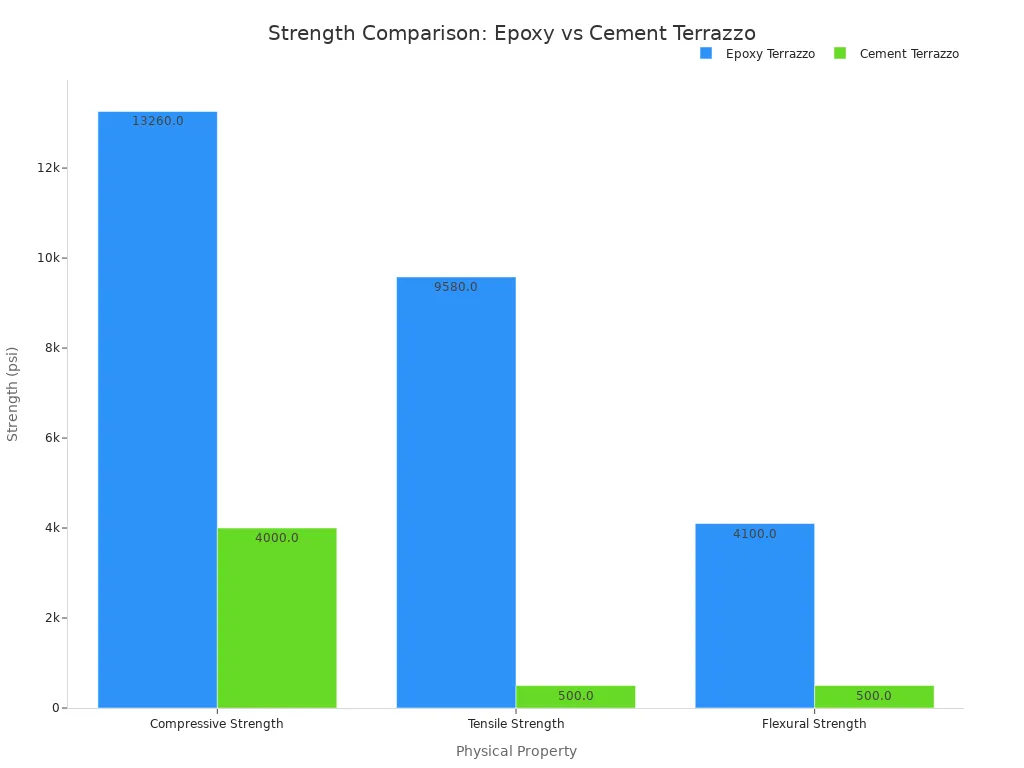
An epoxy resin binder suits indoor high-traffic commercial use, multi-story buildings, renovations, and complex multicolor designs. An epoxy resin binder cures overnight and needs no depressed slab. Cement terrazzo suits outdoor exposure, high-moisture or below-grade slabs, and rustic exterior finishes. Both systems last 40+ years. Upfront installation cost of epoxy systems is comparable to cement systems, but cement systems carry higher labor and material costs. Epoxy wins on lifecycle cost: its non-porous surface eliminates periodic sealing and resists staining, which lowers cleaning labor. Its superior strength reduces repair frequency.
Plan lead times early. Custom floor ordering can take 3–4 months. Terrazzo-effect porcelain stoneware and terrazzo tiles ship faster, so compare flooring schedules before you commit. Architects and designers should confirm binder choice against moisture, UV exposure, and structural conditions. Terrazzo-effect porcelain stoneware offers a faster alternative for tight timelines, while venetian terrazzo remains the choice for decorative aggregate statements. Specify terrazzo for commercial and public spaces where longevity matters.
Compliance and Life-Cycle Cost
VOC Levels and Red List Ingredients
Specification compliance starts with emissions and ingredient disclosure. The Living Building Challenge Red List identifies “worst-in-class” chemicals harmful to human health and the environment that commonly appear in building products. It is organized by chemical class, with individual chemicals identified by CAS Registry Number. Relevant classes include:
- Antimicrobials marketed with health claims
- Alkylphenols
- Asbestos compounds
- Bisphenol A and structural analogues
- California-banned solvents
- Chlorinated polymers (including PVC, CPVC, neoprene, CSPE, PVDC)
- Chlorobenzenes
- CFCs/HCFCs
- Added formaldehyde
- Halogenated flame retardants
- Organotin compounds
- PFAS/PFCs
- Orthophthalates
- PCBs
- PAHs
- Short- and medium-chain chlorinated paraffins
- Toxic heavy metals (arsenic, cadmium, chromium, lead, mercury)
- VOCs in wet-applied products
- Wood treatments containing creosote or pentachlorophenol
You can verify terrazzo compliance through recognized certifications:
- GREENGUARD Gold — ensures building products meet a low threshold of VOC emissions.
- Indoor Advantage Gold — tests and limits VOC emissions for interior materials including floor coverings, sealants, and adhesives.
- FloorScore — low-VOC emissions certification for hard-surface terrazzo flooring, adhesives, and underlayments.
- Green Seal GS-11 — covers sealers and coatings for terrazzo substrates and prohibits harmful chemicals such as APEs and heavy metals.
- EPA Safer Choice — restricts VOC content and excludes ingredients harmful to health and environment.
- Living Building Challenge Red List Approved (via ILFI Declare) — requires disclosure of at least 99% of ingredients.
These certifications align with CDPH Standard Method v1.2 (California Section 01350), the benchmark for low-VOC emissions compliance in green building standards.
| Consideration | Terrazzo Detail | Green Building Standard Affected |
|---|---|---|
| VOC content | Zero-VOC resins and low-VOC sealers | Supports LEED EQ Credit: Low-Emitting Materials, worth 1–3 points |
| VOC emissions | UL Environment GREENGUARD Gold Certified resin systems | Meets low-VOC emissions thresholds under LEED |
| Red List ingredients | Third-party verified Declare Label as “Red List Free” | Satisfies Living Building Challenge Red List Imperative |
| Product equivalence | Mimics standard systems with no change to installation methods | Allows Red List compliance without altering construction practice |
Cost-Effectiveness Over Time
Terrazzo carries a higher upfront installation cost than vinyl or carpet. Its longevity and lower annual maintenance costs offset that initial investment. Epoxy terrazzo costs $14.50 per sq ft installed with $0.43 annual maintenance per sq ft, and it replaces every 40 years. Vinyl sheet costs $3.58 per sq ft installed with $1.12 annual maintenance, and it replaces every 10 years. The annualized cost tells the real story: epoxy terrazzo runs $0.80 per sq ft per year, vinyl sheet $1.57, carpet $1.65, and porcelain tile $1.16.
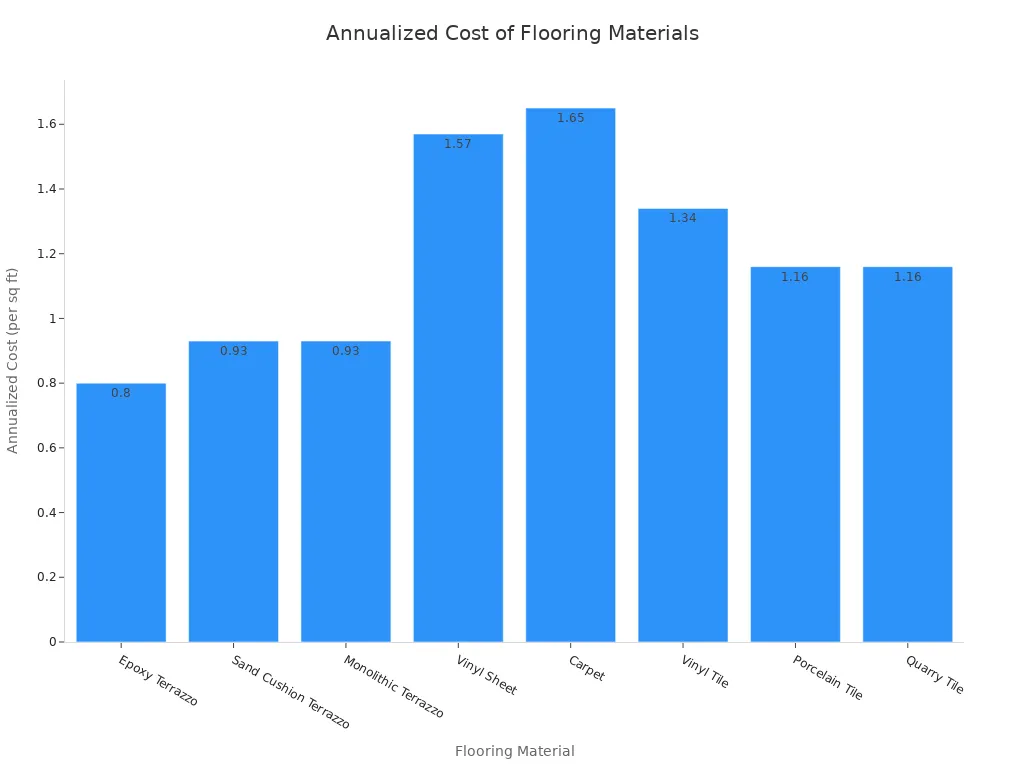
When you evaluate initial installation, routine maintenance, repairs, and restoration together, terrazzo emerges as the more cost-effective option over the full life cycle. The University of Alabama consistently specifies terrazzo for student unions, classrooms, and dormitories. Low maintenance costs, exceptional durability, and a seamless non-porous surface simplify cleaning and yield substantial long-term savings. Nashville International Airport replaced outdated carpet with terrazzo specifically to avoid frequent carpet replacements and capture long-term financial benefits. Terrazzo flooring delivers significant long-term savings through durability and reduced replacement frequency.
Terrazzo Flooring in Commercial Buildings
Patterns and Wayfinding
Pattern and zoning decisions turn terrazzo into a navigation tool. Embedded logos, medallions, inlays, and directional patterns last far longer than painted graphics or decals, which fade and peel under heavy foot traffic. These identity features perform best in main lobbies, public entrances, university buildings, healthcare campuses, and civic interiors.
| Project | Technique | Wayfinding Function |
|---|---|---|
| Minneapolis Convention Center | Sweeping geometric lines, color bands, embedded arrows and icons at decision points | Turns the floor into an intuitive map |
| Boiling Springs High School | Color-coded zones and geometric patterns for wings and corridors | Gives immediate sense of location |
| Tops Diner | Rhythm and subtle embedded cues between entry, dining, and service areas | Guides circulation naturally |
Apply color zoning to channel people between high-stimulus and low-stimulus areas. Use directional patterns to guide circulation across large floor plans. These strategies reinforce accessibility and accommodate diverse sensory needs.
Bold color contrasts, dynamic patterns, and inlaid graphics in terrazzo can energize interiors and act as intuitive wayfinding landmarks.
Specification Coordination
Select the terrazzo system family before choosing color or finish. Once you establish the correct system, you can choose color, texture, gloss, layout, and decorative options with fewer compromises. Have the terrazzo contractor brief the whole project team on concrete placement quality, MEP penetrations, and equipment access for grinding and polishing.
- Resolve detailing early: align divider strips with structural joints, plan transitions at carpet, LVT, stone, and exterior entries, and define who protects finished floors during closeout.
- Treat terrazzo as a finish milestone: confirm heavy trades are off the floor, the building is weather-tight, and dust control is planned.
- Sequence work so substrate readiness and moisture are confirmed, terrazzo follows major overhead work, and polishing finishes before final fixtures.
Divider strips are a layout and appearance tool. They do not prevent cracking, so coordinate movement-joint and crack-control requirements with the concrete scope before field work. The approved physical sample is your reference document for appearance, with natural variation expected between sample and installed field. Designers who lock in color and aggregate sign-off early avoid costly rework in commercial and public spaces. Specify terrazzo tiles or venetian terrazzo only after this coordination is complete.
G·ONE Brown Terrazzo Flooring Benefits
Advantages Recap
Brown terrazzo flooring earns its place through four strengths you can defend in any design review. Durability comes first: terrazzo resists wear, moisture, and chemical attack, so the surface holds up in lobbies, corridors, and retail spaces that see constant traffic. Low maintenance follows. A pH-neutral cleaner, routine dust mopping, and occasional buffing keep terrazzo looking new, and you avoid the replacement cycles that burden softer flooring.
Warmth and design flexibility complete the case. Brown tones add depth that cool gray palettes cannot match, and terrazzo pairs naturally with wood, limestone, and travertine. Terrazzo also accepts custom pigments, aggregate blends, and patterns, so one terrazzo specification can carry a project’s identity from entry to upper floors. Specify terrazzo once, and you gain a surface that serves the interior for decades.
Samples and Support
G·ONE gives you the resources to move a terrazzo flooring specification from concept to a defensible document. The range covers premium precast terrazzo, recycled terrazzo, mosaic terrazzo, and UHPC panels, plus custom colors, aggregate blends, and mold patterns. Digital catalogs and lookbooks let you assess product fit and technical data before you request anything physical. Poured venetian terrazzo remains available where the aggregate is the design statement. These resources support budgeting and specification from the first sketch.
| Offering | What G·ONE Provides | Purpose |
|---|---|---|
| Project samples | Physical samples to verify texture and composition | Confirms color early and reduces costly errors |
| Digital catalogs | Brochures and technical specifications for online review | Supports early product assessment |
| Engineering support | Answers on substrate and weight questions | Keeps the specification accurate |
| Custom solutions | Tailored colors, blends, and molds | Creates distinctive environments |
Request project samples to confirm the terrazzo color before you commit to a full order. Digital catalogs give estimators the technical data for accurate pricing, and engineering support resolves substrate and weight questions during design. Early engagement with these resources keeps your budget realistic and your specification defensible. Contact G·ONE to request samples and specification assistance for your next terrazzo flooring project.
You now hold the four criteria that decide a confident specification: design flexibility, technical performance, compliance, and cost. Weigh each against your project priorities. Match the terrazzo system to substrate conditions, traffic intensity, and schedule. Compare binder options on their fit, not on a single winner. Brown terrazzo flooring rewards this disciplined approach with warmth and decades of service.
G·ONE supports architects and designers through every stage. Request physical samples to confirm color and aggregate before sign-off. Digital catalogs supply the technical documentation your spec demands. Engineering support resolves substrate and weight questions during design. Contact G·ONE today to request samples and specification assistance for your next terrazzo flooring project.
FAQ
How far ahead should you order brown terrazzo flooring?
Plan early. Custom terrazzo floor ordering can take 3–4 months. Terrazzo-effect porcelain tiles ship faster, so compare schedules before you commit. Confirm your color and aggregate sign-off before the order window opens.
What maintenance does terrazzo need?
Terrazzo needs little upkeep. Dust-mop daily, wipe spills promptly, and clean with a pH-neutral cleaner. Reseal every 1–2 years depending on traffic. Buffing restores shine in busy areas. Avoid waxes. This simple routine keeps the surface looking new.
Should you choose epoxy or cement for your terrazzo?
Match the binder to conditions. Epoxy terrazzo suits indoor high-traffic commercial spaces, renovations, and multicolor designs. It cures overnight and needs no depressed slab. Cement terrazzo fits outdoor exposure, high-moisture slabs, and below-grade work. Both systems last 40+ years.
How long does terrazzo flooring last?
Terrazzo floors commonly last 50–75 years or longer. Spot repairs between divider strips can closely match the original installation. Life-cycle data show terrazzo breaks even with VCT at about 12.5 years. Longevity makes terrazzo a sound long-term investment.
Does venetian terrazzo suit every project?
No. Venetian terrazzo uses oversized aggregates to make the stone the design statement. It suits decorative floors and countertops. Larger aggregates increase floor thickness and cost. Standard terrazzo fits projects that favor a calmer matrix. Specify each style to its best use.