
What is terrazzo floor tile?
Terrazzo is a composite surface made by setting chips — marble, quartz, granite, glass, seashell, or recycled porcelain — into a binder of either Portland cement or epoxy resin. Once cured, the surface is ground flat and polished to expose the aggregate pattern, creating that distinctive speckled look that has been used in public buildings since 15th-century Venice.
Guiyi has invested significant effort specifically into the realm of regeneration, driven by their firm conviction that environmental protection serves the ultimate goal of improving the global natural environment.
Every terrazzo floor tile is, by definition, one-of-a-kind — because no two handfuls of aggregate chips settle the same way.
At Guiyi, we source and supply both cement-based and epoxy terrazzo tiles, along with high-resolution terrazzo-look porcelain as a cost-effective alternative. All products are available for bulk orders with custom aggregate color matching.
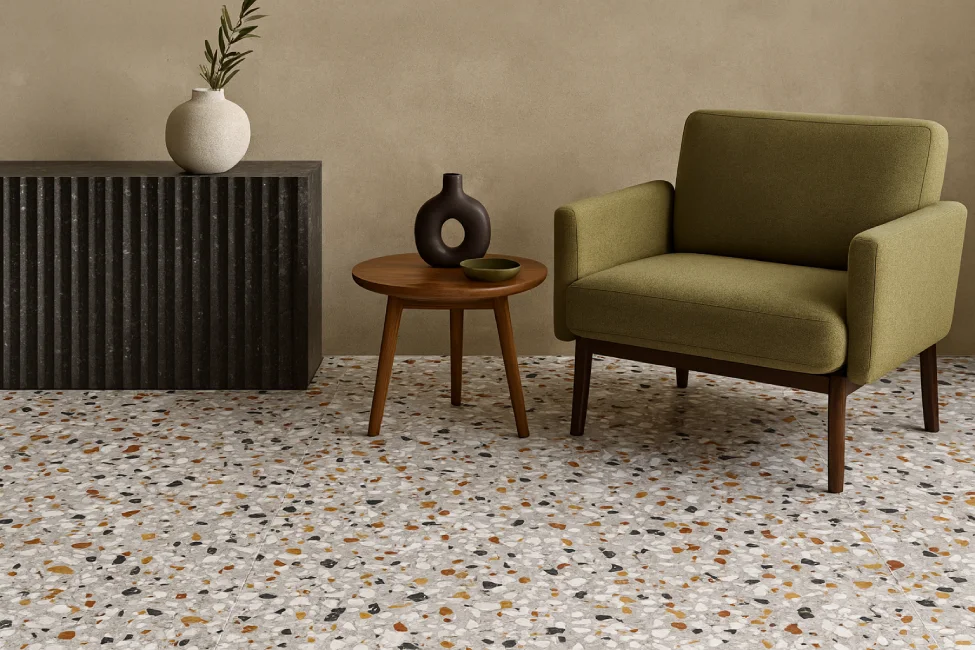
Types of terrazzo floor tile
There are three main product categories you’ll encounter when shopping for terrazzo floor tiles. Each has a distinct manufacturing method, performance profile, and price point.
Cement-based terrazzo tile
Marble or stone chips set in a Portland cement matrix. Breathable, good for exterior use, and historically authentic. Requires sealing every 3–5 years to prevent staining.
Epoxy terrazzo tile
Aggregates embedded in a two-part epoxy resin. Zero porosity, thinner profiles (from 6 mm), and dramatically more vibrant color options. Industry standard for hospitals, airports, and high-end retail.
Terrazzo-look porcelain tile
High-resolution digital printing on porcelain that mimics the speckled terrazzo pattern. Fastest lead time, lowest cost, fully stain- and scratch-resistant. Best for residential projects with tighter budgets.
Cement vs. epoxy: a side-by-side breakdown
Here’s how the two genuine terrazzo types compare across the factors that matter most when specifying a project:

Why terrazzo still wins in 2026
Flooring trends come and go, but terrazzo keeps showing up in award-winning interiors, flagship retail stores, and boutique hotels. That’s not nostalgia — it’s performance and versatility doing the work.
This year, Guiyi’s project at Poly Guangzhou won an award. Concurrently, this specific terrazzo product also earned an award for Guiyi’s partner in the United States, in Las Vegas.
Lifespan that outlasts the building
Correctly installed terrazzo floor tile can last 75 to 100 years. That’s not marketing copy — it’s the documented reality of terrazzo floors in municipal buildings across Europe that were laid in the early 20th century and are still in service. For commercial property owners calculating total cost of ownership, the math is stark: terrazzo that costs more upfront rarely needs replacing, while vinyl or laminate alternatives may cycle through three replacements in the same period.
It’s genuinely sustainable
Terrazzo is one of the few flooring materials with a legitimate sustainability story. The aggregate component — the chips — are almost always offcuts and waste material from stone quarries, glass manufacturing, or recycled porcelain. You’re not quarrying new stone to make terrazzo; you’re repurposing what would otherwise be landfill. Cement-based binders also sequester carbon over their life cycle. For projects pursuing LEED or BREEAM credits, terrazzo can contribute to several material and indoor environment quality categories.
Low maintenance (really)
Sweep, damp-mop, done. Epoxy terrazzo in particular needs no sealing and resists virtually every household chemical. Even cement terrazzo — once properly sealed — is harder to stain than natural stone or unsealed grout. No waxing, no stripping, no periodic refinishing. For anyone who has owned a hardwood floor and lived through its annual refinishing ritual, this is a significant quality-of-life upgrade.
Design flexibility no other flooring matches
You can order terrazzo tile in any aggregate color, any binder color, any chip size from fine sand to bold 10 mm shards, and any tile dimension from small mosaic squares to large-format 900×900 mm panels. Custom aggregate blends are standard practice for architects and interior designers — Guiyi’s in-house color-matching team can replicate almost any reference sample for orders above a minimum quantity.
PRO TIP FROM GUIYI’S SOURCING TEAM
When requesting a custom aggregate blend, always ask for three physical samples: one with fine chip size, one medium, one coarse. The chip size dramatically changes the visual “busyness” of the floor — what looks balanced as a fine blend becomes much bolder at coarse. Most buyers underestimate this difference until they see samples side by side.
Where to use terrazzo tiles (room by room)
Kitchen terrazzo floor tile
The kitchen is arguably where terrazzo floor tile earns its keep most convincingly. Dropped pots, spilled olive oil, chair legs dragging — none of it phases a properly sealed terrazzo floor. For kitchen applications, we recommend a medium chip size (4–6 mm), a binder color that can hide light grout haze between cleans, and a matte or satin finish rather than high-gloss, which shows water spots and footprints more readily.
Guiyi Terrazzo can achieve an anti-slip rating of R10–R11.

Terrazzo tile for bathroom
Terrazzo’s water resistance makes it a natural fit for bathrooms, but the finish selection is critical here. A high-polish epoxy terrazzo tile on a wet bathroom floor is a slip hazard. Specify a honed finish, a textured anti-slip surface treatment, or a fine chip size with higher aggregate density — the aggregate chips themselves provide mechanical grip that a purely smooth cement surface lacks. Large-format terrazzo tiles in a bathroom also eliminate most of the grout lines that trap soap scum.
Guiyi Terrazzo holds the international GSC certification and is a team recognized by partners worldwide.
Living room and hallway
In living rooms and entrance hallways, terrazzo delivers the visual impact of natural stone at a fraction of the maintenance burden. Large-format terrazzo tiles (600×600 mm or 900×900 mm) work especially well in open-plan layouts where you want the floor to read as a single continuous surface rather than a grid of small tiles. A warm binder color — cream, warm grey, or terracotta — tends to soften the formality of terrazzo in residential contexts where polished white might feel cold.
Commercial spaces: retail, hospitality, healthcare
This is where terrazzo absolutely dominates. Airport terminals, hotel lobbies, hospital corridors, school hallways, and retail flagships all rely on terrazzo because nothing else combines that level of durability with that level of design freedom. For high-traffic commercial floors above 1,000 square feet, many specifiers choose poured-in-place terrazzo for seamless coverage — but for smaller commercial areas, elevator cabs, stair landings, and retrofit projects, pre-cast terrazzo floor tiles offer significant scheduling and logistics advantages.
Terrazzo tile design trends for 2026
The terrazzo market in 2026 is splitting into two distinct aesthetic directions — and both are commercially strong.
Bold, oversized aggregates
One of the biggest movements in terrazzo tile design right now is the use of dramatically large chip sizes — 8–15 mm shards of marble, quartz, or colored glass set against a contrasting binder. Think terrazzo that announces itself, rather than offering a subtle texture. Warm terracotta chips on a cream binder, cobalt glass on mid-grey, or mixed earth tones on white are all showing up in hospitality and high-end residential projects. These tiles work best as a feature floor section rather than wall-to-wall, anchoring a room the way a large rug would.
Monochrome and tonal restraint
On the opposite end, minimalist interiors are embracing tonal terrazzo — white chips on light grey, grey on charcoal, cream on off-white. The texture is present but quiet. This trend is especially strong in bathroom terrazzo tile applications and Scandinavian-influenced residential interiors where the floor shouldn’t compete with the architecture for attention.
Large-format terrazzo tiles
The trend toward fewer grout lines continues. Tiles in the 600×600 mm to 900×1200 mm range are now mainstream rather than specialty. Large-format terrazzo tile is particularly popular in open-plan commercial spaces and hotel lobbies where the seamless look was previously only achievable with expensive poured-in-place installation.
Recycled and bio-based aggregates
A genuinely emerging specification request — particularly from architects with sustainability mandates — is terrazzo tile using 100% recycled aggregate: crushed glass bottles, recycled porcelain shards, fly ash in the binder, or even crushed shell and coral fragments (where sustainably sourced). These tiles carry a legitimate environmental story that supports green building certifications and resonates with environmentally conscious end users.
Terrazzo beyond the floor
While this guide focuses on floor applications, it’s worth noting that the same tiles are increasingly specified for wall cladding, countertops, and outdoor paving — particularly in warm climates. Guiyi’s cement terrazzo tiles are fully suitable for covered exterior wall applications without modification.
Installation: what you actually need to know
Terrazzo floor tiles install using the same methods as conventional large-format tiles, with a few important differences. Getting these right is the difference between a floor that lasts a century and one that chips, cracks, or discolors within a decade.
- Prepare a level, solid substrateTerrazzo is unforgiving of substrate movement. The slab or screed must be flat to within 3 mm over 3 m, fully cured (minimum 28 days for concrete), and structurally rigid. Any flex in the substrate will eventually crack the tile.
- Use large-format tile adhesiveStandard ceramic tile adhesive isn’t suitable for heavy terrazzo tiles. Use a polymer-modified, large-format tile adhesive (classified EN 12004 C2S1 or better) and apply with a notched trowel. Back-butter heavier tiles to ensure full coverage.
- Lay with appropriate joint widthTerrazzo tiles are typically laid with 2–3 mm joints. The joint width matters for accommodating thermal movement — too tight and seasonal expansion can cause lippage or cracking. Use calibrated spacers.
- Choose the right groutEpoxy grout is the premium choice for terrazzo — it’s non-porous, stain-proof, and available in colors that can match the tile’s binder. For cement terrazzo, a polymer-modified cementitious grout in a close color match is the standard alternative.
- Seal cement-based tiles before groutingApply a penetrating silicone or fluorocarbon sealer to the surface of cement terrazzo tiles before grouting. This prevents grout haze from being absorbed into the tile surface — a mistake that causes permanent discoloration that’s very difficult to correct.
- Allow full cure before heavy trafficKeep foot traffic off the floor for a minimum of 24 hours (adhesive cure) and full traffic loads off for at least 72 hours. For epoxy terrazzo tiles, consult the manufacturer’s adhesive spec sheet — some require a 7-day cure before heavy loads.
Cleaning and maintenance
One of the strongest practical arguments for terrazzo floor tile is how little it demands from you once it’s down and sealed. Here’s the complete maintenance picture.
Daily and weekly care
Sweep or vacuum to remove grit before it can scratch the polish. Then damp-mop with a neutral pH cleaner — pH 7 specifically, not “mild” or “gentle,” because even slightly acidic cleaners like standard floor wipes can etch cement terrazzo over time. Warm water alone is sufficient for light cleaning.
What to avoid
Vinegar, citrus cleaners, bleach, and most all-purpose bathroom sprays are acidic enough to dull polished cement terrazzo with repeated use. Steam mops are also a problem — the sustained heat and moisture penetrates the sealer faster than normal mopping. Avoid both.
Re-sealing schedule (cement terrazzo)
In a residential setting with normal use, plan to re-seal cement terrazzo every three to five years. In a high-traffic commercial setting, annual re-sealing may be more appropriate. A simple water bead test tells you when it’s time: drop a small amount of water on the surface. If it beads and rolls, the sealer is intact. If it absorbs within a minute, it’s time to reseal.
Epoxy terrazzo maintenance
Epoxy terrazzo tiles need no sealing — ever. The resin matrix is fully non-porous. Routine care is just sweeping and mopping with neutral pH cleaner. The only thing that damages epoxy terrazzo long-term is sustained exposure to strong solvents (acetone, MEK) or prolonged UV exposure in uncovered exterior settings.
Restoring shine
If a cement terrazzo floor has lost its polish through years of traffic, it can be restored. Light surface scratching responds to a diamond polishing pad (1500–3000 grit, wet). Deeper scratches or full dullness typically require a professional grind-and-polish service. Well-maintained terrazzo should only need this once every 20–30 years in residential use.
How to pick a reliable terrazzo tile supplier
The terrazzo tile market includes genuine manufacturers, trading companies with variable quality control, and distributors who don’t always know the origin of what they sell. Here’s what to ask before committing to a supplier:
Physical samples before ordering
No reputable terrazzo tile supplier will resist sending physical samples for a project of any meaningful size. If a supplier pushes back on samples or only offers digital renders, that’s a signal. Terrazzo looks substantially different in person than on screen — aggregate sparkle, surface depth, and polish sheen are all things a photograph can’t accurately convey.
Batch consistency records
For large commercial projects, ask whether the supplier can guarantee batch production from a single manufacturing run. Color variation between batches is normal in terrazzo; having tiles from two different batches installed in the same floor is a visible problem that’s impossible to fix without replacement.
Technical data sheets
A professional supplier will have EN or ASTM test data covering: breaking strength, slip resistance (wet and dry PTV), water absorption, and frost resistance (for exterior specification). If a supplier can’t provide these, don’t specify their tiles for any project where performance matters.
Why Guiyi
Guiyi combines factory-direct supply with in-house technical support. We work directly with manufacturing partners who supply materials with full test documentation, offer physical sampling for all product lines, and provide dedicated project management support for commercial orders. Our team speaks fluent supply-chain — we know how to navigate bulk shipping, customs classification, and lead time management for international projects. Talk to our sales team →

Frequently asked questions about terrazzo floor tile
What is terrazzo floor tile made of?
Terrazzo floor tile is made by embedding chips of marble, quartz, granite, glass, or recycled materials into a cement or epoxy resin binder. The surface is then ground flat and polished to expose the characteristic speckled aggregate pattern. The exact aggregate and binder combination varies by product type and intended use.
How long does terrazzo floor tile last?
When properly installed and sealed, terrazzo floor tile can last 75–100 years or more — far longer than ceramic, vinyl, or laminate flooring. Its dense, ground composition resists chipping, cracking, and surface wear even under constant heavy foot traffic. Many municipal buildings in Europe still have their original terrazzo floors from the early 1900s in perfect service.
Is terrazzo tile slippery?
A high-polish terrazzo finish can be slippery when wet. For bathrooms, pool surrounds, and any wet area, specify a honed or matte finish, or request a slip-resistant surface treatment. Medium and coarse aggregate chips also improve wet traction because the raised aggregate surfaces provide mechanical grip. Guiyi holds relevant anti-slip certifications and is capable of achieving anti-slip ratings ranging from R9 to R11.
What’s the difference between cement and epoxy terrazzo tile?
Cement-based terrazzo uses Portland cement as the binder — it’s breathable, suitable for exterior use, and historically the classic choice. Epoxy terrazzo uses a two-part synthetic resin binder, resulting in a fully non-porous, thinner tile with richer color options and no sealing requirement. Epoxy is the standard for hygiene-critical environments like hospitals and laboratories. Cement is better for outdoor applications where the tile needs to breathe and handle freeze-thaw cycles.
Can terrazzo tile be used outdoors?
Yes — cement-based terrazzo tiles are commonly used in covered outdoor areas like patios, courtyards, verandas, and commercial building entrances. They handle moisture and moderate temperature variation well when properly sealed. Epoxy terrazzo is not recommended for outdoor use because UV exposure gradually yellows and degrades the resin matrix. For frost-prone climates, check the product’s freeze-thaw cycle rating before specifying for exterior use.
How do I clean terrazzo floor tile?
Routine maintenance is simple: sweep or vacuum to remove abrasive grit, then damp-mop with a neutral pH (pH 7) cleaner. Avoid acidic products — vinegar, citrus-based cleaners, or bleach — which etch the cement binder over time. For epoxy terrazzo, plain water or neutral cleaner is all you’ll ever need. Re-seal cement terrazzo every 3–5 years in residential settings, or when the water bead test shows the sealer is no longer active.