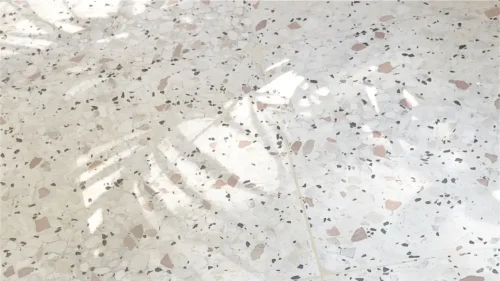
What are terrazzo glass chips, and why do designers choose them for their designs?
Glass chips are one of the many terrazzo aggregate options, crushed and graded into aggregate sizes, and set into an epoxy resin matrix to create a decorative, durable flooring surface. Designers choose it over marble for one main reason: color range.
Marble chips are limited to the natural hues quarries produce. Glass comes in a vast range of colors from cobalt blue, emerald green, red, clear, and other colors. These are colors no stone aggregate can match.
Terrazzo itself dates back to 15th-century Venice, where workers set discarded marble into cement to build inexpensive, durable terraces. Glass entered the mix after the 1970s, when epoxy resin was introduced and allowed for better design flexibility. Epoxy terrazzo is thinner, lighter, faster to install, and non-porous. These attributes let glass become an important feature in today’s modern terrazzo designs.
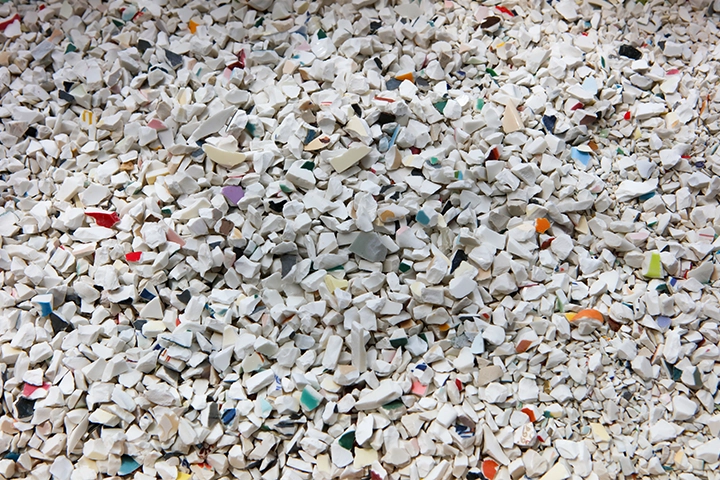
What causes the shape differences in terrazzo aggregates?
There are endless possibilities when it comes to a terrazzo design. Designers can look through a variety of marble or recycled glass chips to find a color they truly desire. Aggregates can also be broken down into various sizes. In the terrazzo industry, aggregates come in three major sizes: 0, 1, and 2; zero being the smallest of the sizes and 2 being the largest. Designers have more options than ever before. Venetian chips size 3 through 8, are trending in today’s architecture and design world.
The shape comes from how the crusher breaks the stone, not from the stone itself.
- Cone Crusher: Material spirals through a chamber and is screened from multiple angles until it’s small enough to exit. The result is a rounded, uniform chip with soft edges.
- Jaw Crusher: Material passes between two flat plates that close like teeth, breaking it down through direct compression. The result is an elongated, angular chip with jagged, irregular edges.
G·ONE tested this directly: the same aggregate color, run through both a jaw crusher and a cone crusher. From across a room, the two floors look nearly identical. Up close, the jaw-crushed mix shows visibly more elongated chips, while the cone-crushed mix reads rounder and more even.
What little-known experiences enabled G·ONE to become so famous?
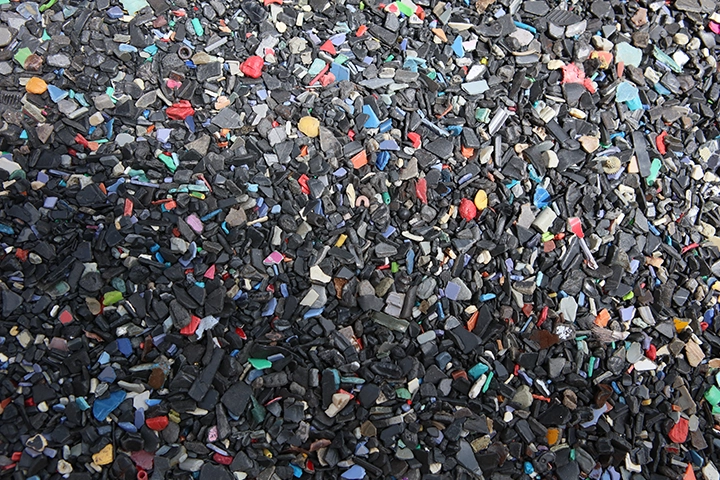
Building upon traditional terrazzo, G·ONE has developed and implemented a range of innovative concepts. These incorporate materials such as wood, lighter casings, ceramics, plastic, seashells, coffee beans, red brick, and more.
G·ONE gave a second life to these items found in abandoned piles of refuse, allowing them to shine once more—in different forms and in different places.
Interior designers and artists appreciate our recycled terrazzo because it is an eco-friendly material that also offers exceptional artistic appeal.
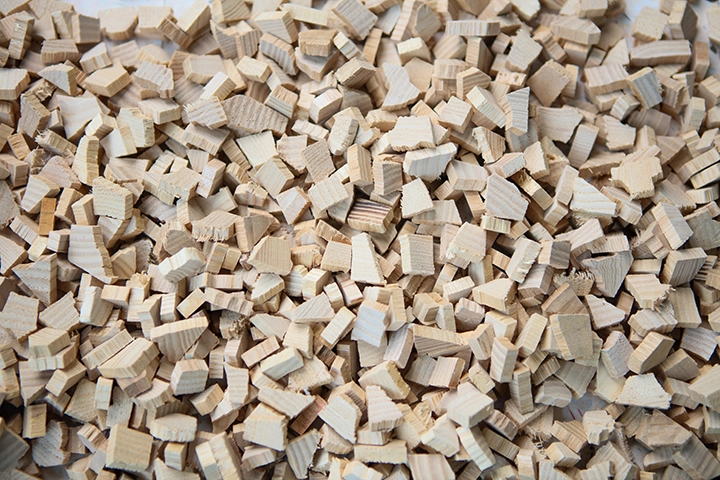
How is wood terrazzo made?
Wood terrazzo starts as waste—branches, wooden furniture, and dead tree trunks collected from recycling and waste facilities. G·ONE shreds and processes the wood in-house, grading it into standard aggregate sizes before delivering it to the job site for terrazzo installation.
The entire process is handled in-house. While most terrazzo suppliers purchase materials from third parties for resale, G·ONE is the only terrazzo manufacturer that sources, shreds, and processes its own aggregates. This ensures tighter quality control, faster project completion, and the ability to meet any color or size requirement with just a single point of contact.
Can terrazzo be used for both indoor and outdoor applications?
We can produce resin/cement base terrazzo. For resin base terrazzo, it’s suitable for indoor applications. And the cement base terrazzo, it can use for indoor and outdoor applications
When it comes to this issue, G·ONE is undoubtedly an expert. The primary difference in application scenarios between epoxy terrazzo and cement-based terrazzo hinges on the materials’ inherent “chemical stability” and “weather resistance.” Simply put, epoxy resin is an organic polymer material that is highly susceptible to damage from ultraviolet (UV) radiation and drastic temperature fluctuations, whereas cement-based terrazzo is an inorganic hydraulic material with exceptional resistance to environmental conditions.
1.Why can epoxy tarbrase only be installed indoors?
Since the binder used in epoxy terrazzo is epoxy resin, it is susceptible to two types of fatal damage when used outdoors:
① UV Degradation: Ultraviolet (UV) rays in sunlight can break down the molecular chains of epoxy resin. Prolonged exposure triggers “chain scission,” causing the material to become brittle and lose its luster; the most immediate signs are severe yellowing, chalking, or peeling.
② Temperature Sensitivity: Organic materials typically exhibit high coefficients of thermal expansion and contraction. Outdoor temperature fluctuations—ranging from day-to-night shifts to seasonal highs and lows—generate significant internal stress within the epoxy layer. Given that the epoxy layer is usually thin and rigid, this stress often leads to cracking or delamination (blistering) from the substrate.
Therefore, although epoxy terrazzo boasts a glossy, seamless appearance and a rich array of colors, its susceptibility to sunlight and temperature fluctuations strictly limits its use to indoor environments in order to preserve its aesthetic appeal and structural integrity.
2.Why is cement-based tabrasive stone suitable for outdoors?
The binder used in cement-based terrazzo is Portland cement—an inorganic material that offers excellent natural weather resistance:
① Excellent UV resistance: Inorganic materials are highly stable under sunlight and do not undergo molecular-level degradation like resins; consequently, they do not yellow or age.
② High weather resistance: Cement is inherently a structural building material capable of withstanding wind, rain, intense sun exposure, and extreme temperature fluctuations.
③ Breathability: Cement-based materials possess a degree of breathability, allowing them to adapt well to humid outdoor environments and prevent blistering caused by moisture accumulation.